Need expert help now? Work with a food labeling consultant from Food Label Maker’s team of certified nutritionists.
Creating nutrition facts labels that meet industry regulations can be challenging, especially with changing requirements across different markets. Ensuring label compliance is essential for product transparency, consumer trust, and avoiding costly mistakes.
A food labeling consultant helps businesses navigate complex labeling laws, ensuring accuracy in nutrition labeling, ingredient declarations, and health claims. This guide explores why compliance matters, when to seek expert help, and how to find the right consultant to streamline the process.
Why Food Labeling Compliance Matters
Food labeling is more than just listing ingredients—it’s critical to ensuring consumer safety and regulatory approval. Labels must be accurate, transparent, and legally compliant to protect consumers and meet industry standards. When labels contain misleading claims, undeclared allergens, or incorrect nutrition information, they can pose health risks and lead to legal consequences.
Regulatory bodies like the FDA (USA), CFIA (Canada), FSA (UK), EFSA (EU), and FSANZ (Australia & New Zealand) enforce strict nutrition labeling laws with different regulations applying across markets. For example, in the U.S., FDA regulations set specific requirements for nutrition facts labels, ingredient declarations, and health claims.
To remain compliant, food companies must regularly update their labels and, in some cases, reformulate products or adjust claims as laws evolve. Failure to do so can lead to fines, product recalls, or damage to brand reputation, making it essential for manufacturers to stay informed and proactive.
Working with a food labeling consultant helps businesses navigate the labeling process, ensuring their labels meet current regulations and remain market-ready.
The Role of Nutritionist Consultation in Food Labeling
A food labeling consultant plays a key role in ensuring that nutrition facts labels are both accurate and compliant with regulations. Nutritionists involved in label development have expertise in nutrition analysis, food science, and regulatory compliance, helping businesses create clear and legally valid labels.
Through nutrition analysis, they calculate nutrient values, portion sizes, and ingredient breakdowns to ensure accuracy. They also verify nutrient content claims, such as “low sodium” or “high in fiber,” and check for compliance with allergen declarations and health claims.
Beyond compliance, nutritionists can also help businesses improve recipe formulations. For example, if a product contains high levels of saturated fat or sodium, they can suggest ingredient substitutions to meet nutritional thresholds while maintaining taste and quality. Their expertise helps businesses avoid mislabeling risks and maintain consumer trust.
See How FoodLabelMaker Can Help You
When to Use a Food Labeling Expert for Your Business
Navigating food labeling laws can be complex, especially for businesses new to the industry or expanding into new markets. A food labeling consultant provides regulatory support to ensure compliance with government regulations and accurate nutrition facts labels. Businesses may need expert assistance in the following situations:
- When you’re launching a new product. Your first label sets the standard for every product that follows, and errors found after launch can mean relabeling, recalls or fines. A consultant calculates your nutrition values, sets a compliant serving size and builds an FDA-compliant Nutrition Facts label from your recipe, so your product launches ready for retail.
- When you’re expanding to new markets. Each country has its own label format, allergen list, rounding rules and front-of-pack requirements, so a label that’s compliant in the US won’t pass in Canada, the UK or Mexico. A consultant who knows the nutrition labeling standards in each country can adapt your labels for every market you sell in.
- When you’re reformulating a product. Changing a single ingredient can shift your nutrition values, allergens and ingredient order, and can affect whether your claims still qualify. A consultant can update your label after each change and help you optimize your recipe’s nutrition to cut sugar or sodium or to meet a claim threshold.
- When you’re a startup or small business. If you don’t have a regulatory team in-house, labeling rules can take weeks to learn and are easy to get wrong. A consultant gives you expert-checked labels without the cost of a full-time hire, while you build your knowledge with resources like our Regulatory Hub.
- Before you print packaging. Once artwork goes to print, mistakes are expensive to fix. A packaging artwork review checks your finished design against the regulations in your market, including the nutrition panel, ingredient list, allergens, net quantity and any claims on pack.
- When you want to make protein claims. In the US, declaring a protein % Daily Value requires a correction for protein quality using PDCAAS (Protein Digestibility Corrected Amino Acid Score). A consultant can calculate your PDCAAS score and confirm whether your product qualifies for claims like “high in protein.”
A food labeling expert simplifies the labeling process by offering specialized knowledge and tailored solutions. They help businesses create compliant labels while improving efficiency and reducing the risk of costly revisions.

How to Evaluate a Food Labeling Consultant
Selecting the right food labeling consultant ensures that your labels comply with industry regulations and meet legal requirements. To find the right consultant, businesses should evaluate experience, credentials, and specialization in food labeling compliance.
The next sections will cover what to look for in a consultant and where to find trusted professionals to help streamline the labeling process.
What to Look for in a Food Labeling Consultant
A qualified expert should have a strong background in food labeling regulations, compliance laws, and industry standards across different markets, including FDA, CFIA, and FSA requirements.
When evaluating a consultant, businesses should consider the following factors:
- Experience: Look for professionals with at least five years of experience in regulatory guidance and food labeling compliance.
- Credentials: In the U.S., consultants should hold certifications such as Registered Dietitian (RD), Certified Nutrition Specialist (CNS), or HACCP certification.
- Specializations: Some experts focus on nutrition labeling, chemical analysis, or ingredient verification, ensuring compliance with nutrient content claims and regulatory standards.
- Technology & Tools: Consultants should be familiar with labeling software, food analysis tools, and digital compliance platforms to create accurate product labels efficiently.
- Knowledge of Market-Specific Regulations: If a business operates internationally, the consultant should be well-versed in region-specific compliance laws, including EU, UK, Australian, and Middle Eastern food labeling guidelines.
- Understanding of Reformulation Strategies: A strong consultant can also provide guidance on recipe adjustments to ensure compliance with nutritional thresholds while maintaining product integrity.
Once businesses understand what to look for in a consultant, the next step is finding a trusted expert who can guide them through the labeling process.
Where to Find a Food Labeling Consultant
With strict food labeling regulations in place, businesses need qualified experts to ensure compliance and accuracy. Whether you need help with nutrition labeling, ingredient verification, or regulatory approvals, there are several ways to find the right food labeling consultant:
- Specialized food compliance firms that provide professional regulatory guidance and labeling services.
- Independent consultants with expertise in product labeling, chemical analysis, and allergen declarations.
- Industry directories and associations that connect businesses with certified professionals.
- Online platforms like LinkedIn, freelancer marketplaces, and regulatory associations, where businesses can find experts offering online nutritionist consultations and compliance support.
For a trusted solution, Food Label Maker’s food labeling consultants service connects businesses with experienced consultants who specialize in food labeling compliance and industry regulations.
Work With Food Label Maker’s Food Labeling Consultants

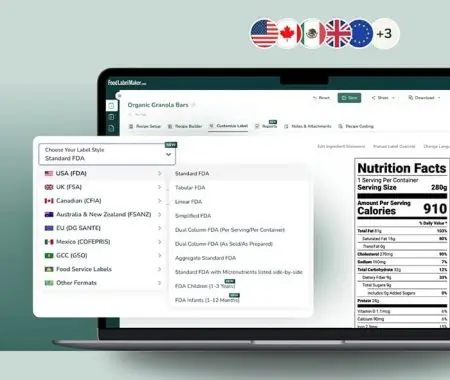
Food Label Maker’s food labeling consulting services help businesses create accurate, compliant nutrition facts labels for markets including the USA, Canada, UK, Mexico, EU, Australia, and the Middle East.
The process is simple:
- Send us your recipes in any format you have available.
- Our nutrition experts review your recipes and generate the food labels.
- We deliver ready-to-use, regulatory-compliant nutrition facts labels.
With customized consultation, businesses can avoid compliance risks, access automatic updates, and receive recipe formulation advice without hiring an in-house team.
In addition to label generation, our team provides detailed recipe and label reports, including nutrition breakdowns, recipe cards, and menu label reports. We also offer regulatory guidance on nutrition and marketing claims and assist with reformulating recipes to meet dietary requirements and nutrition claims.
Selling supplements? Our supplement labeling consultants create FDA-compliant Supplement Facts panels.
Services a Good Food Labeling Consultant Should Offer
Not every consultant covers the same ground. Before you hire one, check that they can handle everything your product needs, not just the nutrition panel:
- Nutrition Facts labels for every market you sell in, from FDA labels in the US to Canada’s Nutrition Facts table and the UK’s back-of-pack nutrition declaration
- Allergen identification and declarations, following each market’s list of allergens
- Front-of-pack labelling, such as Canada’s “High in” symbol, Mexico’s warning seals and the UK’s traffic light labels
- Nutrition and marketing claims review, so claims like “low fat” or “high fibre” meet the rules
- Protein quality analysis (PDCAAS) for products making protein claims in the US
- Packaging artwork review before your labels go to print
- Recipe reformulation to cut sugar, sodium or allergens, or to qualify for a claim
Food Label Maker’s food labeling consulting services cover all of these, with labels delivered in 1 to 3 business days.
Conclusion
Ensuring accurate labels is essential for regulatory compliance, consumer safety, and brand trust. Every detail, from ingredient lists to nutrition facts panels, must meet industry standards to prevent fines, recalls, and reputational damage.
A food labeling consultant provides expert guidance to navigate regulations, verify nutrition content claims, and ensure compliance. Businesses that invest in professional support can streamline labeling and avoid costly mistakes.
At Food Label Maker, our food labeling consultants specialize in nutrition facts label compliance, helping businesses create accurate, regulatory-approved labels. Whether you’re launching a new product or updating labels, we provide tailored solutions to meet your needs. View our pricing options or contact us today to learn how we can help simplify your food labeling process.
For more insights on labeling regulations, explore our articles on “How to Get an FDA-Compliant Nutrition Facts Label for Food Products” and “What are the New Changes to the FDA Nutrition Facts Label?”.
Frequently Asked Questions About Food Labeling Consultants
1. How much does a food labeling consultant cost?
Costs vary by consultant, market and number of products. Some charge by the hour, others per label or per project. With Food Label Maker, you can see your exact price for expert-made food labels before you order.
2. Do I need a food labeling consultant or labeling software?
If you have many recipes and someone in-house to manage them, nutrition labeling software is often the most efficient option. A consultant makes more sense when you’re launching your first products, entering a new market, making nutrition claims or don’t have regulatory expertise in-house. Many brands use both.
3. What qualifications should a food labeling consultant have?
Look for a nutrition or food science background, such as a registered dietitian or certified nutritionist, hands-on experience with the regulations in your target markets and a track record with products like yours.
4. Should I get my packaging reviewed before printing?
Yes, if you can. Even a correct Nutrition Facts panel can end up non-compliant once it’s placed on packaging, for example if font sizes, placement or claims don’t meet the rules. A review of the finished artwork catches these errors before you pay for a print run.