
La PDCAAS et la DIAAS sont les principales méthodes utilisées par l’Organisation des Nations Unies pour l’alimentation et l’agriculture et l’Organisation mondiale de la santé pour l’évaluation de la qualité des protéines. Alors que les méthodes plus anciennes, telles que le ratio d’efficacité protéique (PER) et la valeur biologique, se concentraient sur la croissance animale, les méthodes modernes analysent la composition des acides aminés et les besoins en acides aminés humains afin de déterminer dans quelle mesure une protéine soutient la synthèse des protéines et la nutrition humaine globale.
Cet article présente les scores de digestibilité des protéines pour les aliments courants chez les fabricants alimentaires et aborde la nouvelle méthode DIAAS pour les scores de qualité des protéines.
Si vous hésitez à déterminer la bonne qualité de protéines pour vos étiquettes alimentaires, contactez l’un de nos nutritionnistes afin qu’il puisse vous guider dans le processus avec une consultation experte.
Découvrez comment le créateur d’étiquettes alimentaires peut vous aider
Quel est le but des PDCAA (Protein Digestability-Corrected Amino Acid Score)
Les fabricants alimentaires s’appuient sur le Protein Digestability-Corrected Amino Acid Score (PDCAAS), la norme officielle de la FDA, pour évaluer la qualité des protéines.
Ce score mesure la facilité avec laquelle le corps digère et absorbe les protéines, influençant directement la formulation du produit et les affirmations de contenu en protéines faites sur les emballages.
Quel est le but des DIAA (Indice d’Acides Aminés Indispensables Digérables)?
Le score d’acides aminés indispensables digestibles (DIAAS) est une approche moderne pour mesurer la qualité des protéines des aliments basée sur la qualité réelle de la digération et de l’absorption des acides aminés individuels par l’organisme.
Le DIAAS utilise la véritable digestibilité iléale, mesurant la digestibilité des acides aminés à l’extrémité de l’intestin grêle, plutôt que de se fier à la digestibilité fécale ou à la véritable digestibilité à l’azote fécal. Cela évite les distorsions causées par les bactéries intestinales et les pertes d’acides aminés endogènes, qui confèrent souvent les mesures réelles de la digestibilité de l’azote fécal. En se concentrant sur la véritable digestibilité iléale, le DIAAS prend en compte les facteurs antinutritionnels (comme les phytates dans les protéines végétales) qui peuvent inhiber la digestion dans l’intestin grêle, offrant une mesure supérieure de la disponibilité des acides aminés comparée à la digestibilité fécale.
Contrairement au PDCAAS, le DIAAS n’est pas limité à 1,0, ce qui permet une différenciation claire entre des protéines de haute qualité. En évaluant la digestibilité au niveau des acides aminés — généralement déterminée par des analyses en laboratoire telles que l’hydrolyse acide — le DIAAS permet des comparaisons plus précises entre les protéines animales, végétales et les sources de protéines mélangées.
Quand la PDCAAS est légalement requise selon la FDA
La PDCAAS est la norme réglementaire officielle pour déterminer la qualité des protéines sur les étiquettes nutritionnelles aux États-Unis et au Canada. Elle est requise chaque fois qu’un produit fait une allégation nutritionnelle liée aux protéines.
Les fabricants sont légalement tenus d’appliquer la PDCAAS lorsque :
- Faire une affirmation de contenu en protéines : « Bonne source de protéines », « Riche en protéines », « Excellente source de protéines », « Protéine ajoutée », ou toute affirmation marketing impliquant la qualité des protéines.
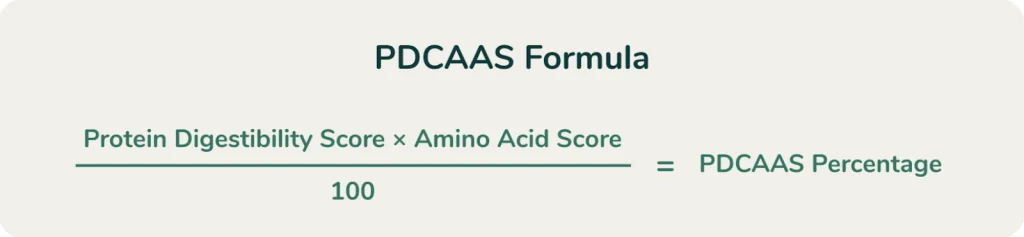
- Affichage du pourcentage de valeur quotidienne pour les protéines : Le%DV sur l’étiquette des informations nutritionnelles doit être calculé comme : (grammes de protéines par portion × PDCAAS) ÷ valeur de référence quotidienne
- Lorsque la protéine contribue à une affirmation ou une comparaison de contenu nutritif : Des exemples incluent « Plus de protéines que… », « Protéines réduites… », « Enrichies en protéines… »
- Pour les aliments destinés aux enfants ≥ 1 an : La PDCAAS utilise le modèle de référence des acides aminés pour enfants d’âge préscolaire, exigé par la FDA.
Les fabricants alimentaires n’ont pas à s’inquiéter d’utiliser des PDCAAS dans les conditions suivantes :
- Si aucune affirmation sur la protéine n’est faite
- Si l’étiquette affiche seulement des grammes de protéines (pas de%DV)
- Si la nourriture est commercialisée sans accent sur la promotion des protéines,
Selon les règlements de la FDA, les allégations protéiniques (telles que « bon » ou « excellent ») ne peuvent pas être légalement formulées à moins qu’un calcul PDCAAS n’ait été effectué. Ne pas le faire pourrait entraîner des rappels coûteux qui affecteront la réputation de la marque.
Tableau PDCAAS
Voici un tableau PDCAAS qui liste les sources de protéines, leurs valeurs de digestibilité et le score final PDCAAS pour les aliments courants.
La véritable digestibilité des protéines (TD) mesure la proportion de protéines ingérées absorbées par le corps, tenant compte de l’azote métabolique dans les matières fécales, tandis que le PDCAAS est la valeur finale corrigée à utiliser pour générer une étiquette nutritionnelle conforme. Il est important de se rappeler qu’une valeur PDCAAS est une référence pour faire des affirmations protéiques sur les labels alimentaires telles que « Bonne source de protéines », « Excellente source de protéines » ou « Protéine supplémentaire ».
Il est aussi important que les fabricants notent que le traitement affecte la qualité; Par exemple, un isolat de protéine de lactosérum hautement purifié ou un concentré de protéine de riz peut donner des scores de digéribilité véritables en acides aminés différents de ceux des aliments entiers. Le tableau ci-dessous compare les protéines animales (qui fournissent généralement un profil complet standard d’acides aminés) aux protéines végétales, qui peuvent contenir un acide aminé limitant.
Les informations de ce tableau sont particulièrement utiles pour les fabricants alimentaires et les spécialistes des services alimentaires qui souhaitent une évaluation correcte de la qualité des protéines sur leurs étiquettes alimentaires.
| Aliment | Véritable valeur de digestibilité des protéines | PDCAAS | Target |
| Protéines d’origine animale | |||
| Bœuf | 0.95 | 0.92 | 2, 5 |
| Bœuf, faible en gras, haché | 0.91 | 0.92 | 2, 5 |
| Thon en conserve | 0.90 | 0.93 | 2, 6 |
| Caseine / Lait de vache | 0.96 | 1 | 1 |
| Poulet (poitrine) | 1.00 | 0.92 | 2, 6 |
| Poulet Frankfurt | 0.97 | 0.92 | 2 |
| Blanc d’œuf / Œuf | 0.97 | 1 | 2, 5 |
| Poissons | 1.0 | 0.98 | 2 |
| Filet de porc et filet tendou | 0.98 | 0.98 | 2, 7 |
| Protéine de lactosérum | 0.96 | 1 | 1 |
| Protéines d’origine végétale | |||
| Orge | 0.98 | 0.63 | 1 |
| Haricots noirs / Haricots rouges / Haricots rouges | 0.81 | 0.68-0.75 | 1, 5 |
| Pois chiches (pois chiches) | 0.85 | 0.77 | 1 |
| Maïs | 0.84 | 0.41 | 1 |
| Protéine de fèves | 0.86 | 0.63 | 1 |
| Lentilles | 0.85 | 0.73 | 1 |
| Protéine Lupin | 0.76 | 0.76 | 2 |
| Pois | 0.97 | 0.83 | 1 |
| Haricots Pinto | 0.73 | 0.61 | 1 |
| Patate | 0.89 | 0.87 | 1 |
| Protéine de soja | 0.97 | 0.9 | 1 |
| Tofu | 0.95 | 0.95 | 3 |
| Noix, graines et grains | |||
| Canola / Colza | 0.85 | 0.88 | 2 |
| Avoine | 0.91 | 0.51 | 1 |
| Peanuts | 0.93 | 0.46-0.52 | 1, 5 |
| Quinoa | 0.89 | 0.78 | 1 |
| Riz | 0.90 | 0.53 | 1 |
| Blé / Gluten | 0.94 | 0.45 | 1 |
| Laitiers et aliments transformés | |||
| Fromage cottage | 0.95 | 1 | 4 |
| Yogourt grec / Yagourt | 0.95 | 1 | 4 |
Calcul PDCAAS
Le calcul du score d’acides aminés corrigés par digestibilité protéique (PDCAAS) est souvent perçu comme une tâche accablante, car il exige plusieurs étapes complexes et chronophages.
Cela commence souvent par une analyse externe coûteuse en laboratoire afin de déterminer avec précision les quantités précises des neuf acides aminés essentiels dans votre produit. Une fois cela fait, il doit ensuite comparer leurs ratios d’ingrédients avec le modèle de référence officiel de la FDA – pour les enfants d’âge préscolaire – afin d’identifier l’acide aminé limitant unique et de déterminer la qualité globale des protéines du produit (souvent des acides aminés soufrés dans les légumineuses ou de la lysine dans les céréales).
Enfin, ce score d’acides aminés déterminé doit être corrigé en obtenant le facteur de Vraie Digestibilité Protéique (TPD) approprié pour l’ingrédient. Gardez à l’esprit que le TPD change beaucoup selon les méthodes de traitement, avant d’arriver au score final et plafonné requis pour vos déclarations d’étiquette alimentaire.
La prochaine norme – Qu’est-ce que la DIAAS?
Le score d’acides aminés indispensables digérables (DIAAS) est une méthode, soutenue par l’Organisation des Nations Unies pour l’alimentation et l’agriculture (FAO), qui introduit l’utilisation de coefficients de digestibilité des acides aminés iléaux et de scores protéiques non tronqués. Des inquiétudes ont été soulevées concernant la méthode PDCAAS, car elle menait à une surestimation de la qualité des protéines. Le DIAAS mesure la véritable digestibilité iléale (au niveau de l’intestin grêle) pour chaque acide aminé indispensable individuel, afin d’éviter les mesures fécales inexactes et les interférences microbiennes du PDCAAS. De plus, le score DIAAS n’est pas plafonné à 1,0, ce qui permet une différenciation et un classement précis de protéines de très haute qualité que le système de la méthode PDCAAS a simplement regroupées.
Voici un tableau avec les valeurs DIAAS pour les ingrédients alimentaires courants :
| Aliment | DIAAS | Target |
| Protéines d’origine animale | ||
| Bœuf | 1.09-1.22 | 8 |
| Caseine / Lait de vache | 0.90-1.2 | 1, 8 |
| Poulet (poitrine) | 1.08 | 8 |
| Egg | 1.12-1.13 | 8 |
| Protéine de lactosérum | 0.96 | 1 |
| Protéines d’origine végétale | ||
| Haricots noirs / Haricots rouges / Haricots rouges | 0.61 | 1 |
| Pois chiches (pois chiches) | 0.69 | 1 |
| Maïs | 0.38 | 1 |
| Lentilles | 0.75 | 1 |
| Pois | 0.66 | 1 |
| Patate | 0.85 | 1 |
| Protéine de soja | 0.92 | 1 |
| Haricots noirs / Haricots rouges / Haricots rouges | 0.61 | 1 |
| Noix, graines et grains | ||
| Avoine | 0.44 | 1 |
| Peanuts | 0.47 | 1 |
| Riz | 0.52 | 1 |
| Blé / Gluten | 0.39 | 1 |
| Laitiers et aliments transformés | ||
| Fromage cottage | 0.90-1.2 | 1, 8 |
| Yogourt grec / Yagourt | 0.90-1.2 | 1, 8 |
Les valeurs du DIAAS sont basées sur la véritable digestibilité iléale plutôt que sur la digestibilité fécale, offrant une image plus claire des acides aminés individuels absorbés dans l’intestin grêle.
Calcul étape par étape du DIAAS
Suivez les 4 étapes ci-dessous pour effectuer un calcul précis de la DIAAS et obtenir une évaluation précise de la qualité des protéines.
- Déterminez la quantité de chaque acide aminé indispensable (IAA) dans 1 gramme de la protéine testée en utilisant des méthodes de laboratoire comme l’hydrolyse acide. Cela repose sur la teneur en acides aminés de la protéine et sa digestibilité iléale standardisée (SMS). Contrairement au PDCAAS, qui tronque les valeurs, le DIAAS vous permet de mettre en évidence des protéines de haute qualité qui dépassent les besoins en protéines de référence.
- La formule est : (mg d’IAA spécifique dans 1 g de protéine testée) x (SID de cette IAA).
- Déterminez la quantité de chaque IAA dans 1 gramme de la protéine de référence. Ces valeurs sont basées sur des modèles de référence établis pour un groupe d’âge spécifique (par exemple, nourrissons, enfants, adultes).
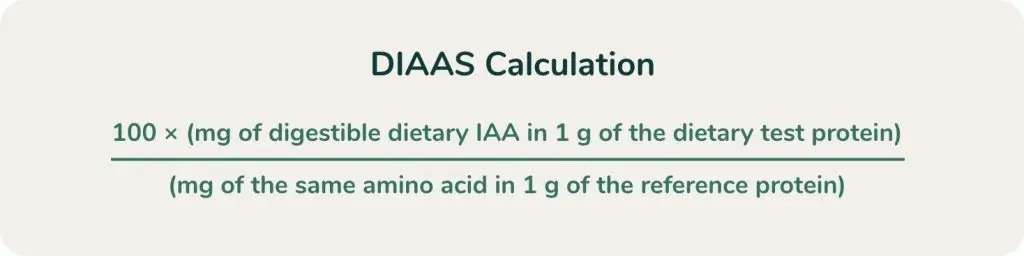
- Calculez le « rapport de référence des acides aminés indispensables et digestibles » pour chaque IAA. Divisez la quantité d’IAA digestible provenant de la protéine testée par la quantité de la même IAA dans la protéine de référence.
- La formule est : (mg d’IAA digestible dans 1 g de protéine testée) / (mg du même IAA dans 1 g de protéine de référence).
- Calculez le score final du DIAAS. Multipliez le plus petit « rapport de référence des acides aminés indispensables digérables » calculé à l’étape précédente par 100 pour obtenir un pourcentage.
Réflexions finales : Comment calculer facilement les PDCAAS
Bien que la DIAAS soit la norme scientifique et soit de plus en plus utilisée en recherche académique, la PDCAAS demeure la norme réglementaire, surtout aux États-Unis et au Canada.
Ainsi, pour garantir que vos étiquettes alimentaires soient à jour avec les règlements de la FDA et de la CFIA, nous avons intégré PDCAAS à notre outil — facilitant la détermination de la qualité des protéines. Vous pouvez maintenant facilement obtenir un score précis de qualité des protéines en utilisant la valeur PDCAAS du tableau de cet article, ou, si vous préférez faire vos propres calculs, vous pouvez utiliser l’outil Food Label Maker pour obtenir les valeurs requises pour la formule PDCAAS.
Pour calculer votre score PDCAAS, il suffit d’entrer votre valeur de digestibilité protéique (à partir du tableau de cet article), d’utiliser l’outil pour générer instantanément un profil complet d’acides aminés (appelé le Rapport des acides aminés) et d’identifier automatiquement le limiteur.
Une fois que vous ajoutez votre score PDCAAS à votre recette, sur le tableau de bord foodlabelmaker.com , votre protéine par portion sera automatiquement multipliée par la valeur PDCAAS, vous donnant un score final de qualité protéinaire conforme à la réglementation.
Si vous souhaitez en savoir plus sur la façon dont Food Label Maker peut vous aider, réservez une démonstration avec l’un des experts en nutrition.
Questions fréquemment posées
Devrais-je utiliser le DIAAS ou le PDCAAS pour calculer la qualité des protéines?
Vous pouvez utiliser les deux, cependant, la PDCAAS demeure la méthode la plus largement utilisée dans les normes réglementaires de la FDA et de la CFIA.
Bien que le Digestible Indispensable Amino Acid Score (DIAAS) soit considéré comme la méthode scientifiquement supérieure et la plus précise, le Protein Digestability Corrected Amine Acid Score (PDCAAS) demeure la méthode la plus largement utilisée dans les cadres réglementaires mondiaux pour les allégations d’étiquetage des aliments et de contenu protéique. Même si la DIAAS a été officiellement recommandée par la FAO pour remplacer l’ancienne norme, elle nécessite toujours une adoption complète par les organismes gouvernementaux de réglementation. Cela s’explique par le fait qu’ils nécessitent plus de temps pour générer des données DIAAS standardisées pour tous les aliments et mettre à jour la politique alimentaire existante.
Si vous avez besoin d’aide pour utiliser la méthode PDCAAS et que vous ne savez pas comment déterminer l’acide aminé limitant de votre aliment, prenez rendez-vous avec l’un de nos experts en nutrition afin qu’il puisse vous guider à travers l’une de nos fonctionnalités utiles : le Rapport sur le Motif des Acides Aminés.
Quelle est la différence entre la vraie digestibilité des protéines et le PDCAAS?
Les termes véritable digestibilité des protéines et PDCAAS (Protein Digestability Corrected Amino Acid Score) sont apparentés, mais représentent des concepts différents dans l’évaluation de la qualité des protéines.
Les mesures plus anciennes telles que la valeur biologique et le ratio d’efficacité des protéines ne sont plus recommandées pour l’évaluation moderne de la qualité des protéines.
La digestibilité des protéines est le facteur d’ajustement qui vous indique quel pourcentage des protéines consommées est réellement absorbé par le corps. Le PDCAAS (Protein Digestability Correctioned Amino Acid Score) est le score final de qualité qui utilise ce facteur d’ajustement pour rétrograder la qualité initiale d’une protéine en fonction de sa mauvaise digestion et de son absorption.
Essentiellement :
- Score d’acides aminés = À quel point la protéine est bonne sur le papier (sa composition idéale en acides aminés).
- Digestibilité des protéines = Quelle quantité de cette protéine se retrouve réellement dans votre organisme.
- PDCAAS = Score des acides aminés x digestibilité des protéines (le score final réel).
Pour en savoir plus sur la qualité des protéines et comment faire des affirmations exactes sur la teneur en protéines, réservez une démonstration avec l’un de nos experts en nutrition.
Comment puis-je utiliser le PDCAAS dans des formulations multi-ingrédients?
Dans le cas d’avoir des recettes faites avec différents ingrédients, ou des suppléments alimentaires (par exemple, mélanger des protéines de lait avec des protéines de pois), vous finirez par avoir plusieurs ingrédients qui contribuent à la quantité de protéines par portion, et vous ne pouvez pas simplement faire la moyenne des scores.
Vous devez calculer la qualité des protéines du mélange. Si un ingrédient est faible en un acide aminé spécifique, un autre ingrédient riche en ce même acide aminé peut compenser. C’est ce qu’on appelle la complémentation des protéines, et cela améliore le profil global des acides aminés ainsi que la valeur biologique du produit final.
Pour ce faire :
- Calculez le score combiné des acides aminés (AAS) :
Trouvez l’acide aminé limitant dans tout le mélange protéique. Additionnez les acides aminés essentiels (EAA) de tous les ingrédients. Comparez ce profil EAA total (par gramme de protéine totale) avec le modèle de référence humain. Le ratio le plus bas trouvé est l’AAS.
- Calculer la digestibilité moyenne pondérée des protéines (DP) :
Trouvez la digestibilité globale de la protéine totale. Déterminez le pourcentage de protéines totales apportées par chaque ingrédient. Multipliez ce pourcentage par le facteur de digestibilité connu de l’ingrédient. Additionnez ces valeurs pondérées pour obtenir la moyenne pondérée de la DP.
- Déterminez les PDCAAS finaux :
Formule : PDCAAS = AAS x DP moyenne pondérée
Règle : Le score final est plafonné à 1,0 (100%), peu importe la valeur calculée.
Le motif des acides aminés et la digestibilité globale des protéines changent une fois les protéines mélangées, ce qui signifie que le PDCAAS final doit être calculé pour l’ensemble de la formulation, et non pour chaque ingrédient isolément.
Si vous avez besoin d’aide pour calculer la valeur PDCAAS de votre recette, engagez l’un de nos experts ayant de l’expérience dans les réglementations d’étiquetage à la FDA, à la CFIA et sur d’autres marchés mondiaux.
Note importante sur les valeurs : Les scores PDCAAS, les coefficients de digestibilité des protéines et les valeurs DIAAS sont compilés à partir de diverses publications scientifiques et réglementaires et sont fournis à des fins conceptuelles et éducatives.
En raison des différences dans l’approvisionnement des matières premières, les techniques d’isolement des ingrédients et les limites de la méthode de test in vivo, vous pouvez rencontrer des valeurs différentes. Il est essentiel de documenter pleinement la source faisant autorité pour toute valeur utilisée dans l’étiquetage nutritionnel commercial.
Cet article a été mis à jour le 2 décembre 2025. Veuillez noter que les normes réglementaires et la compréhension scientifique de la qualité des protéines, notamment en ce qui concerne la transition entre PDCAAS et DIAAS, évoluent continuellement.
Sources
- https://pmc.ncbi.nlm.nih.gov/articles/PMC7760812/#:~:text=at%20least%200.75.-,Table%202.,-Protein%20quality%20of
- https://www.foodrisk.org/resources/sendFile/88
- https://pubmed.ncbi.nlm.nih.gov/32932087/
- https://openknowledge.fao.org/server/api/core/bitstreams/ef6594d6-1fff-45a5-93e3-c12ab7a0e332/content
- https://www.jssm.org/vol3/n3/2/v3n3-2pdf.pdf
- https://www.researchgate.net/publication/232737392_Protein_quality_evaluation_twenty_years…
- https://www.sciencedirect.com/topics/food-science/digestible-protein
- https://www.fao.org/ag/humannutrition/35978-02317b979a686a57aa4593304ffc17f06.pdf