Ice cream is one of the only foods where the FDA regulates the recipe before you ever reach the label. Get the formulation wrong and you can lose the right to call your product “ice cream” at all, no matter what the panel says.
This guide covers the FDA standard of identity, what you can legally call your product, the serving size, the nutrients that matter most, the panel format for a pint, and the allergens you have to declare. It builds on our roundup of the 6 hardest foods to label so that by the end you’ll be able to build a compliant ice cream nutrition label in Food Label Maker from recipe to export.
If you need your ice cream label done fast, hire one of our regulatory experts who can create an FDA-compliant label for you in 3-5 business days.
Key takeaways
- To be labeled “ice cream,” a product must meet the FDA standard of identity: at least 10% milkfat, 10% nonfat milk solids, and 4.5 lb per gallon (21 CFR 135.110).
- Add 1.4% or more egg yolk solids and it must be called frozen custard or French ice cream.
- The serving size is 2/3 cup, and a pint holds 3 servings, which requires a dual-column panel.
- Saturated fat and added sugars are the lines to watch, and only the sweeteners you add count as added sugars, not the natural lactose.
What Makes a Product Legally “Ice Cream”? The FDA Standard of Identity
Ice cream is regulated by the FDA and is one of the foods the agency holds to a formal standard of identity under 21 CFR 135.110. That standard sets a baseline a recipe mix must abide by for the name “ice cream” to be legally used.
The core requirements of simple ice cream are:
- at least 10% milkfat
- at least 10% nonfat milk solids
- at least 1.6 pounds of total solids per gallon
- a finished weight of at least 4.5 pounds per gallon.
The milkfat minimum is the one most makers run into, since trimming fat to cut calories or cost can quietly push a product under the line.
The milkfat and nonfat milk solids figures are linked. As you raise milkfat above the 10% floor, the regulation lets the required nonfat milk solids come down in step, because the extra fat displaces some of the other solids:
| Milkfat | Minimum nonfat milk solids |
| 10% | 10% |
| 11% | 9% |
| 12% | 8% |
| 13% | 7% |
| 14% | 6% |
Flavored ice creams are measured differently. When you add a bulky flavor such as chocolate, fruit, cookies, or nuts, two limits apply at the same time:
| Measured against | Minimum milkfat | Minimum total milk solids |
| The mix, after subtracting the bulky flavors | 10% | 20% |
| The whole finished product (hard floor) | 8% | 16% |
“Total milk solids” means milkfat plus nonfat milk solids, so the 20% figure is the same ten-plus-ten standard applied to the portion that is not bulky flavoring.
The 4.5 pounds per gallon is really a limit on overrun, the air whipped into the mix as it freezes. Ice cream is sold by volume, so the weight minimum stops a maker from inflating a half-gallon with enough air that there is barely any ice cream left in it.
Miss any of these minimums and you lose the legal right to call the product “ice cream.” What you can call it instead depends on the recipe, which is the next thing to sort out.
Ice Cream vs. Frozen Custard vs. French Ice Cream: Naming Your Product
The name on the front of the tub is not a marketing choice.
The standard of identity decides which name your recipe has earned, and three things settle it:
- how much egg yolk you use
- how the product is flavored
- how much fat it contains
How Much Egg Yolk Turns Ice Cream Into Frozen Custard?
Egg yolk is the dividing line between ice cream and frozen custard.
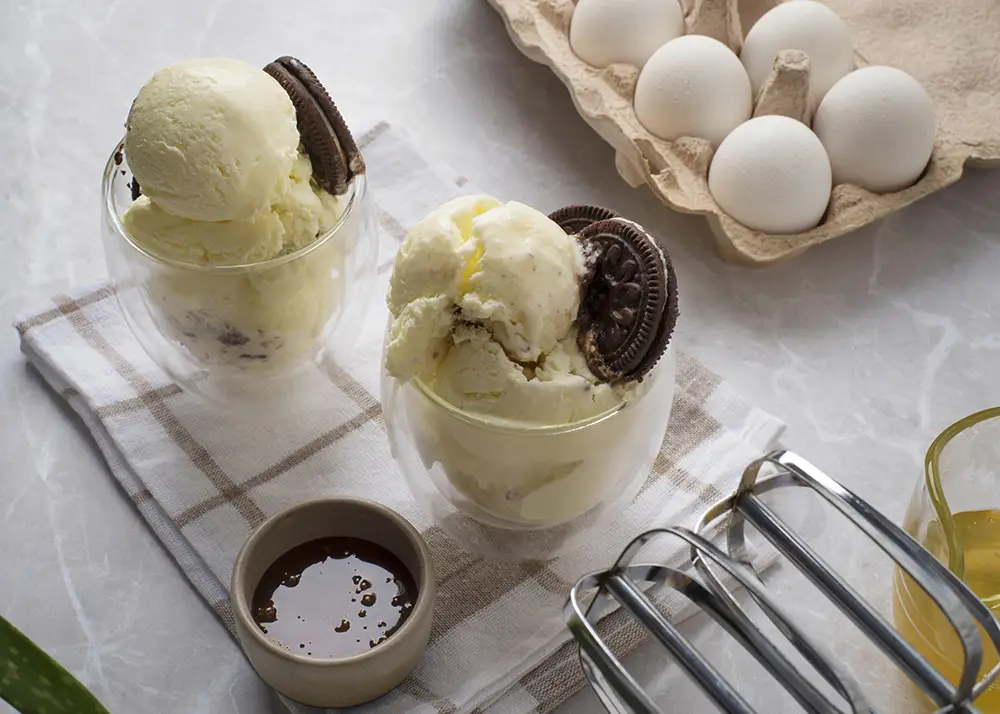
Under 21 CFR 135.110, a product with less than 1.4% egg yolk solids by weight is “ice cream.” At 1.4% or more it has to be called “frozen custard,” “French ice cream,” or “French custard ice cream.”
When bulky flavors are added the threshold can come down in proportion, though never below 1.12%. A rich, custard-style base is exactly the recipe that crosses this line, so if you are adding yolks for body and mouthfeel, confirm where you land before you print “ice cream” on the label.
How to Name Your Ice Cream Flavor on the Label (Vanilla, “Flavored,” or “Artificial”)
The same standard governs how you state the flavor. The characterizing flavor, such as “vanilla” or “strawberry,” has to appear on the front panel in letters at least half the height of the words “ice cream.” How you word it depends on where the flavor comes from:
- All natural flavor: name it plainly, for example “Vanilla Ice Cream.”
- Natural flavor is helped along by an added flavor that simulates it: add “flavored,” as in “Vanilla Flavored.”
- Artificial flavor that predominates, or artificial flavor used alone: label it “artificial” or “artificially flavored.”
How Much Milkfat Ice Cream Needs Before It Has to Be Renamed
Fat decides whether you can use the word “ice cream” at all. The 10% milkfat floor from the standard of identity is the cutoff. Drop below it and the product takes a different legal name set by the FDA’s nutrient content claim rules for fat, such as “reduced fat,” “light,” “low fat,” or “nonfat” ice cream, each defined by its own threshold. Makers hit this when a leaner reformulation quietly changes the category. Lowering the fat to make a healthier product can move you into a different name on the front of the pack, whether you intended it or not.
See How FoodLabelMaker Can Help You
What Goes on an Ice Cream Nutrition Facts Panel?
Once the recipe is settled, the panel itself is fairly straightforward. Ice cream is eaten in real portions, so the values on the panel show up as real numbers. Two lines deserve the most attention: saturated fat and added sugars.
Why Ice Cream’s Serving Size Is 2/3 Cup
Every panel is built on the Reference Amount Customarily Consumed, the RACC, which the FDA assigns by food category in 21 CFR 101.12. For ice cream and other frozen desserts the RACC is 2/3 cup, and it includes the volume of any coating or wafer on a novelty like a bar or a cone. On the label it appears as “2/3 cup” with the gram weight beside it, and that gram weight depends on how dense your mix is once frozen. Because the serving is a genuine portion, the nutrients in it show up at their real values rather than rounding away.
Saturated Fat and Added Sugars: The Two Lines That Matter Most
Two things about ice cream guarantee these lines will carry weight. The milkfat the standard of identity requires is mostly saturated, so even a plain ice cream lands a meaningful saturated fat figure against the 20 gram Daily Value. The sweeteners that make ice cream palatable then push added sugars up against the 50 gram Daily Value, often further than makers expect.
Added sugars is the line that catches people out. Milk and cream bring their own naturally occurring sugar in the form of lactose, and that lactose counts toward total sugars but not toward added sugars. Only the sweeteners you put in, such as cane sugar, corn syrup, or honey, belong on the added sugars line. The result is that the two sugar figures on an ice cream panel will not match, and getting the split right is what keeps the panel accurate.
What’s the Correct Nutrition Facts Format for Ice Cream?
Most ice cream is sold in tubs and cartons with plenty of label space, so the standard vertical panel is almost always the right layout, and the compact tabular or linear formats rarely come into play. For ice cream the real format decision is a different one: whether your package needs a single column or dual column.
How Many Servings Are in a Pint of Ice Cream?
Servings per container is your package volume divided by the 2/3 cup serving size, and you need it before you finalize the panel. A pint holds 2 cups, which works out to exactly 3 servings. A quart holds 6, and a half-gallon holds 12. The pint is the size to watch, because three servings is the point where the labeling rules change.
When Does Ice Cream Need a Dual-Column Label?
Under 21 CFR 101.9, a package that holds between 200% and 300% of the reference amount has to show two columns of nutrition information, one “per serving” and one “per container.” A pint works out to exactly 300% of the ice cream RACC, three 2/3-cup servings, which puts it inside that band, so a pint needs the dual-column panel. This is why the pints in the freezer aisle list their numbers twice. Larger containers such as a quart or a half-gallon sit past the range and are meant to be portioned over time, so they stay single-column, per serving. For a full breakdown of every layout and when each applies, see our guide to the different nutrition facts label formats.
Build Your Ice Cream Label in Food Label Maker, Step by Step
Here’s the whole process in Food Label Maker, using the French Vanilla Ice Cream recipe as the worked example.
Step 1: Set Up Your Recipe and Choose Your Servings
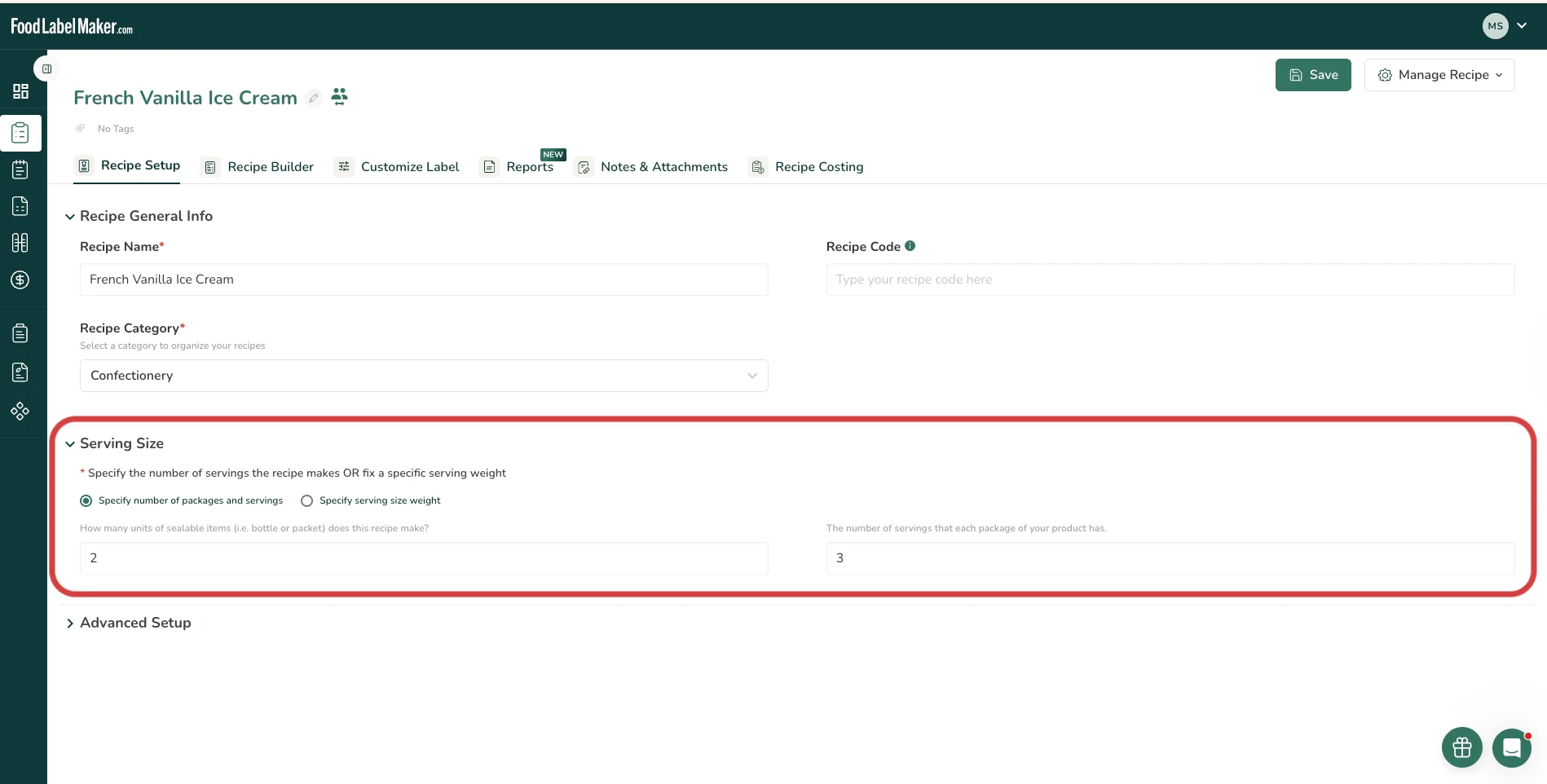
Start on the Recipe Setup tab and give the recipe its name. Then open the Serving Size section, where you tell the tool how your product is packaged. Choose “Specify number of packages and servings,” which lets you describe the container you actually sell instead of fixing a serving weight by hand.
Now enter the container that goes on the shelf. Our batch fills about two pints, so the number of packages is 2, and since a pint holds three 2/3 cup servings, the servings per package is 3. That second figure is the one that carries weight later. Three servings per container is what puts a pint in the range where the FDA requires a dual-column panel, so getting it right here is what makes the rest of the label fall into place.
Step 2: Enter Your Recipe Ingredients by Weight or Volume
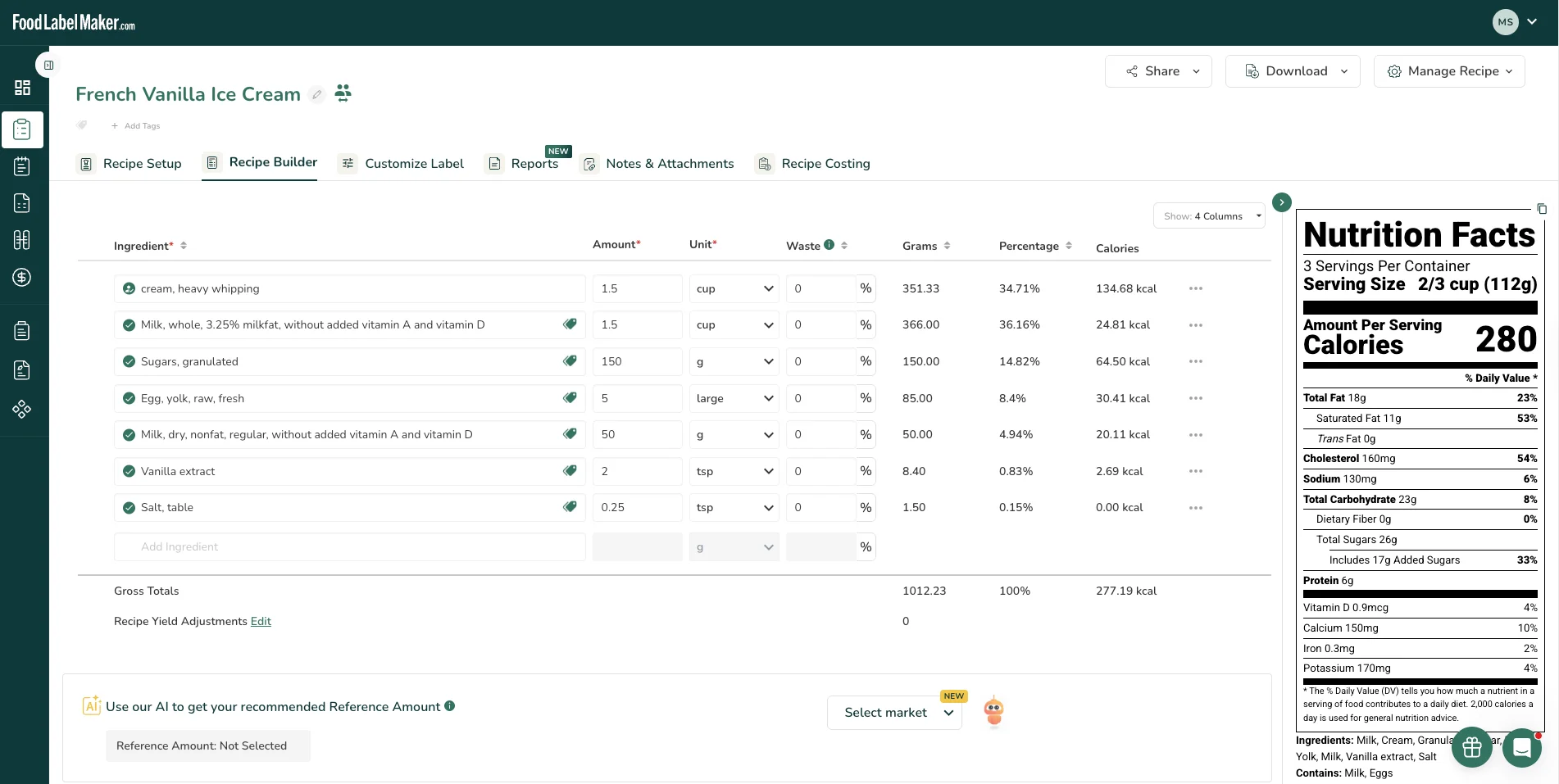
Move to the Recipe Builder tab and add every ingredient with its amount. Weight in grams gives the most accurate panel, so if you have your formula in grams, enter it that way: cream, whole milk, sugar, egg yolks, nonfat dry milk, vanilla, and salt.
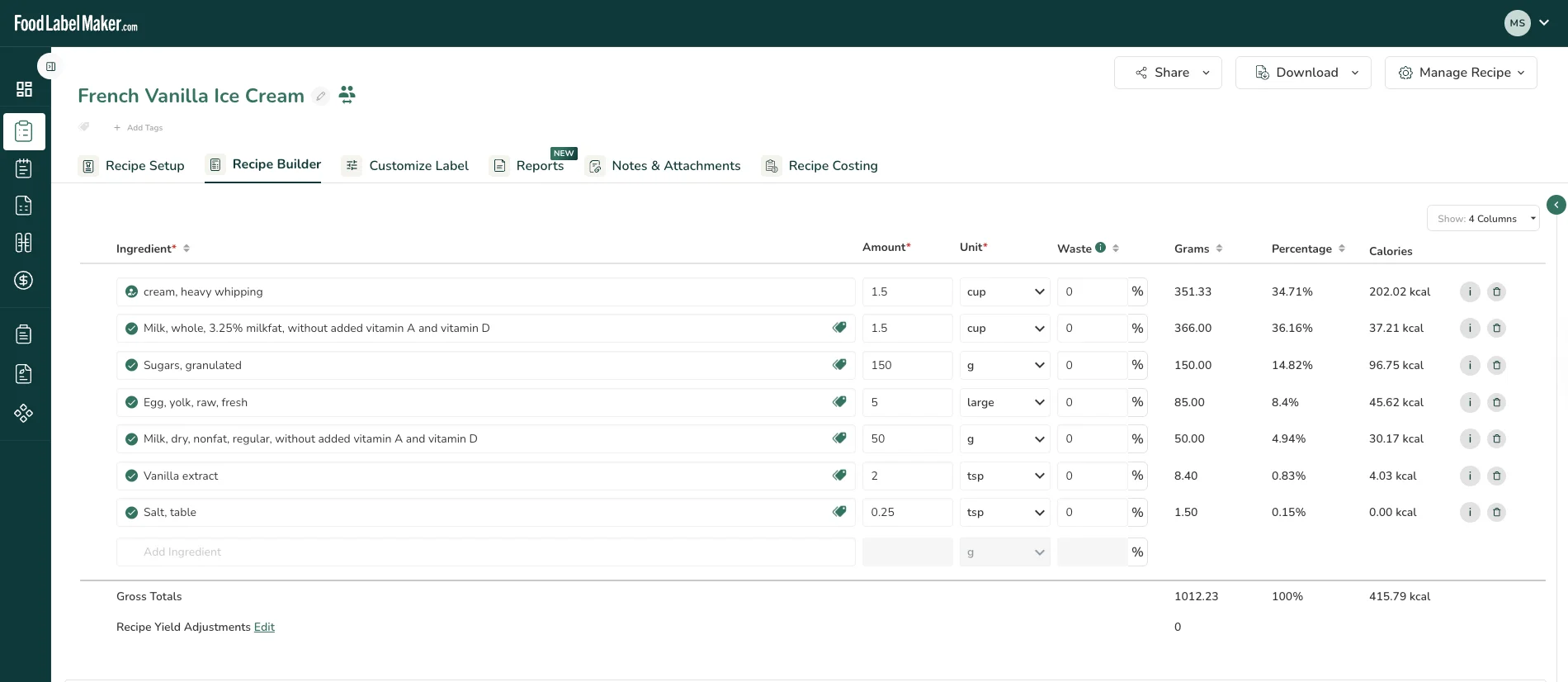
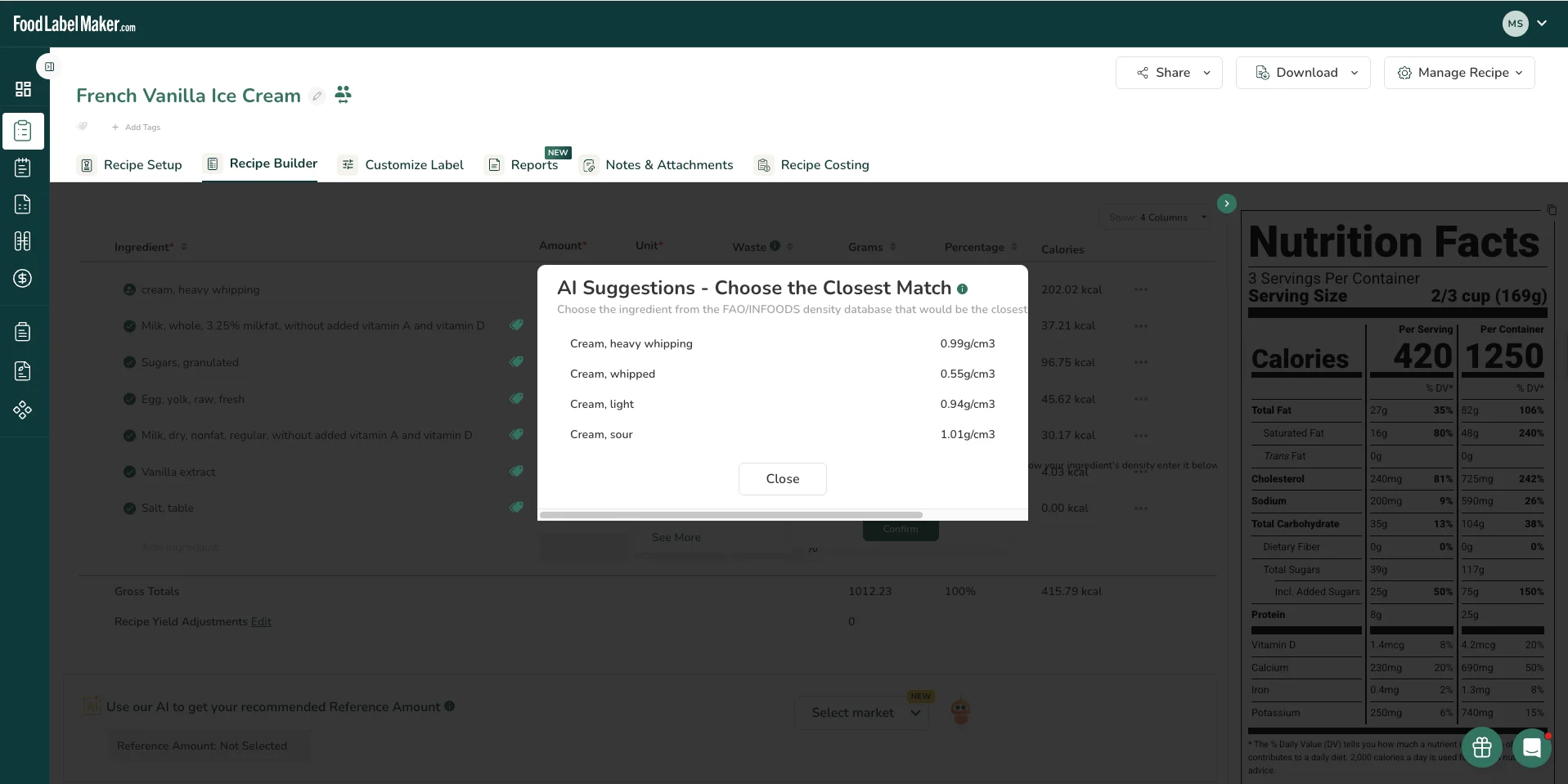
Most recipes don’t come that tidy. If yours lists the cream and milk in cups, you don’t have to convert anything by hand. Enter each ingredient in whatever unit you have, and when you pick a volume unit like cups or mL, Food Label Maker flags that it needs a density conversion. You can type in the density yourself if you know it, or let RIA, our Regulatory Intelligence Assistant, pull the closest match from the FAO/INFOODS database so your volumes turn into accurate gram weights. That’s especially handy for the liquid dairy that makes up most of an ice cream base.
💡 One ingredient is worth keeping in grams: the nonfat dry milk. Powder is deceptive by volume, and a cup of it weighs far more than you would guess, so weigh it instead of measuring by the cup. Getting this one wrong quietly changes your milk solids and throws off the panel.
H3: Step 3: Confirm the Serving Size with the AI RACC Check
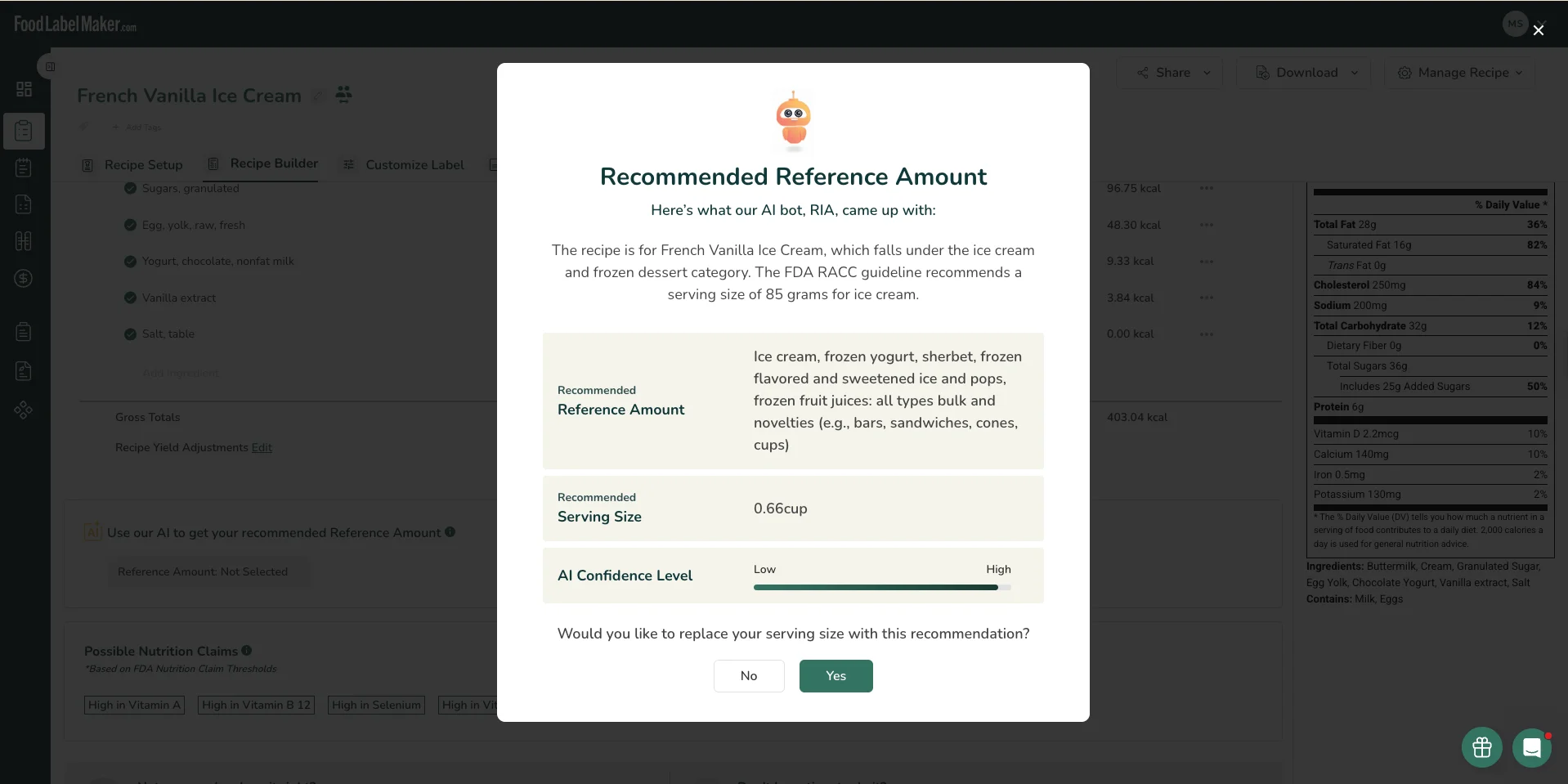
Every nutrition panel is built on the Reference Amount Customarily Consumed, so getting the serving size right is what makes the rest of the numbers meaningful. At the bottom of the Recipe Builder, run “Use our AI to get your recommended Reference Amount.” For ice cream it lands on the “Ice cream, frozen yogurt, sherbet, frozen flavored and sweetened ice and pops” category and sets the serving to 2/3 cup, the FDA reference amount for frozen desserts.
How Overrun Affects Your Ice Cream Serving Size
Ice cream is sold by volume, so the 2/3 cup serving size is fixed, but the gram weight of that serving depends on overrun, the air whipped into the ice cream as it churns. Food Label Maker builds your panel from the mix, which has no air in it yet, so if you accept the serving weight it calculates straight from the recipe, every per-serving number will read high, sometimes close to double.
To keep the panel accurate, weigh 2/3 cup of your actual finished, frozen ice cream and enter that number using “Specify serving size weight,” or set your servings per container based on the finished churned volume. The same applies to any aerated product where air changes the finished density, such as whipped toppings, mousse, or marshmallow.
How Overrun Affects Your Ice Cream Serving Size
Ice cream is sold by volume, so the 2/3 cup serving size is fixed, but the gram weight of that serving depends on overrun, the air whipped into the ice cream as it churns. Food Label Maker builds your panel from the mix, which has no air in it yet, so if you accept the serving weight it calculates straight from the recipe, every per-serving number will read high, sometimes close to double.
To keep the panel accurate, weigh 2/3 cup of your actual finished, frozen ice cream and enter that number using “Specify serving size weight,” or set your servings per container based on the finished churned volume. The same applies to any aerated product where air changes the finished density, such as whipped toppings, mousse, or marshmallow.
Step 4: Review the Panel: Check Saturated Fat and Added Sugars
With the recipe entered and the serving size set, the panel generates on the right. Two lines are worth your attention, because they shape both your claims and how the product reads to a shopper: saturated fat and added sugars.
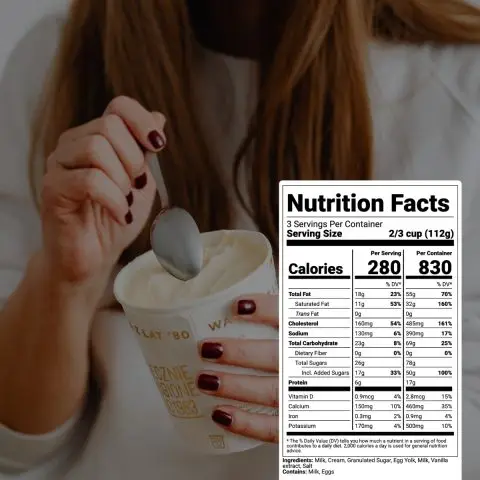
Saturated fat comes in at 11 g per serving, or 53% of the Daily Value. That’s expected for ice cream, since the milkfat the standard of identity requires is mostly saturated. Added sugars land at 17 g, or 33% of the Daily Value, and this is where the useful detail sits. The panel also shows 26 g of total sugars, and the gap between the two is the lactose that comes naturally from the milk, cream, and dry milk. Only the cane sugar you added counts toward added sugars, which is why the two figures come out different.
One more line is worth a look on a French vanilla: cholesterol, at 160 mg per serving, or 54% of the Daily Value. Egg-yolk styles like frozen custard and French ice cream run noticeably higher here than an egg-free base, so it’s a number to check whenever you build with yolks.
Step 5: Choose the Dual-Column Format for Your Pint
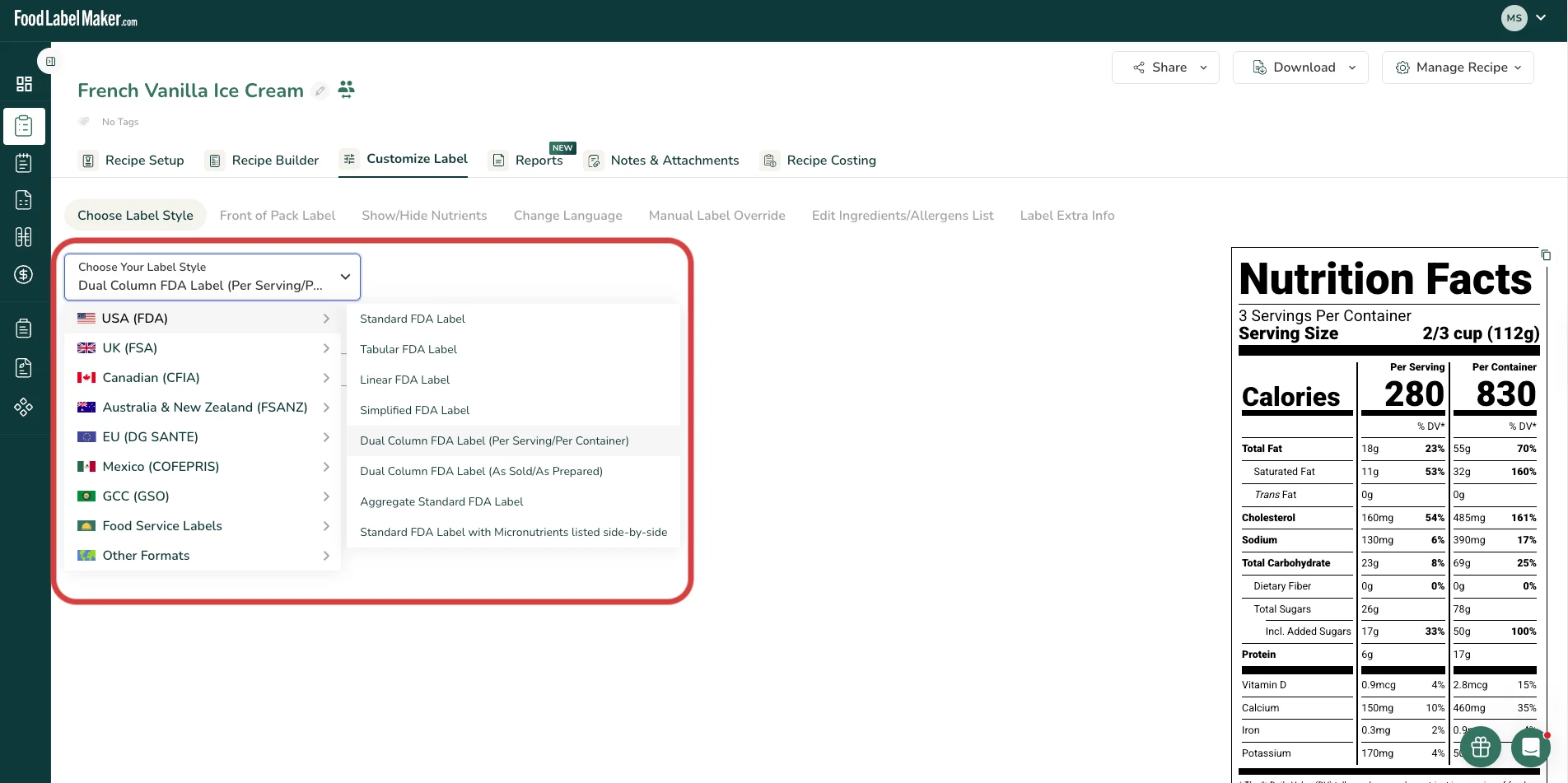
Move to the Customize Label tab and open Choose Label Style. Under USA (FDA) you’ll find the format options, including “Dual Column FDA Label (Per Serving/Per Container).” Select it.
This isn’t a design preference. A pint holds three 2/3 cup servings, which puts it in the range the FDA defines as needing two columns, between 200% and 300% of the reference amount. Containers that size have to show the nutrition both per serving and per container, so a shopper can see the numbers for one portion and for the whole pint they might finish in one sitting. Larger tubs like a quart or half gallon fall outside that range and stay single column.
Step 6: Clean Up Your Ingredient and Allergen Statement
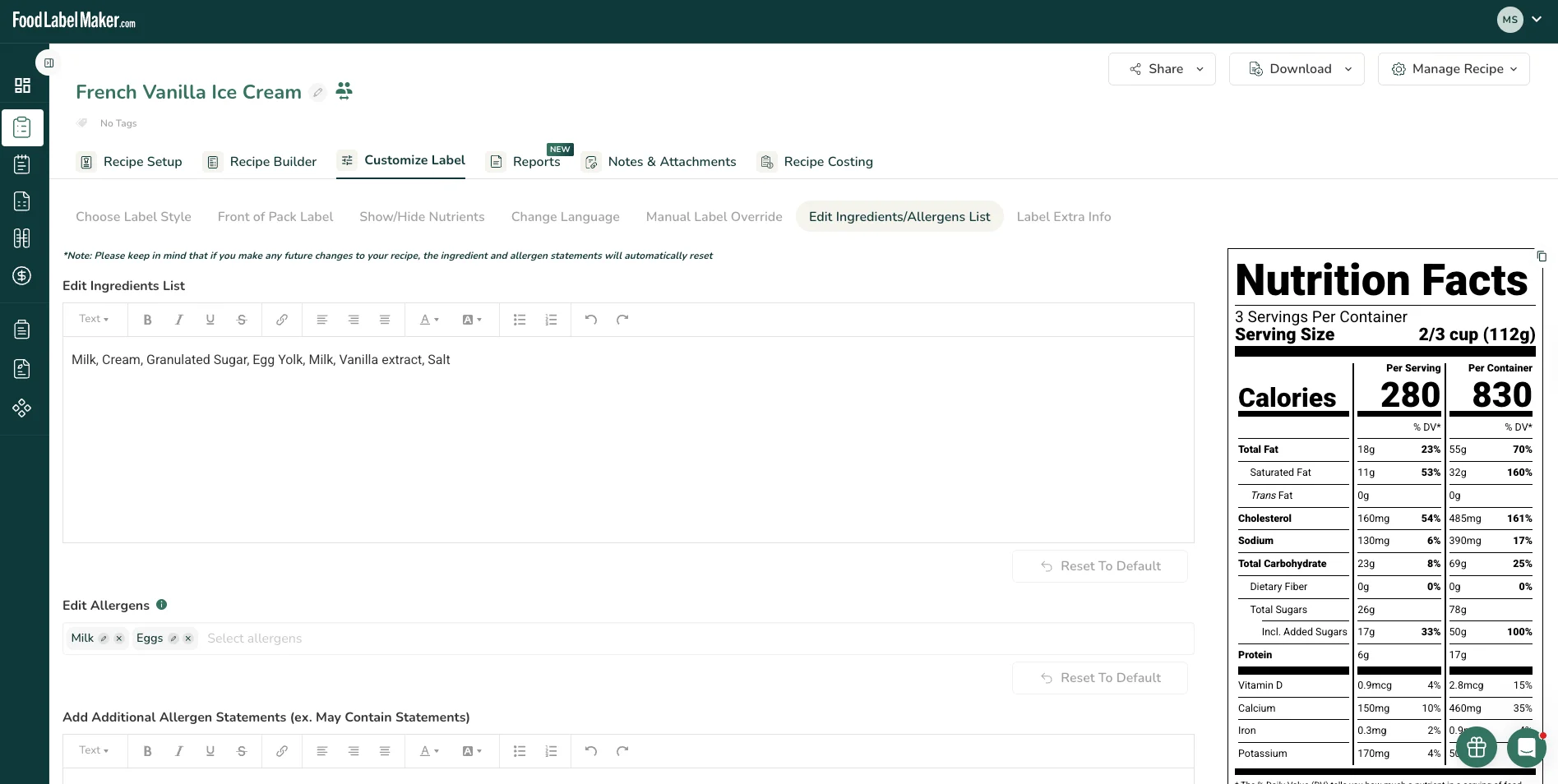
On the Customize Label tab, open Edit Ingredients/Allergens List. Food Label Maker builds both statements automatically from your recipe, so the ingredient list is already populated, in descending order, and the allergens are already flagged.
The one thing to fix is the ingredient list itself. Because you used two dairy ingredients, it reads “Milk, Cream, Granulated Sugar, Egg Yolk, Milk, Vanilla extract, Salt,” with “Milk” showing up twice. Each ingredient has to appear under its own common name, so change the second one to “Nonfat Dry Milk.” The finished list should read “Milk, Cream, Granulated Sugar, Egg Yolk, Nonfat Dry Milk, Vanilla Extract, Salt.”
Check the allergen line while you’re here. This recipe triggers two allergens under FALCPA, milk from the dairy and egg from the yolks, so the label carries “Contains: Milk, Eggs.” The tool pulls these from your ingredients automatically, but confirm they’re right, since these are the declarations makers most often miss.
One thing to know about timing: if you change the recipe after editing these statements, they reset to the automatic version. So make this your last stop before the label elements and export.
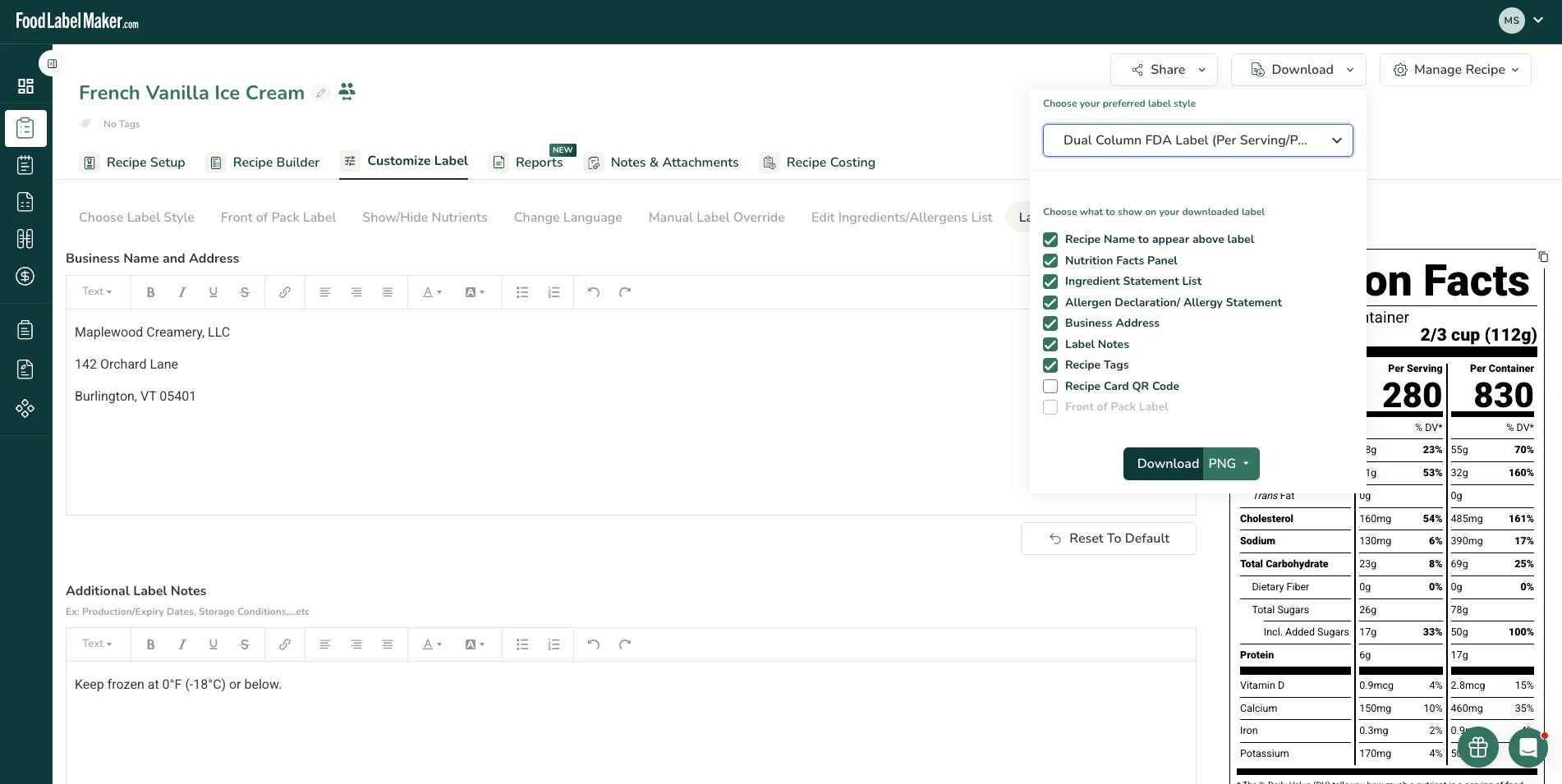
Step 7: Add Your Business Details and Export
The last stop is the Label Extra Info tab under Customize Label. In the Business Name and Address field, add your manufacturer or distributor name and address, which every packaged food has to carry. In Additional Label Notes, add anything else the label should state, like a storage instruction. Ice cream should carry a line such as “Keep frozen at 0°F (-18°C) or below.”
With the dual-column format selected and your details in place, use the Download button to export your finished label, ready to place on your packaging.
Final Thoughts: Building a Compliant Ice Cream Label
Ice cream carries more compliance weight than most foods because the recipe itself is regulated. Hit the 10% milkfat and milk solids minimums or you lose the right to the name, watch the egg yolk because enough of it turns your ice cream into frozen custard, and remember that a pint almost always needs a dual-column panel. Get those right and the rest of the label follows.
Food Label Maker handles the serving size, the rounding, the added-sugars split, and the allergen declarations for you, so the panel comes out compliant the first time. If you would rather have it done for you, our regulatory experts will review your recipe and build a fully compliant label start to finish.
Frequently Asked Questions
1. Can you legally call your product “ice cream”?
Only if it meets the FDA standard of identity in 21 CFR 135.110: at least 10% milkfat and 10% nonfat milk solids, at least 1.6 pounds of total solids per gallon, and a finished weight of at least 4.5 pounds per gallon. Fall short on any of these, most often the milkfat, and you lose the right to the name.
Build your recipe in Food Label Maker to see where your formula lands before you commit to the label.
2. What’s the difference between ice cream, frozen custard, and French ice cream?
Egg yolk. Under 1.4% egg yolk solids by weight it’s “ice cream.” At 1.4% or more it has to be labeled “frozen custard,” “French ice cream,” or “French custard ice cream.” A rich custard base crosses that line easily, so if you’re adding yolks for body and mouthfeel, check where you land before printing the name. If you’re not sure, our regulatory experts can confirm the correct name for your recipe.
3. What is the serving size for ice cream?
The FDA reference amount (RACC) for ice cream and other frozen desserts is 2/3 cup, shown on the label as “2/3 cup” with the gram weight beside it. It’s a real portion, so the panel carries meaningful calories, saturated fat, and sugars. The AI RACC check in Food Label Maker confirms the serving for you, just make sure the gram weight reflects your finished, churned product rather than the mix, since overrun changes the density.
4. Why does my pint of ice cream need a dual-column label?
Because a pint holds three 2/3 cup servings, which falls in the 200% to 300% of RACC range the FDA requires to be shown in two columns, one per serving and one per container. Larger tubs like a quart or half gallon sit outside that range and stay single column. Our guide to the different nutrition facts label formats walks through each layout, and Food Label Maker generates the dual-column panel automatically once you set your servings per container.
5. Can I label my ice cream “reduced fat” or “light”?
You can, but it changes the name. Those are defined nutrient content claims, and once you drop below the 10% milkfat floor the product no longer qualifies as “ice cream.” It then takes a modified name like “reduced fat,” “light,” “lowfat,” or “nonfat” ice cream, each with its own threshold. A leaner reformulation is as much a naming decision as a nutrition one, so it’s worth having our labeling experts confirm which claim and name your formula qualifies for.