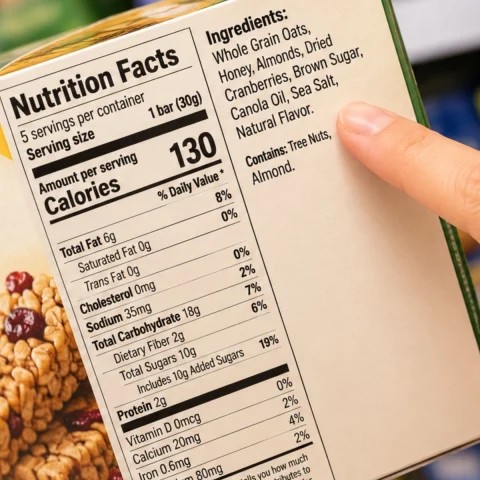
An ingredient statement, also called an ingredient list, is the list of every ingredient in a packaged food, each shown by its common or usual name. The FDA requires ingredients to be listed in descending order of predominance by weight. That means the ingredient that weighs the most comes first, and the one that weighs the least comes last.
Most packaged foods made from two or more ingredients need an ingredient statement. It goes either on the front of the package or on the information panel, usually next to the Nutrition Facts label, and it works together with your allergen statement.
This guide covers the FDA rules for ordering and naming ingredients, how to list compound ingredients and sub-recipes, what you can leave off, and real examples, plus how to create your ingredient statement in Food Label Maker.
Get your ingredient list in order
FDA Ingredient List Rules at a Glance
| Rule | What the FDA requires | Example |
| Order | Ingredients listed by weight, heaviest first | Rolled Oats, Honey, Almonds |
| Small amounts | Ingredients at 2% or less can be grouped at the end | Contains 2% or Less of Cinnamon, Salt |
| Names | Each ingredient’s common or usual name, not a brand or a general category | Whole Wheat Flour, not “Flour Blend” |
| Compound ingredients | The ingredient’s name with its own ingredients in brackets, or each of its ingredients listed separately | Chocolate Chips (Sugar, Chocolate, Cocoa Butter) |
| Water | Added water is an ingredient, unless all of it is removed during processing | Pinto Beans, Water, Salt |
| Spices and flavors | Can be listed as “spice”, “natural flavor” or “artificial flavor” | Spices, Natural Flavor |
| Coloring spices | Paprika, turmeric and saffron are listed as “spice and coloring” or by name | Paprika |
| Colors | Certified colors listed by name; others as “artificial color” or “color added” | Yellow 5 |
| Preservatives | Name plus what it does | Sodium Benzoate (Preservative) |
| Allergens | The 9 major allergens declared in brackets or in a “Contains” statement | Whey (Milk); Contains: Milk |
| What you can leave off | Processing aids and carryover substances at insignificant levels with no function in the final food | Not listed |
| Placement and size | On the front of the package or the information panel, at least 1/16 inch tall | Next to the Nutrition Facts label |
Source: FDA ingredient labeling rules, FDA rules for spices, flavors and colors, FDA Food Labeling Guide
What Is an Ingredient Statement?
An ingredient statement lists every ingredient in your food by its common or usual name, the name people know it by, like “sugar” or “whole wheat flour”. Under federal food labeling law, any food made from two or more ingredients must list each one on the label.
The list goes on either the principal display panel or the information panel, according to FDA’s ingredient labeling rules. In practice, it usually sits on the same panel as the manufacturer’s name and address. It starts with the word “Ingredients”, like this example from the FDA Food Labeling Guide:
INGREDIENTS: Pinto Beans, Water, and Salt
Water counts as an ingredient too. Water added while making a food has to be listed, unless all of it is removed during processing, for example by baking.
In What Order Are Ingredients Listed on a Food Label?
Ingredients are listed in descending order of predominance by weight: the ingredient that weighs the most comes first, and the one that weighs the least comes last. To get the order right, use the weight of each ingredient in your recipe, not its volume.
How to List Minor Ingredients With “Contains 2% or Less”
Ingredients at 2% or less of the product by weight can be grouped at the end of the list.
- They don’t have to follow the weight order.
- Introduce them with a statement like “Contains 2% or less of”.
- The threshold can also be 1.5%, 1% or 0.5%.
- No ingredient in that group can be above the number you state.
How to List Minor Ingredients With “Contains 2% or Less”
A granola made with 300 g rolled oats, 80 g honey, 60 g almonds, 40 g sunflower oil, 30 g raisins, 4 g cinnamon and 2 g salt is listed in that order, heaviest first. Cinnamon and salt are each under 2% of the recipe, so they can be grouped at the end:
INGREDIENTS: Rolled Oats, Honey, Almonds, Sunflower Oil, Raisins, Contains 2% or Less of Cinnamon, Salt.
Food Label Maker’s ingredient label maker works out this order for you from your recipe weights, and combines an ingredient you’ve added more than once into a single entry.
How Should Ingredients Be Named on a Food Label?
Each ingredient has to be listed by a specific common or usual name, the name shoppers recognize, not a general category or a supplier’s trade name. There are a few exceptions for spices, flavors and colors, which can be grouped or named in set ways.
Your supplier’s ingredient spec sheet is the best place to check what’s inside each ingredient you buy, including any sub-ingredients, colors or preservatives you’ll need to list.
How to Use Common or Usual Names
Use the name shoppers know, not a general category or a brand, like “sugar” instead of a brand name. For the ingredients below, the FDA’s ingredient labeling rules set the names you can use.
| Ingredient | Name you can use on the label |
| Skim milk, concentrated skim milk, reconstituted skim milk, nonfat dry milk | “Skim milk” or “nonfat milk” |
| Milk, concentrated milk, reconstituted milk, dry whole milk | “Milk” |
| Bacterial cultures | “Cultured” plus the name of what’s cultured, e.g. “cultured skim milk” |
| Sweet cream buttermilk (in any form) | “Buttermilk” |
| Whey (in any form) | “Whey” |
| Cream (reconstituted, dried or plastic) | “Cream” |
| Butteroil, anhydrous butterfat | “Butterfat” |
| Whole eggs (dried, frozen or liquid) | “Eggs” |
| Egg whites (dried, frozen or liquid) | “Egg whites” |
| Egg yolks (dried, frozen or liquid) | “Egg yolks” |
| Wheat flour (including bromated, enriched and self-rising flour) | “Flour”, “white flour”, “wheat flour” or “plain flour” |
| Whole wheat flour | “Whole wheat flour”, “graham flour” or “entire wheat flour” |
| Durum flour / whole durum flour | “Durum flour” / “whole durum wheat flour” |
| Sugar | “Sugar” means sucrose from sugar cane or sugar beets only |
| Fats and oils | Each by its specific name, e.g. “canola oil”. Blends can be “vegetable oil shortening” or “blend of vegetable oils” with each oil in brackets. Oils that may or may not be used can be listed with “and/or” or “contains one or more of the following” |
| Leavening agents | “Leavening” with each agent in brackets, e.g. “Leavening (Baking Soda, Sodium Aluminum Phosphate)” |
| Yeast nutrients | “Yeast nutrients” with each nutrient in brackets |
| Dough conditioners | “Dough conditioners” with each conditioner in brackets |
| Firming agents | “Firming agents” with each agent in brackets |
| Wax or resin on fresh produce | “Coated with food-grade animal-based wax, to maintain freshness” or “coated with food-grade vegetable-, petroleum-, beeswax-, and/or shellac-based wax or resin, to maintain freshness” |
| Fish protein in processed seafood (species vary by season) | “Fish protein (contains one or more of the following: …)” |
Source: FDA ingredient labeling rules
How to List Spices and Natural Flavors
Spices and flavors can be grouped without naming each one, with a few exceptions.
| Ingredient | How to list it | Example |
| Spices (e.g. basil, cinnamon, ginger, pepper) | “Spice”, “spices” or by name | Spices |
| Paprika, turmeric, saffron | “Spice and coloring” or by name | Paprika |
| Onion, garlic, celery (including powders) | By name, since these count as foods, not spices | Garlic Powder |
| Natural flavor | “Natural flavor” | Natural Flavor |
| Artificial flavor | “Artificial flavor” | Artificial Flavor |
| Salt | “Salt” | Salt |
| Monosodium glutamate | “Monosodium glutamate”, never grouped as a flavor | Monosodium Glutamate |
| A spice or flavor that contains a major allergen | The allergen must still be declared | Contains: Milk |
Source: FDA rules for spices, flavors and colors
How to List Certified and Exempt Color Additives
Certified colors are always listed by name. Colors exempt from certification can be listed by name or grouped.
- Drop “FD&C” and “No.” if you like: “FD&C Yellow No. 5” can be listed as “Yellow 5”.
- Lakes keep the word “Lake”, like “Blue 1 Lake”.
- Exempt colors can be listed as “artificial color”, “artificial color added” or “color added”, or by name, like “colored with beet juice”.
| Certified color | Name on the label | Status for food |
| FD&C Blue No. 1 | Blue 1 | Allowed |
| FD&C Blue No. 2 | Blue 2 | Allowed |
| FD&C Green No. 3 | Green 3 | Allowed |
| FD&C Red No. 40 | Red 40 | Allowed |
| FD&C Yellow No. 5 | Yellow 5 | Allowed |
| FD&C Yellow No. 6 | Yellow 6 | Allowed |
| Citrus Red No. 2 | Citrus Red 2 | Allowed for restricted uses only |
| FD&C Red No. 3 | Red 3 | Authorization revoked; foods must be reformulated by January 15, 2027 |
| Orange B | Orange B | No longer allowed in food since September 8, 2026 |
Common colors exempt from certification include beet powder, annatto extract, caramel, fruit juice, vegetable juice, paprika, turmeric, spirulina extract and butterfly pea flower extract.
Source: FDA summary of color additives, FDA rules for spices, flavors and colors
How to List Chemical Preservatives and Their Function
Chemical preservatives need two things on the label: the preservative’s common name and a description of what it does.
- Put the function in brackets after the name.
- Use one of the FDA’s example descriptions, or another clear description of what the preservative does.
| FDA function wording | Example on a label |
| Preservative | Sodium Benzoate (Preservative) |
| To retard spoilage | Calcium Propionate (to Retard Spoilage) |
| A mold inhibitor | Potassium Sorbate (a Mold Inhibitor) |
| To help protect flavor | BHT (to Help Protect Flavor) |
| To promote color retention | Ascorbic Acid (to Promote Color Retention) |
Source: FDA rules for spices, flavors and colors
How Do You List Compound Ingredients and Sub-Recipes?
A compound ingredient is an ingredient made from two or more ingredients, such as chocolate chips, frosting, a sauce or a sub-recipe you make in-house. FDA’s ingredient labeling rules give you two ways to list one. You can name the compound ingredient and put its ingredients in parentheses, or you can drop its name and list each of its ingredients directly in the main statement by weight.
How to List a Compound Ingredient on a Food Label
You can use either option. Both are compliant as long as every ingredient is declared in descending order by weight.
| Option 1: Parentheses | Option 2: Merged into the main list | |
| How it looks | The compound ingredient’s name, then its ingredients in parentheses in descending order by weight | Each of its ingredients listed on its own, without the compound ingredient’s name |
| Where it goes in the list | Placed by the total weight of the compound ingredient | Each ingredient placed by its own weight in the finished food |
| Same ingredient used twice | Can appear twice, once in the parentheses and once in the main list | Appears once, placed by its combined weight |
| Example | Semisweet Chocolate Chips (Sugar, Chocolate, Cocoa Butter) | Sugar, Chocolate, Cocoa Butter, each placed by its own weight |
Source: FDA ingredient labeling rules
Compound Ingredient Example for Chocolate Chip Cookies
Here is the same cookie recipe written both ways. These are the recipe weights for a 1,000 g batch:
- Wheat flour: 290 g
- Semisweet chocolate chips: 250 g (sugar 125 g, chocolate 90 g, cocoa butter 30 g, milkfat 3 g, soy lecithin 1.5 g, vanilla 0.5 g)
- Butter: 200 g
- Sugar: 150 g
- Eggs: 100 g
- Salt: 6 g
- Baking soda: 4 g
Option 1, with parentheses:
INGREDIENTS: Wheat Flour, Semisweet Chocolate Chips (Sugar, Chocolate, Cocoa Butter, Milkfat, Soy Lecithin, Vanilla), Butter, Sugar, Eggs, Salt, Baking Soda.
Option 2, merged:
INGREDIENTS: Wheat Flour, Sugar, Butter, Eggs, Chocolate, Cocoa Butter, Salt, Baking Soda, Milkfat, Soy Lecithin, Vanilla.
In option 2, sugar moves up to second place. That’s because the 125 g in the chips and the 150 g in the dough are added together, for 275 g in total.
How to List the Same Ingredient From Two Sub-Recipes
When the same ingredient is in more than one sub-recipe, FDA’s ingredient labeling rules handle it differently for each option.
- Parentheses: the parentheses must list every ingredient in the sub-recipe. If the main recipe also uses that ingredient, it appears again in the main list.
- Merged: each ingredient is placed by its weight in the finished food. Add up its weight across every sub-recipe and the main recipe, then list it once.
- Allergens: an allergen inside a sub-recipe still has to be declared, even when the sub-recipe’s name doesn’t show it.
How to Show Sub-Recipes in Food Label Maker
Food Label Maker lists sub-recipes with parentheses by default. You can switch to the merged format with one setting.
- Default: each sub-recipe appears by name, with its own ingredients in parentheses ordered by weight.
- Merged: in Edit Ingredient Statement, turn on Aggregate Sub-Recipe Ingredients to merge identical ingredients across your recipe and sub-recipes into one entry.
- Before you switch: turning this on resets your ingredient and allergen statements and any unsaved customizations, so you may need to redo manual edits.
- Learn more: how ingredient lists are automatically ordered on the label
Our ingredient list generator handles both formats, so you can compare them before you print.
Using sub-recipes?
How Do You Declare Allergens in an Ingredient List?
Each of the 9 major food allergens in your product has to be named by its food source. You can do that in parentheses inside the ingredient list, in a “Contains” statement right after it, or both. This comes from the Food Allergen Labeling and Consumer Protection Act and the FASTER Act, which added sesame. For the full rules, see our FDA allergen labeling guide.
Which Allergens Must Be Declared on an FDA Label?
FDA requires these 9 allergens to be declared, and some need a more specific name than the allergen group.
| Major allergen | What to name on the label |
| Milk | Milk. Covers milk from cows, goats, sheep and other ruminants. Name the animal when it’s not a cow, such as goat milk |
| Eggs | Eggs. Covers eggs from chickens, ducks, geese, quail and other fowl |
| Fish | The species, such as bass, cod or salmon. “Fish” alone is not enough |
| Crustacean shellfish | The species, such as crab, lobster or shrimp. “Shellfish” alone is not enough. Mollusks like oysters and clams are not major allergens |
| Tree nuts | The specific nut: almond, black walnut, Brazil nut, California walnut, cashew, filbert/hazelnut, heartnut/Japanese walnut, macadamia nut/bush nut, pecan, pine nut/pinon nut, pistachio or walnut (English, Persian). Coconut is not on FDA’s list |
| Peanuts | Peanuts |
| Wheat | Wheat. Covers all wheat species, such as durum, spelt and einkorn |
| Soybeans | Soy or soybeans |
| Sesame | Sesame, including when it’s part of a spice blend |
Source: FDA allergen labeling guidance
How to Write a “Contains” Statement
A “Contains” statement lists every major allergen in the product, right after the ingredient list.
- Wording: start with “Contains” (capital C), followed by the food source names.
- Placement: immediately after or next to the ingredient list.
- Type size: the same size as the ingredient list.
- Complete list: include every major allergen in the food, even ones already named in the ingredient list.
- Formatting: bold text and a colon are optional.
Example for chocolate chip cookies:
Contains: Wheat, Milk, Eggs, Soy.
How to Declare Allergens in Parentheses
To declare an allergen inside the ingredient list, add its food source in parentheses right after the ingredient.
- Examples: Whey (Milk), Lecithin (Soy), Spices (Sesame).
- When you can skip it: when the ingredient’s name already includes the source, such as Nonfat Dry Milk or Wheat Flour.
- Already named elsewhere: if the allergen’s name already appears elsewhere in the list, you usually don’t need to repeat it. A name that only looks similar doesn’t count. Buckwheat doesn’t declare wheat, for example.
- Using both methods: that’s allowed, but the “Contains” statement still has to list every major allergen.
Which Ingredients Are Exempt From Allergen Labeling?
Only a few ingredients are exempt, and allergens in flavors, colors and incidental additives still have to be declared.
- Highly refined oils: refined, bleached and deodorized oils are exempt, but the oil’s source still goes in its name, such as Soybean Oil.
- FDA-exempted ingredients: ingredients FDA has exempted through a petition or notification because they don’t contain allergen protein.
- Not exempt: allergens in flavorings, colorings, spice blends and incidental additives, such as processing aids.
Food Label Maker identifies the major allergens in your recipe automatically. You can edit the allergen statement in Edit Ingredient Statement.
What Can You Leave Off an Ingredient List?
You can leave off incidental additives. These are substances present at insignificant levels that have no technical or functional effect in the finished food (FDA ingredient labeling exemptions).
| Type of incidental additive | When you can leave it off |
| Carry-over from an ingredient | The substance had a function in an ingredient you used (such as a preservative in that ingredient) but has no function in your finished food |
| Processing aid that is removed | It’s added during processing and then removed before the food is packaged |
| Processing aid that is converted | It’s added during processing, converted into constituents normally in the food, and doesn’t significantly increase their amount |
| Processing aid at insignificant levels | It’s added for a technical effect during processing, but is at insignificant levels in the finished food and has no effect there |
| Substances from equipment or packaging | It migrates into the food from equipment or packaging and is not a food additive, or is a food additive used as FDA’s food additive regulations allow |
Source: FDA ingredient labeling exemptions
Even as incidental additives, these must always be declared:
- Allergens: any of the 9 major allergens, even in a processing aid or carry-over ingredient.
- Sulfites at 10 ppm or more: sulfur dioxide, sodium sulfite, sodium bisulfite, potassium bisulfite, sodium metabisulfite and potassium metabisulfite, once the finished food has 10 ppm or more.
- Anything with a function in your food: if a substance still does something in your finished product, such as a preservative that keeps preserving it, it’s an ingredient and must be listed.
Where Does the Ingredient List Go on a Food Label?
The ingredient list goes on the same panel as the name and address of the manufacturer, packer or distributor. That can be the principal display panel, which is the front of the package, or the information panel, which is the panel right next to it. It also has to meet FDA’s minimum type size.
| Rule | FDA requirement |
| Panel | The principal display panel or the information panel, on the same panel as the name and address |
| Information panel | The panel immediately to the right of the principal display panel, as the consumer faces it |
| Unusable panel | If the panel to the right is too small or can’t be used (such as folded flaps or can ends), use the next panel to the right |
| Top of the container as the front | If the top of the container is the principal display panel, the information panel can be any panel next to it |
| Intervening material | Nothing FDA doesn’t require can sit between the required information on the information panel |
| Type size | At least 1/16 inch tall, based on the lowercase “o” |
| Readability | Prominent, conspicuous and easy to read |
| Small packages | Individual serving-size packages with 3 square inches or less of label space can use type as small as 1/32 inch, if they meet FDA’s other conditions |
| “Contains” statement | Immediately after or next to the ingredient list, in the same type size |
| Heading | Most labels start the list with “Ingredients:”, as in FDA’s own examples |
Source: FDA Food Labeling Guide and FDA label placement rules
How to Create an Ingredient List in Food Label Maker
Food Label Maker builds your ingredient list from your recipe. It lists ingredients in descending order by weight and adds a “Contains” statement for any major allergens. Here’s how to create one with our ingredient label maker:
- Set up your recipe: enter the recipe name, category, number of packages and servings per package. See how to set up a new recipe.
- Add your ingredients: search the 500,000+ ingredient database and enter quantities. Weight units like grams give the most accurate results. Add custom ingredients for anything not in the database, and use sub-recipes for components like frosting or sauces.
- Review your ingredient list: your ingredients are listed by weight using their common names, and allergens are flagged with a “Contains” statement.
- Edit if needed: go to Customize Label, select Ingredients/Allergens List, make your changes and click Save. Use this to adjust an ingredient name or group minor ingredients under “Contains 2% or less of.”
- Check the wording: on the Enterprise plan, run the AI Ingredient Statement Check before you download. See how it works below.
- Download your label: export it as a PDF, SVG, PNG or BMP. See how to create and customize a compliant nutrition label.
Turn your recipe into a label
How to Check Your Ingredient Statement Before You Print
The AI Ingredient Statement Check reviews your ingredient statement against the labeling rules of the market your label is built for, such as the US. It catches wording issues before your label is downloaded, printed or sent to a retailer.
| What it checks | What it flags |
| Order by weight | Ingredients that aren’t listed in descending order by weight |
| Repeated ingredients | Ingredients that appear to be listed more than once, which often happens with sub-recipes |
| Common or usual names | Names that are too generic or non-standard, such as a purchased ingredient listed under a shorthand name |
| Consistent naming | The same kind of ingredient named differently across the list |
| Grouping | Subgroups that should be regrouped |
| Regulatory wording | Wording that doesn’t match the regulatory language of your market, where common names and allergen wording can differ |
How to run it:
- Finalize your recipe first, since recipe changes reset the edited ingredient list.
- Go to Customize Label and select Edit Ingredient Statement.
- Check the Edit Ingredients List box.
- Click Compliance Check above your ingredient list.
- Review the results. Each suggestion comes with an explanation, and if nothing is flagged you’ll see “No issues found in ingredient statement.”
- Click Apply Suggestion where it’s offered. Other suggestions need a manual edit.
- Click Replace Ingredient Statement to save, or Ignore to keep your original wording.
Because it’s AI-powered, results depend on how clear your input is. Always do a final review against your regulatory and quality requirements before printing. See how to use the AI Ingredient Statement Check.
Frequently Asked Questions About FDA Ingredient Lists
1. Is an ingredient statement the same as an ingredient list?
Yes. “Ingredient statement,” “ingredient list” and “ingredient declaration” all mean the list of ingredients on a food label. FDA’s ingredient labeling rules call it the statement of ingredients.
2. How do you write an FDA ingredient statement?
List every ingredient by its common or usual name, in descending order by weight. Show the ingredients of any compound ingredient, either in parentheses or merged into the main list. Then declare the 9 major allergens in parentheses or in a “Contains” statement. Put the statement on the same panel as the manufacturer’s name and address, in type at least 1/16 inch tall.
3. Are ingredients listed by weight or by volume?
Ingredients are listed by weight, not by volume. FDA requires ingredients to be listed in descending order of predominance by weight, so ingredients you measure in cups or milliliters still need to be ranked by their weight.
4. Do you have to show ingredient percentages on an FDA label?
No. FDA requires ingredients in descending order by weight but not their percentages. Some products do need a percentage elsewhere on the label, such as the percentage of juice in a juice beverage.
5. Do you need a “may contain” statement on a food label?
No. FDA doesn’t require “may contain” statements. They’re voluntary warnings about unavoidable cross-contact, such as shared equipment. If you use one, it must be truthful and not misleading, and it can’t replace good manufacturing practices. Allergens from cross-contact aren’t listed in the ingredient list or the “Contains” statement. Learn more in our FDA allergen labeling guide.
6. Which foods don’t need an ingredient list?
Single-ingredient foods, such as a bag of plain almonds, don’t need one, because FDA only requires an ingredient list for foods made from two or more ingredients. Variable assortments, like assorted candies, can list their shared ingredients plus a statement naming other ingredients that may be present. Bulk foods at retail can show ingredients on the bulk container in plain view, or on a sign or counter card, in letters at least ¼ inch tall (FDA ingredient labeling exemptions).
7. Are ingredient list rules the same in Canada?
No. Canada also lists ingredients in descending order by weight, but the list must be in English and French, and sugars-based ingredients are grouped in brackets after “Sugars.” It also has its own formatting rules, such as a sans serif font, a bold “Ingredients:” title and a border or contrasting background. See our guide to ingredient lists in Canada and CFIA’s ingredient list requirements.
8. How can I create an ingredient list for free?
Sign up for Food Label Maker and create your first label for free. Add your recipe, and our free ingredient list maker lists your ingredients in descending order by weight and adds a “Contains” statement for allergens.
Not sure your ingredient statement is right? A food labeling consultant from our team can review your full packaging against FDA rules, including ingredient list order and allergen declarations, before it goes to print.
Want an expert to check your label?

Related Posts