Brands have had to pull food products off shelves not because of contamination or allergen scares, but because their labels didn’t meet the food labeling requirements for their product category.
Some common foods are deceptively difficult to label because regulatory classifications, standards of identity, and which government agency regulates them create hidden traps.
This article walks through 6 of the trickiest foods to label namely: ice cream, beef jerky, kombucha, foods in brine, chicken & beef broth and hot sauce.If you’re struggling with a tricky food to label and you’re unsure of its food labeling requirements, reach out to one of our regulatory experts who can create a fully compliant nutrition label for you.
Food Labeling Requirements At A Glance: The 6 Hardest Foods To Label
| Food | Regulating agency | Key regulation | Primary labeling risk |
| Hot sauce | FDA | 21 CFR 101.12 (RACC) | 1-teaspoon serving size distorts sodium values and tempts invalid “low sodium” claims |
| Ice cream | FDA | 21 CFR 135.110 (standard of identity) | Product can’t legally be called “ice cream” if it fails milkfat, milk solids, or weight thresholds |
| Brined foods | FDA | 21 CFR 101.9(b) (packing medium) | Sodium migrates from brine into food; raw ingredient data dramatically understates sodium |
| Kombucha | FDA / TTB | 0.5% ABV threshold | Post-bottling fermentation can push product past 0.5% ABV, changing regulatory jurisdiction |
| Chicken & beef broth | USDA | 9 CFR 317, 319 | Wrong agency jurisdiction means wrong label format; “bone broth” has no legal standard of identity |
| Beef jerky | USDA | 9 CFR 319 (moisture-protein ratio) | Must meet 0.75:1 ratio to use “jerky” name; nutrition must reflect dehydrated product, not raw |
1. Food Labeling Regulations for Hot Sauces
Hot sauce is a difficult food product to label because of the complexities that come up with its serving size calculations.
What’s the RACC for Hot Sauce?
The Reference Amount Customarily Consumed (RACC) for hot sauce is 1 teaspoon, or 5 grams. At that serving size, rounding rules from the Food and Drug Administration (FDA) can cause most nutrients to round down to zero, but sodium is the exception. A single teaspoon of hot sauce can contain 100–200mg of sodium, which means the Nutrition Facts panel shows zeros across the board with a sodium value that looks disproportionately high
Hot Sauce Sodium Claims
“Low sodium” requires less than 140mg per RACC. With salt as a primary ingredient, most hot sauces go past that threshold. The small serving size tempts brands into thinking their per-serving sodium is low enough to qualify, but the FDA evaluates the claim against the RACC, not against what the number looks like relative to other nutrients on the panel. “No sodium” is even stricter, requiring less than 5mg per RACC, which virtually no salt-containing hot sauce can meet.
Does Hot Sauce Qualify for the Small Package Labeling Exemption?
Bottles with less than 12 square inches of available label space may qualify for an abbreviated Nutrition Facts panel or a full exemption. Many small-batch hot sauce brands assume this means they can skip nutrition labeling entirely but they can’t as the exemption is conditional. If a brand makes any nutrient content claim on the label (like “low sodium” or “zero sugar”), the full Nutrition Facts panel is required regardless of package size.
Are Scoville Ratings on Hot Sauce Labels Allowed Under FDA Food Labeling Regulations?
Scoville ratings are entirely voluntary and have no FDA-standardized format or placement rules. They’re a marketing tool, not a regulated metric. Placing them inside or adjacent to the Nutrition Facts panel in a way that makes them look like an official declaration is a labeling violation. Brands that want to include Scoville ratings should place them on a separate part of the label, clearly distinguished from required regulatory elements.
If you’re confused on how to label your hot sauce, reach out to one of our regulatory experts – with experience in food labeling tricky food products – and they will create your nutrition label for you.
For a closer look at how these challenges apply in practice, see our guide on How to Create a Hot Sauce Nutrition Label (FDA Requirements), which covers the process step by step.
2. Ice Cream vs Frozen Dairy Dessert: Food Labeling Requirements
Ice cream is considered a complex food to label because its standard of identity, air content, and mix-in sub-recipes each introduce labeling requirements that most brands don’t see coming.
The Standard of Identity for Ice Cream
A standard of identity is a set of requirements that defines what a product must contain to be sold under a specific name. To legally call a product “ice cream,” it must meet all of the following:
- Milkfat: minimum 10% by weight
- Total milk solids: minimum 20%, which includes both fat and nonfat solids
- Weight: minimum 4.5 pounds per gallon
- Total solids: minimum 1.6 pounds per gallon
- Protein: must be derived solely from milk
- Egg yolk: if the product contains more than 1.4% egg yolk solids, it’s no longer ice cream, it’s classified as frozen custard or french ice cream
If any of these conditions aren’t met, the product becomes a “frozen dessert”, which is a different product name with different regulatory rules and a very different consumer perception. Brands using plant-based fats like coconut oil often assume they can still use the term “ice cream” on their label. They can’t, and doing so is a standard of identity violation that can trigger FDA enforcement.

How Does Overrun Affect Ice Cream Nutrition Labels?
When manufacturing ice cream, air gets incorporated into the mix when freezing or churning which is defined as overrun. Failing to incorporate overrun into an ice cream nutrition label creates an inaccurate and non-compliant label because serving sizes are weight-based, not volume-based. Two identical containers could have different nutrition panels depending on how much air is inside, ice cream at 100% overrun will have 50% air following the below overrun calculation:
| overrun percentage calculation (%) = (volume of ice cream − volume of mix) ÷ volume of mix × 100 |
How Do Mix-Ins Change Ice Cream Labeling Requirements?
Cookie dough, brownie pieces, candy swirls – each mix-in is a sub-recipe with its own allergens, artificial colors, and ingredient declarations. Every sub-recipe must be parenthetically listed in the ice cream ingredient statement. Missing an allergen that’s buried in a mix-in component leaves a very high risk for product recall. The more mix-ins a product has, the more complex the ingredient declaration becomes and the more opportunities there are for a compliance error.
Managing multiple sub-recipes and allergen declarations gets complex fast. Food Label Maker automatically handles ingredient statements and allergen tracking for ice cream products, or if you’d prefer hands-on help, our regulatory experts can build the label for you.
Looking for a deeper dive into ice cream nutrition labeling? Read our guide on Ice Cream Nutrition Label: FDA Requirements and How to Build One for a step by step walkthrough.
See How FoodLabelMaker Can Help You
3. Food Labeling Requirements for Brined Foods
Any food that sits in brine absorbs sodium from the liquid over time and that absorbed sodium must be reflected on the Nutrition Facts panel. Most brands miss this entirely.
How Does Brine Affect Nutrition Label Accuracy?
During brining, sodium moves from the liquid into the food through osmotic diffusion.
A fresh cucumber has roughly 2mg of sodium but a dill pickle spear can have 300–400mg. Fresh tuna can have about 90-95mg per 100g serving and a brine-packed tuna, even after draining, can reach 200–220mg per 100g. The same principle applies to olives, anchovies and anything else packed in salt water.
The sodium is inside the food, not just on the surface. The FDA doesn’t distinguish between “intrinsic” and “absorbed” sodium meaning the nutrition facts label must reflect the final product composition and not the raw ingredient. Brands that calculate nutrition from pre-brined ingredient data will dramatically understate sodium, which FDA considers misbranding under 21 CFR 101.9.
When Does the Food’s Packing Liquid Count Toward Nutrition Labeling?
The FDA distinguishes between packing liquids that are typically consumed and those that are typically discarded, under 21 CFR 101.9(b).
For canned peaches in syrup, consumers discard the liquid, so labeling is based on drained weight. Pickles are trickier because many consumers drink the brine, use it in recipes, or consume it alongside the product. If the liquid packing medium is reasonably expected to be consumed, its nutrients must be included in the nutrition panel, if not then the declaration of nutrients should be according to the drained solids.
Tuna goes the other direction as consumers typically drain and discard the brine, so the FDA allows labeling on a drained basis. But the nutrient analysis is still performed on the drained product, which already contains the absorbed sodium. Either way, brine sodium ends up on the food label. Brands need to determine how consumers actually use the liquid packing medium for their specific product, because that decision changes what goes on the panel.
Food Label Maker automatically calculates sodium and additive declarations to meet FDA requirements — or connect with a regulatory expert who will create it for you.
4. Food Labeling Requirements for Kombucha: ABV%, Bottling & Health Claims
Kombucha is a difficult food when it comes to food labeling because its nutrition label can be fully compliant at the time of production and non-compliant by the time it reaches the consumer. This is because kombucha doesn’t stop fermenting after it’s bottled.
Kombucha ABV% Threshold
Below 0.5% ABV, kombucha is regulated by the FDA as a food. Above 0.5%, it falls under the Alcohol and Tobacco Tax and Trade Bureau (TTB), which is an entirely different agency with different labeling rules, permits, and distribution requirements. There is no grace period or overlap so a food product that crosses that line is subject to TTB jurisdiction whether the brand intended it or not.
Can Kombucha Food Labels Become Non-Compliant After Bottling?
Kombucha continues to ferment after bottling. A batch that tests at 0.3% ABV at production can exceed 0.5% ABV on the shelf, especially if the cold chain is broken during shipping or storage. That means a food label that was accurate and compliant at the time of manufacture can become non-compliant at retail without the brand changing anything. Several major kombucha brands have faced recalls when shelf samples tested above the 0.5% threshold. This is a risk that doesn’t exist for many other food products.

Health Claims on Kombucha Nutrition Labels
Kombucha naturally contains live cultures, which makes probiotic claims tempting — but FDA regulates these tightly. Claims like “boosts immunity” or “improves gut health” require FDA-approved health claim authorization. Structure/function claims (like “supports digestive health”) are permitted but come with strict notification requirements under DSHEA, including a 30-day advance notice to FDA before the product goes to market. Brands that print probiotic health claims without following DSHEA notification requirements are in violation regardless of whether the claims are scientifically accurate.
Food Label Maker handles fermented beverage labeling with proper alcohol and sugar declarations built in — or connect with a regulatory expert who will create it for you.
5. Chicken and Beef Broth Food Labeling Requirements
Broth looks like one of the simplest foods to label — water, meat, salt, seasonings. But it sits at the intersection of USDA and FDA jurisdiction, and picking the wrong agency means the entire nutrition label is formatted under the wrong set of rules.
Is Broth Regulated by the USDA or the FDA?
Chicken broth and beef broth containing meat or poultry are regulated by USDA FSIS, not FDA. That means 9 CFR Part 317 governs the label with a different format, a different review process, and a requirement for pre-approval of labels before products go to market. USDA-regulated labels must be submitted through the agency’s label approval system, and products cannot legally be sold until that approval is granted. This is a fundamentally different process from FDA-regulated products, where brands can go to market without prior label review.
But not all broths fall under USDA. Vegetable broth is FDA-regulated under 21 CFR Part 101. A product marketed as “broth-flavored seasoning” with minimal meat content might also qualify as FDA-regulated. Even within meat-based products, the percentage of meat or poultry in the formula can determine which agency has jurisdiction i.e a soup with a small amount of chicken may fall under FDA, while one with a higher percentage falls under USDA. The jurisdiction line is not intuitive, and getting it wrong doesn’t just mean a few corrections, it means the entire nutrition label was built under the wrong agency’s rules, with the wrong format, the wrong nutrition panel layout, and without the required pre-market approval.
What’s the Difference Between Broth, Stock, Bouillon, and Bone Broth?
The USDA defines “broth” as a liquid made by simmering meat or poultry in water. “Stock” is made from bones and typically has a higher gelatin content due to the collagen extracted during cooking. “Bouillon” is a concentrated or dehydrated form — each has different solids requirements outlined in the FSIS Labeling Policy Book, which serves as the primary reference for how USDA evaluates product names and standards.
The term “bone broth” has no legal standard of identity. Despite its popularity as a distinct product category, USDA regulates it as regular broth. That means any claims about collagen content, protein levels, or “slow-simmered” processes need verification under FSIS labeling guidelines. If the food product doesn’t meet the existing definition for broth or stock, the brand may need to work with FSIS through the label approval process to determine what product name is acceptable.
Dual-Column Labeling for Broths
Concentrated broths that require dilution need dual-column labeling showing both “As Packaged” and “As Prepared” values under 21 CFR 101.9. A concentrate serving might be 2 tablespoons, making sodium appear manageable at around 400mg. But the “As Prepared” column reflects what a consumer actually eats, which is one cup of broth made by diluting that concentrate with water. The water adds volume but no sodium, so the sodium per serving stays the same while the serving size jumps from 2 tablespoons to a full cup. The result is that the “As Prepared” column shows 800–1,200mg of sodium per serving. The sodium doesn’t increase but it gets reported against a realistic portion size instead of a tiny concentrate measure. Brands that only show the concentrate column are technically compliant but functionally misleading, and both FDA and USDA increasingly scrutinize this practice.
Why Are Sodium and “No MSG” Claims So Risky on Broth Labels?
The RACC for broth is 1 cup (240g), which is large enough that sodium numbers look alarming. “Low sodium” requires 140mg or less per RACC and “Reduced sodium” requires 25% less than a reference product. Most regular broths run 800–1,200mg per cup, which means even “reduced sodium” versions often sit at 600–900mg.
Then there’s MSG. Many broths contain hydrolyzed vegetable protein (HVP) or yeast extract, both of which contain naturally occurring glutamates, chemically similar to MSG. Claiming “No MSG” while using these ingredients is misleading and has triggered FDA warning letters. Similarly, “All Natural” claims on USDA-regulated products require case-by-case approval, and “natural flavors” must comply with the FDA’s definitions.
Skip the guesswork on your broth labels.Food Label Maker automatically formats serving sizes and nutrient values to FDA standards — or connect with a regulatory expert who will create it for you.
6. Beef Jerky Food Labeling Requirements
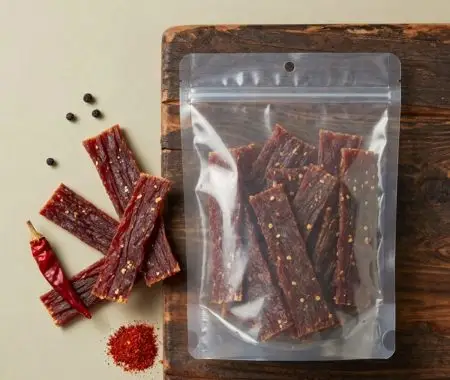
Beef jerky is difficult to label because it’s a USDA-regulated dehydrated meat product. This means the label format, the approval process, and even the product name are all governed by rules most food brands have never worked with.
Is Beef Jerky Under FDA or USDA Food Labeling Regulations?
Like broth, beef jerky is a meat product regulated by USDA FSIS. But unlike broth, which is sometimes unclear and ambiguous, jerky is very clearly a USDA regulated food product. Most food manufacturers don’t know the USDA is involved at all. They build a label using FDA placement and font rules, when they should be following 9 CFR Part 317, which governs labeling, marking, and containers for USDA-regulated meat products. USDA also requires prior label approval, meaning the label must be submitted and approved before the product can be sold.
What Is the Moisture-to-Protein Ratio for Beef Jerky?
Beef jerky’s moisture-to-protein ratio was historically referenced by USDA as a shelf-stability guideline, but FSIS removed that reference from the official Food Standards and Labeling Policy Book in 2025, after confirming it had never actually established a regulatory standard for jerky. Today, manufacturers focus on achieving a safe water activity level (aw) of 0.85 or less to inhibit bacterial growth.
How Does Dehydration Affect Beef Jerky Nutrition Labels?
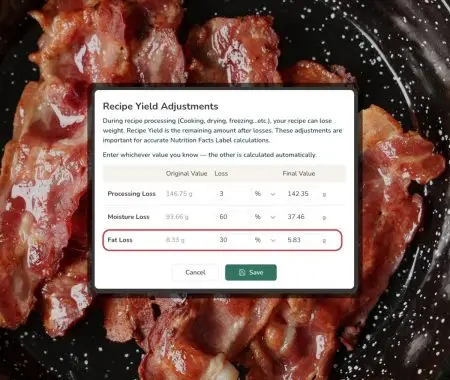
Dehydration concentrates the nutrients in a food product. A 100g raw batch that yields 40g of finished jerky has a completely different nutrient density per serving than its raw ingredients. Protein, sodium and fat all increase on a per-gram basis because the water is gone but everything else stays. Nutrition must be calculated based on the finished dehydrated product instead of the raw recipe. Brands that run their raw ingredient list through a nutrition calculator and use those values on the label will understate nearly every nutrient on the panel. For a USDA-regulated product where the label is reviewed before approval, this kind of error will either delay the product’s launch or, if it slips through, create a misbranding liability.
Need a compliant beef jerky label? Food Label Maker automatically applies FDA/USDA formatting and moisture loss requirements — or connect with a regulatory expert who will create it for you.
Read the full USDA Compliance Guide on Beef Jerky Nutrition Labels here.
Conclusion: Final Thoughts
Every product on this list has at least one regulatory requirement that generic food labeling advice doesn’t cover. Standards of identity determine whether a product can even use its own name. Agency jurisdiction determines which set of rules the label must follow. Packing media, fermentation, dehydration, and serving size math all introduce variables that don’t show up in a basic nutrition calculator.
The pattern across all six is the same: the Nutrition Facts panel is the easy part. The hard part is the regulatory layer underneath it, the part that determines whether the food label is compliant before a single nutrient value is entered. Brands that rely on surface-level guidance risk warning letters, forced relabeling, delayed product launches, or worse.
Food manufacturers that need help with complex foods to label can hire one of our regulatory experts who will create a complete, and compliant, nutrition label.
Frequently Asked Questions About Food Labeling Requirements
1. What agency regulates beef jerky — FDA or USDA?
Beef jerky is regulated by the USDA Food Safety and Inspection Service (FSIS), not the FDA. This means labels must follow 9 CFR Part 317 and require prior USDA approval before the product can be sold. Brands that build their label using FDA formatting rules are non-compliant by default.
2. What is the moisture-to-protein ratio required for beef jerky?
To legally use the name “jerky,” the finished product must have a moisture-to-protein ratio of less than 0.75:1. If the finished product doesn’t meet this threshold, it cannot be sold under the jerky name and would require a different product name entirely.
3. Can I call my product “ice cream” if it contains coconut oil?
No. To legally use the name “ice cream,” the product must contain a minimum of 10% milkfat by weight derived from milk, not plant-based fats. A product made with coconut oil fails the standard of identity under 21 CFR 135.110 and must be labeled as a frozen dessert instead.
4. What happens if my kombucha exceeds 0.5% ABV after bottling?
If kombucha exceeds 0.5% ABV at any point — including after bottling — it moves out of FDA jurisdiction and into TTB (Alcohol and Tobacco Tax and Trade Bureau) jurisdiction. This triggers an entirely different set of labeling rules, permits, and distribution requirements. Several major kombucha brands have faced recalls when shelf samples tested above this threshold.
5. Is chicken broth regulated by the FDA or USDA?
Chicken broth and beef broth containing meat or poultry are regulated by USDA FSIS under 9 CFR Part 317, not the FDA. Vegetable broth is FDA-regulated. The jurisdiction line depends on the meat or poultry content of the formula, and getting it wrong means the entire label was built under the wrong agency’s rules.
6. What is the RACC for hot sauce?
The Reference Amount Customarily Consumed (RACC) for hot sauce is 1 teaspoon, or 5 grams. At this serving size, most nutrients round down to zero under FDA rounding rules — but sodium is the exception, and can still show 100–200mg per serving, making sodium claims particularly risky for hot sauce brands.
7. Can I make a “low sodium” claim on hot sauce?
Most hot sauces cannot make a “low sodium” claim. The FDA requires less than 140mg of sodium per RACC to qualify, and with salt as a primary ingredient most hot sauces exceed that threshold even at a 1-teaspoon serving size. “No sodium” is even stricter, requiring less than 5mg per RACC.
8. Does brine sodium count toward the nutrition facts label?
Yes. Sodium that migrates from brine into food through osmotic diffusion must be reflected on the Nutrition Facts panel. The FDA does not distinguish between intrinsic and absorbed sodium under 21 CFR 101.9. Brands that calculate nutrition from pre-brined ingredient data will dramatically understate sodium, which the FDA considers misbranding.
9. What is the difference between broth, stock, and bone broth?
The USDA defines broth as a liquid made by simmering meat or poultry in water, while stock is made from bones and has a higher gelatin content. Bone broth has no legal standard of identity despite its popularity — USDA regulates it as regular broth. Any claims about collagen content or protein levels on bone broth must be verified under FSIS labeling guidelines.
10. Do small hot sauce bottles need a nutrition facts panel?
Not always, but the exemption is conditional. Bottles with less than 12 square inches of available label space may qualify for an abbreviated panel or full exemption — but if the brand makes any nutrient content claim on the label, such as “low sodium” or “zero sugar,” the full Nutrition Facts panel is required regardless of package size.