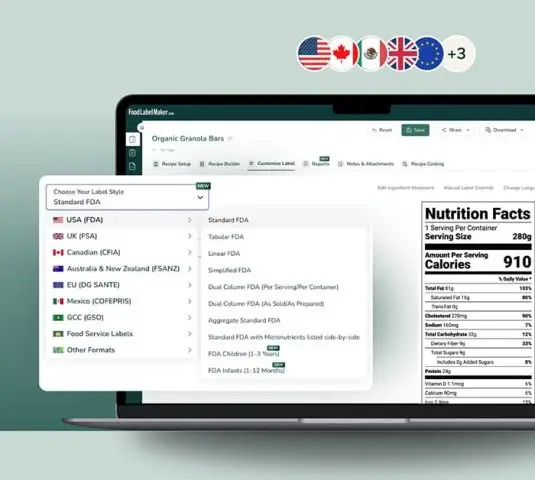
An FDA nutrition label is not compliant outside the United States. Many food businesses assume they can take the data from their FDA label and apply it to another region’s label, but each region sets its own formatting rules, rounding rules, allergen declarations, language requirements and serving sizes.
If you are a food manufacturer expanding distribution into regions like Canada, the EU or Mexico, you need labeling software that supports more than one market.
We compared seven nutrition labeling platforms on the markets each one publicly documents, how label versions are handled when a recipe changes, and how each is priced. Two of the seven publish coverage for more than four markets. The rest stop at four or fewer, or do not publish a market list at all.
Why One Nutrition Label Does Not Work in Multiple Markets
The nutrient data behind your label stays the same wherever you sell, which makes it easy to assume the label can travel with the product. Every region has built its own rules around how that data is presented, from label formats and rounding thresholds to allergen lists and the language on the pack.
The US recognises nine major allergens after sesame was added in January 2023, while the EU requires fourteen to be declared, which changes the ingredient statement and the allergen declaration together. Rebuilding each version by hand across those label formats is where most food labeling errors start, and a rounding mistake on its own is enough to put a panel out of compliance.
The work also repeats itself. A supplier switch or a minor reformulation affects every market version of a product at the same moment, so selling the same item in four regions means maintaining four nutrition labels, four ingredient statements and four allergen declarations before the next print run.
Nutrition Label Requirements by Market: FDA, CFIA, EU, UK, FSANZ, COFEPRIS and GSO
Every regulator sets its own panel, its own front-of-pack rules and its own language requirements. The table covers the seven markets US food businesses reach for first.
| Market | Regulator | Panel format | Front of pack | Language |
| United States | FDA (USDA FSIS for most meat and poultry) | Nutrition Facts, declared per serving from a RACC | Proposed, not finalized | English |
| Canada | CFIA and Health Canada | Nutrition Facts table, per serving | Nutrition symbol mandatory since 1 January 2026 | English and French, with narrow exemptions |
| European Union | DG SANTE, Regulation (EU) 1169/2011 | Nutrition declaration per 100g or 100ml | Voluntary. Nutri-Score and others used by individual member states | A language easily understood in the market where sold |
| United Kingdom | FSA and DHSC, under retained 1169/2011 | Nutrition declaration per 100g or 100ml | Traffic light scheme, voluntary | English |
| Australia and New Zealand | FSANZ | Nutrition information panel, per serving and per 100g together | Health Star Rating, voluntary | English |
| Mexico | COFEPRIS, NOM-051 | Nutrition declaration in Spanish | Warning seals mandatory | Spanish |
| GCC | GSO | labeling under GSO 9 | Governed by GSO standards | Arabic, or Arabic with another language |
Front-of-pack is where these markets diverge most. Canada’s nutrition symbol became mandatory on 1 January 2026, Mexico’s warning seals have been in force for years, and the EU and UK both keep front-of-pack voluntary. The FDA’s Nutrition Info box is still only proposed, so nothing is required on US packs today.
The panel itself splits three ways. The FDA declares per serving from a RACC and requires a dual column label on some packages, the EU and UK declare per 100g or 100ml, and Australia and New Zealand require both columns. The same lab analysis produces three different sets of published numbers before rounding rules are even applied.

See How FoodLabelMaker Can Help You
How to Evaluate Nutrition Labeling Software for Multiple Markets
Most comparisons stop at how many markets a tool claims to cover. That number matters least once you are actually running labels across multiple markets, because the real work is keeping them current. Six things separate the tools.
1. Market coverage, and what “supports” actually means: Ask whether a market includes the full label or only the panel. Some tools generate a compliant nutrition label for a market and leave the ingredient statement and allergen declaration to you, which means you are still doing the hard part by hand.
2. Label version control across markets: One product can have seven live labels. Label version control means the system knows which version belongs to which market and which one is current, so nobody sends a file to print that somebody edited last spring. Without it, every reformulation creates a small window where the wrong label exists somewhere.
3. Regulatory change management: When a rule moves in one market, you need to know which products are affected without opening each one. Regulatory change management combined with proper SKU management turns that from a month of checking into a morning, and it is the capability most often missing.
4. Approval workflow and seats: R&D drafts, regulatory reviews, packaging executes. A label approval workflow records who signed off and when, and it only functions if everyone involved has an account. Tools that cap you at one or five users push the approval back into email, where nothing is recorded.
5. Audit trail: A retailer or auditor asks which label was on pack in March. An audit trail answers that from the system. Without one you are reconstructing it from folders and inboxes, and the audit trail is also what protects you if a recall traces back to a food labeling error.
6. Integrations and pricing model: ERP integration and PLM integration matter once specs live outside the labeling tool, otherwise you maintain the same ingredient data twice. On price, ask whether the model is per site, per user or per market, because those three produce very different numbers at four markets.
Only market coverage and pricing are documented publicly by most vendors. The other four need a demo, so ask about them directly.
The Best Nutrition Labeling Software For Multiple Markets
The table below shows which markets each software covers.
| Tool | US | Canada | Mexico | UK | EU | AU / NZ | GCC | Also covers |
| Food Label Maker | Yes | Yes | Yes | Yes | Yes | Yes | Yes | |
| TraceGains NutriCalc | Yes | Yes | Yes | Yes | Yes | Yes | Yes | South Africa, Hong Kong |
| SKUsafe | Yes | Yes | Yes | Not documented | Yes | Not documented | Not documented | |
| ENTR | Yes | Yes | Not documented | Not documented | Not documented | Not documented | Not documented | |
| ReciPal | Yes | Yes | Not documented | Not documented | Not documented | Not documented | Not documented | |
| Datacor | Yes | Not documented | Not documented | Not documented | Not documented | Not documented | Not documented | |
| Nutritics | Not documented | Not documented | Not documented | Yes | Yes | Yes | Not documented |
Coverage reflects what each vendor publishes as of October 2026. Nutritics does not publish a market list.
Each subsection below covers pricing, strengths and gaps, so a food business weighing international expansion can see which one fits.
1. Food Label Maker – Eight Markets on One Platform
Markets Covered
USA, Canada, Mexico, UK, EU, Australia, New Zealand, GCC
Pricing
- Basic: $49/month or $299/year – 1 market of your choice
- Plus: $99/month or $588/year – 1 market of your choice
- Professional: $199/month or $1,188/year – 2 markets of your choice
- Enterprise: quote – all markets
Strengths
Best for brands selling the same products in three or more major, global markets.
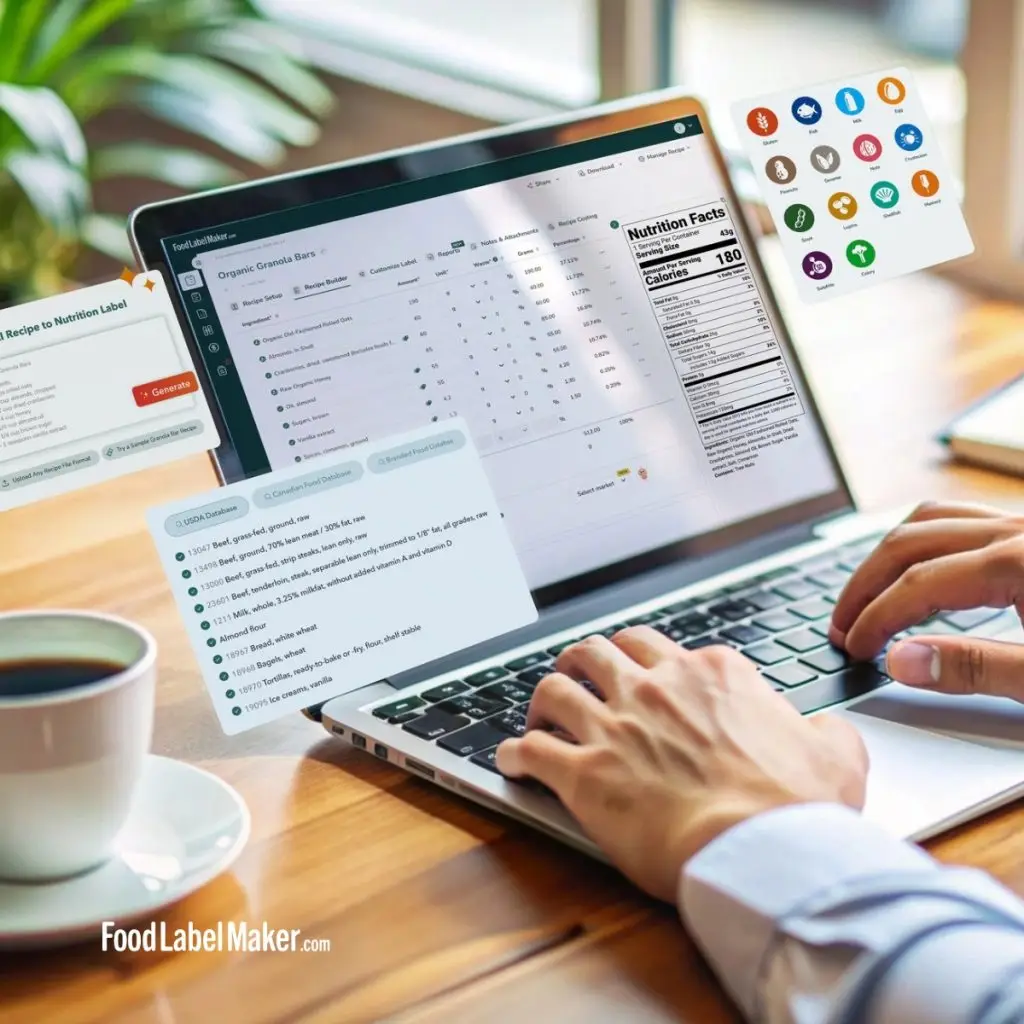
Food Label Maker is a nutrition labeling compliance platform built around markets, and you choose which ones from the eight available rather than being handed a fixed pair. The market you select drives the whole label rather than the panel alone, so the nutrition label, the ingredient statement and the allergen declaration are each generated against that market’s rules, whether FDA, CFIA or any of the other six, with front-of-pack formats (Nutri-Score, Traffic Light, Health Star Rating, Mexico warning seals, Canada FoP) generated for the markets that use them.
Enterprise adds what matters once multi-market compliance runs at scale, with unlimited users, role-based access, and recipe and ingredient history recording which version of a label changed and when. Custom API integration and a white-glove migration service are included at that tier, so labels built in other software move across without being rebuilt.
Limitations
Every plan below Enterprise is single user, and anything past two markets means moving to a quoted plan rather than a list price.
To get started, choose the right plan for your business or book a demo.
2. TraceGains NutriCalc – Ten Markets, At $12,000 A Year Per Site
Markets Covered
USA, Canada, Mexico, UK, EU, Middle East, South Africa, Australia, New Zealand, Hong Kong
Pricing (US plans)
- Professional: $6,000/year per site, up to 5 users – US and Canada only
- Premium: $12,000/year per site, up to 5 users – all 10 markets
Strengths
Best for US brands that need South Africa or Hong Kong.
NutriCalc documents a wide global coverage and its label formats include front-of-pack for Canada, Mexico and the EU as well as Nutri-Score. The company states that its reports and labels meet nutrition, allergen and ingredient requirements in every market it lists, so the ingredient list and allergen declaration are handled alongside the nutrition label.
Limitations
Professional limits you to the US and Canada markets, and those two are fixed rather than chosen. Adding a third market moves you to Premium, which doubles the cost from $6,000 to $12,000 a year. Pricing is per site, so it scales with how many locations you run rather than how much labeling you do, and both plans cap at five users.
Click here to learn more about NutriCalc.
3. SKUsafe – Documents Four Markets Inside a PLM Platform
Markets Covered
United States, Canada, European Union, Mexico
Pricing
Not published, quote only, priced per module – US, Canada, EU, Mexico
Strengths
Best for brands that need a product lifecycle system as much as they need labels.
SKUsafe is product lifecycle management software with a labeling module. It names the US, Canada, EU and Mexico as covered markets and documents nutrition fact panels and supplement fact panels generated from the formula.
Limitations
SKUsafe names four markets, with no UK, Australia, New Zealand or Gulf formats on its published pages, so a brand selling into those regions needs a second tool. Pricing is modular across product lifecycle management, supply chain and quality as well as labeling, and is quote only, so it may be more platform than you need if labels are the job.
Learn more about SKUSafe here.
4. ENTR – Documents FDA and Health Canada Compliance
Markets Covered
United States, Canada
Pricing
Not published, quote only – US and Canada only
Strengths
Best for brands selling only in the US and Canada.
ENTR software covers Nutrition Facts and Supplement Facts panels, ingredient statements, allergen declarations and Canadian front-of-pack labels. The company states the software covers FDA and Health Canada regulatory compliance, so the ingredient statement and allergen declaration are generated alongside the nutrition label from the same recipe data.
Limitations
Coverage stops at the US and Canada. ENTR’s own FAQ says additional markets and regulatory frameworks are coming soon, with no dates attached, so a brand selling into the EU, Mexico or the Gulf needs a second tool today. Pricing is not published.
To learn more about ENTR, click here.
5. ReciPal – Documents FDA and CFIA Labels for Small Businesses
Markets Covered
United States, Canada
Pricing
- Single Serving: $29 per recipe – US and Canada only
- Business: $59/month or $588/year – US and Canada only
- Business Plus: $129/month or $1,284/year – US and Canada only
Strengths
Best for small food businesses selling in the US and Canada.
ReciPal is self-serve nutrition labeling software covering FDA and CFIA formats. It documents label formats for both countries, including vertical, tabular, linear and dual column, with French, English and bilingual setups for Canada. Ingredient statements and allergens populate automatically from the recipe.
Limitations
ReciPal documents FDA and CFIA formats, with no EU, Mexico or Gulf formats named on its published pages. The Business plan is single user and capped at 50 recipes a month, so a team needs Business Plus.
Visit ReciPal’s website to learn more.
6. Datacor – Documents FDA Labels on a USDA Database
Markets Covered
United States
Pricing
Not published, quote only – US only
Strengths
Best for US food and beverage manufacturers producing domestic labels.
Datacor Nutrition Labeling, formerly LabelCalc, is a cloud-based platform for FDA nutrition labels built on a USDA ingredient database. It handles recipe storage, nutrient analysis, allergen tracking and ingredient statements, and the company positions it around speed, citing accurate labels produced in minutes rather than through outsourced consultants.
Limitations
Datacor documents FDA formats built on a USDA ingredient database and names no Canadian, EU or other market format on its product or capabilities pages, so coverage beyond the US would need confirming before you buy. Pricing is not published.
Visit Datacor’s website to learn more.
7. Nutritics – Documents Region-Based Label Formats
Markets Covered
UK, EU, Australia and New Zealand documented. No published market list.
Pricing
Not published, quote only
Strengths
Best for foodservice and hospitality businesses producing labels in house.
Nutritics LabelMagic is nutrition labeling software aimed at hospitality and foodservice that pulls allergen and ingredient information from live recipe data. The company describes its labels as built using regulatory standards defined by each geographical region, and its published guidance is built around Natasha’s Law, the UK prepacked for direct sale allergen rule.
Limitations
Nutritics does not publish a list of the markets it covers or a price. Its support documentation describes a region setting that applies different labelling standards, with UK, EU and FSANZ formats referenced, and its customer stories are UK and Ireland. The product is aimed at foodservice rather than packaged goods sold across borders, so a brand comparing label formats market by market would need to confirm coverage with their team.
To learn more about Nutritics, click here.
Choosing The Best Nutrition Labeling Software for Multiple Markets
Every tool here analyses a recipe and produces a panel. What changes is how many markets it can produce a compliant label for, and the more markets you need, the fewer tools can handle the compliance.
One market. ReciPal charges $29 per recipe, so ten recipes costs about the same as a full year of Food Label Maker’s Basic plan at $299, which allows 50 recipes a month and covers whichever market you choose out of the eight available. Datacor quotes for US labels.
Two markets. ReciPal’s Business plan is $588 a year for 50 recipes a month, US and Canada only. NutriCalc’s Professional also covers the US and Canada at $6,000 a year, per site. ENTR covers them on a quote. Food Label Maker’s Professional plan is $1,188 a year for 100 recipes a month across any 2 of the 8 markets.
Three or more. Three options remain, and two of them are quote only. SKUsafe covers four markets as one module inside a product lifecycle platform. NutriCalc covers ten at $12,000 a year per site, capped at five users. Food Label Maker covers eight on one quoted plan with unlimited users and unlimited recipes.
Each option involves a trade-off. ReciPal costs less at two markets, with 50 recipes a month across a fixed pair of countries. NutriCalc covers more markets, at $6,000 a year for those same two countries but priced per site. SKUsafe reaches four markets inside a wider platform, on a quote. ENTR, ReciPal and Datacor document North America only.
Of these seven, Food Label Maker is the only nutrition labeling software that combines market choice, recipe allowance and price for a clear pathway to labeling compliance across multiple markets.
International expansion usually happens one market at a time but changing labeling software partway through is not a small job. Recipes, ingredient data and every live label version have to move across and be checked again against each market’s rules. Matching your food labeling software to the export markets already on your roadmap costs nothing today and avoids an international migration in two years.
Frequently Asked Questions About Nutrition Labeling Software for Multiple Markets
1. Do I need separate software for each market?
No, though several tools would leave you with that outcome. Three of the seven publish coverage for North America and no other region, so a brand selling into the UK or the Gulf could end up running two systems side by side. Software that generates labels for every market you sell in keeps one set of recipe data behind all of them. You can see how multi-market label generation works on our features page.
2. Can one tool handle FDA and EU formats at the same time?
Yes. The two differ in almost every respect, since the FDA declares per serving based on a reference amount customarily consumed while the EU declares per 100g or 100ml, and the allergen lists run to nine against fourteen. A tool built around markets applies each set of country-specific rules to the same recipe rather than asking you to rebuild it. Our guide to nutrition labeling standards by country breaks the differences down market by market.
3. What happens to my other labels when I change a recipe?
That depends on the tool. Where labels are linked to the recipe, a reformulation updates every market version at once rather than one at a time. In Food Label Maker, a change to a recipe carries across every label type generated from it, and Enterprise plans keep activity history reports alongside ingredient and recipe logs, so you can see which version changed and when. Without that link, each version has to be found and reissued by hand before the next print run, which is where most labeling errors begin.
4. Which markets require a second language on the label?
Canada requires English and French on all mandatory information for consumer prepackaged food, with narrow exemptions for specialty, local and test market foods. Mexico requires Spanish. Gulf states label under GSO 9. The wording used in an allergen statement is itself regulated, so a general translation service will not meet the requirement. Our guide to CFIA bilingual labeling covers the Canadian rules in full.
5. Does selling in Quebec require anything beyond Canadian bilingual labeling?
Yes. Quebec adds its own French language requirements on top of the federal rules, and they are administered provincially rather than by the CFIA. A label that satisfies the federal bilingual requirement can still need adjusting before it goes on shelf in Quebec.
6. What are the new food labeling requirements for 2026?
The main change is in Canada, where the front-of-pack nutrition symbol became mandatory on 1 January 2026 for food imported, manufactured or packaged at retail on or after that date, with no enforcement discretion afterwards. In the US, the FDA’s front-of-package Nutrition Info box is still a proposal, so nothing is required on American packs yet.
7. How much does nutrition labeling software cost for multiple markets?
It varies more than most software categories. Single-market tools start at $29 per recipe. Two markets range from $588 a year to $6,000 a year depending on the vendor and which two countries you get. Past two markets there are three options. Two are quote only, including Food Label Maker’s Enterprise plan, and the one published figure is $12,000 a year per site. Compare our plans to see what each tier covers.
8. What if I need a market the software does not cover yet?
Ask before you buy. On Food Label Maker’s Enterprise plan, custom market requests are prioritised for development, and Enterprise customers get first access to new regions as they are released. If your export markets include somewhere outside the eight, talk to our team about a quote.

Related Posts