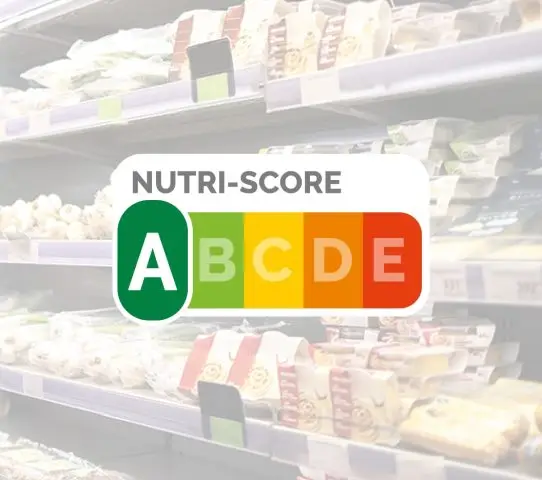
Nutri-Score is a front-of-package labeling system that gives a food a single letter grade, from A to E, to show its overall nutritional quality at a glance. The grade sits on the front of the pack on a colored scale that runs from dark green for the most favorable products through to red for the least favorable. The idea is simple: shoppers should be able to compare two similar products in a second or two, without reading the full nutrition panel on the back.
It is worth being clear from the start about what Nutri-Score is and is not. It does not replace the mandatory nutrition information on a product, such as the Nutrition Facts label in the United States or the nutrition declaration in Europe. It sits alongside that information as a quick visual summary, and in every country that uses it, displaying it is voluntary.
See How FoodLabelMaker Can Help You
How the Nutri-Score grade is calculated
Nutri-Score is based on a nutrient profiling model that scores a fixed amount of food, normally per 100 grams or 100 milliliters. The calculation weighs nutrients to limit against nutrients to encourage.
On the negative side, a product earns points for energy (calories), saturated fat, total sugars, and salt. The more it contains, the higher its negative score. On the positive side, it earns points for fiber, protein, and the proportion of fruits, vegetables, legumes, nuts, and certain oils. The negative points are offset by the positive points, and the final figure is mapped to a letter from A to E and its matching color.
In practice, foods that are higher in fiber and contain more fruits and vegetables, and lower in sugar, salt, and saturated fat, land closer to the green A end. Products high in sugar, salt, and saturated fat and low in those favorable components land closer to the red E end.
The formula was updated recently. A revised algorithm was rolled out for foods and then for drinks across 2023 and 2024, with the aim of better reflecting current dietary guidance. The update changed the grade of some products, for example tightening how sugary drinks and some fatty or salty foods are scored, so older comparisons of a product’s grade may no longer match its current one.
Where Nutri-Score is used
Nutri-Score was developed in France, building on a nutrient profiling model originally created for the UK Food Standards Agency. France officially recommended it in 2017, and several other European countries have since endorsed it, including Belgium, Germany, Luxembourg, the Netherlands, Spain, and Switzerland.
A key point that is widely misunderstood is that Nutri-Score is voluntary everywhere it operates. No country requires manufacturers to use it. Under current European Union rules, a member state cannot make a national front-of-package scheme like this mandatory, so brands choose whether to display it. Adoption also remains contested. Italy, for instance, has opposed Nutri-Score and backs an alternative system, and food industry groups across Europe have raised objections, so the picture continues to evolve.
How Nutri-Score compares to the US and Canadian labels
If you sell in North America, it helps to know how Nutri-Score relates to the systems you actually have to comply with, because they are different and easy to confuse.
In the United States, there is no Nutri-Score. In January 2025 the FDA proposed a front-of-package label of its own, which it calls the Nutrition Info box. Rather than a single letter, it would show the levels of saturated fat, sodium, and added sugars and rate each as “Low,” “Med,” or “High.” As of now this is a proposed rule, published under docket number FDA-2024-N-2910, and it is not finalized, so it is worth checking the FDA’s current status before relying on it.
Canada also does not use Nutri-Score. Canada finalized its own front-of-package rule that requires a “high in” symbol, a magnifying glass icon, on products that are high in saturated fat, sugars, or sodium. The compliance deadline for industry is January 1, 2026. So a Canadian product carries the “high in” symbol where applicable, not an A-to-E grade.
The takeaway is that Nutri-Score, the FDA’s proposed Nutrition Info box, and Canada’s “high in” symbol are three separate front-of-package approaches. Nutri-Score gives an overall grade, while the North American systems flag specific nutrients of concern.
The case for and against Nutri-Score
Supporters argue that a single, color-coded grade is easy to understand and helps people make quicker, healthier choices, and that it gives manufacturers an incentive to reformulate products to earn a better letter. Research has generally found it to be one of the more effective formats for helping shoppers judge nutritional quality quickly.
Critics counter that compressing a food’s nutrition into one letter is too simplistic, that it can penalize minimally processed traditional foods while some heavily processed products score well, and that it does not capture additives or the degree of processing. The 2023 to 2024 update was partly an attempt to address some of these concerns.
Where this leaves food businesses
For most US and Canadian brands, Nutri-Score is not something you will put on your packaging. What matters is getting your mandatory labeling right first, the Nutrition Facts label and ingredient and allergen declarations, and then keeping an eye on the front-of-package rules that do apply to your market, namely the FDA’s proposed Nutrition Info box in the US and the “high in” symbol in Canada.
That is where Food Label Maker helps. It generates accurate, regulation-compliant nutrition facts labels for the US, Canada, the EU, the UK, and more, so your core labeling is correct before you think about any front-of-package symbol.
Ready to get started? Create a free label here.