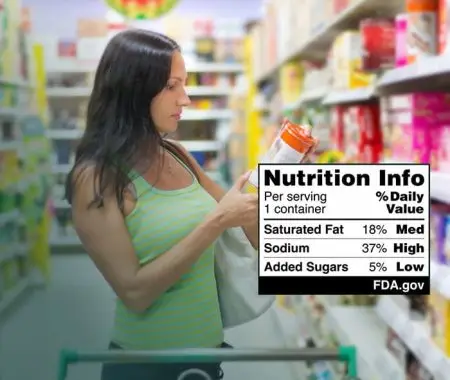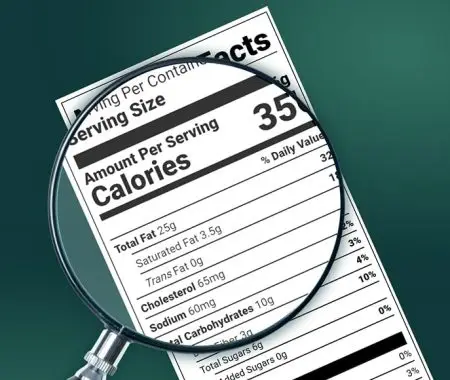
Navigating the intricate world of food labeling and the regulatory requirements that come with it can be a chNavigating the intricate world of food labeling and the regulatory requirements that come with it can be a challenging task.
With various claims that can be made about a product’s health benefits and nutritional content, it’s essential to understand the differences and implications of each. One of the most common dilemmas faced by producers is understanding the distinction between a health claim vs structure function claim. There are three primary types of FDA food label claims you will encounter: health claims, nutrient content claims, and structure/function claims. By the end, you’ll have a clearer understanding of each, ensuring that your product’s label is FDA compliant and informative.
See How FoodLabelMaker Can Help You
What Are FDA Food Label Claims?
FDA food label claims are statements that appear on food or dietary supplement packaging that go beyond the standard nutrition facts table. They are optional, but when a manufacturer chooses to include them, they must follow the FDA’s food labeling regulations under the Federal Food, Drug, and Cosmetic Act.
The FDA recognizes three distinct types of label claims:
- Health claims: Describe a food’s potential health benefits.
- Nutrient content claims: Highlight the level of specific nutrients in a product.
- Structure/function claims: Explain a nutrient or ingredient’s role in the body’s structure or function.
Each one serves a different purpose, communicates a different kind of information to consumers, and operates under its own set of regulatory requirements.
Food manufacturers, dietary supplement manufacturers, and anyone else responsible for a product label needs to understand which claim type applies to their product before any language goes on the packaging. Using the wrong claim type, or making a claim without meeting the applicable requirements, can result in a product being considered misbranded under FDA guidelines.
It is also worth noting that the FDA does not conduct pre-market label approval for most food products. That means the responsibility for getting claims right falls on the manufacturer. The sections below break down each claim type in detail, including what qualifies, what does not, and what the requirements are for each.
Summary Table: Health, Nutrient Content & Structure/Function Claims
| Claim Type | Description | Example | What It Is Not | Requirements |
| Health Claim | Describes the relationship between a food product and a reduced risk of a disease or health-related condition. | “Diets low in sodium may reduce the risk of high blood pressure.” | “Eating a balanced diet is important for overall well-being.” | Must be complete, truthful, and not misleading.Cannot be about the diagnosis, cure, mitigation, or treatment of diseases.Certain foods may be disqualified based on nutrient levels.The substance must have a taste, aroma, or nutrient value at the levels used. |
| Nutrient Content Claim | Characterizes the level of a specific nutrient in a food product. | “High in Vitamin C” | “Good for your health” | Must accurately represent the nutrient level.Should not be misleading.Must meet the FDA’s criteria for the specific claim. |
| Structure/Function Claim | Describes the role of a nutrient or ingredient concerning the structure or function of the human body. | “Calcium builds strong bones.” | “May reduce the risk of heart disease” | Should accurately represent the role of the nutrient or ingredient.Should not be misleading.Conventional food producers don’t need to notify the FDA or make disclaimers. |
In the landscape of food labeling, it’s crucial to discern between different types of claims. Health claims specifically highlight the relationship between a food product and its potential to reduce the risk of a disease or health condition. On the other hand, structure/function claims emphasize how a nutrient or ingredient affects the body’s structure or function.
For instance, while a health claim might suggest that low-sodium-diets can mitigate high blood pressure risks, a structure/function claim would underscore that calcium is instrumental in building strong bones.
Health Claims
Health claims are pivotal in food labeling as they describe the relationship between a food product and a reduced risk of a disease or a health-related condition. These claims can be made using words, images, or even references to third-party certifications.
Examples:
- “Diets low in sodium may reduce the risk of high blood pressure.”
- “Intake of calcium may support bone health.”
What it is not:
It’s essential to differentiate between health claims and general statements. For instance, “Eating a balanced diet is important for overall well-being” is not a health claim. Such statements are more about dietary guidance and don’t assert a reduced risk of a specific disease or health condition.
Types:
- Authorized Health Claims: These claims have been reviewed and approved by the FDA based on “significant scientific agreement.”
- Qualified Health Claims: These are claims supported by scientific evidence but don’t meet the “significant scientific agreement” standard. The FDA authorizes them with specific wording guidelines.
Requirements:
- Health claims must be complete, truthful, and not misleading.
- They cannot be about the diagnosis, cure, mitigation, or treatment of diseases.
- Certain foods may be disqualified from health claims based on nutrient levels deemed unhealthy.
- The substance that is the subject of the health claim must have a taste, aroma, or nutrient value when consumed at the levels used to justify the claim.
Authorized Health Claims
Authorized Health Claims describe a health claim that has been reviewed by the FDA and approved for use. There must be a robust scientific case for the FDA to issue an Authorized Health Claim. For instance, the claim “Eating soluble fiber from foods such as oatmeal, as part of a diet low in saturated fat and cholesterol, may reduce the risk of heart disease” is an example of an authorized health claim.
Qualified Health Claim
A Qualified Health Claim is a statement approved by the FDA for use on food labels that has strict wording requirements. When there’s emerging evidence between a food and the reduced risk of a disease or health condition, but not enough for the FDA to issue an Authorized Health Claim, the FDA may approve a “Qualified Health Claim”.
An example might be: “Some scientific evidence suggests that consumption of antioxidant vitamins may reduce the risk of certain forms of cancer.” However, the FDA has determined that this evidence is limited and not conclusive.
See How FoodLabelMaker Can Help You
Nutrient Content Claims
Nutrient content claims characterize the level of a specific nutrient in a food product. These claims are different from the information listed in the Nutrition Information Panel. Any claims made about nutrition outside of this panel are considered nutrient content claims.
Examples:
- “High in Vitamin C”
- “Low Fat”
- “Reduced Sodium”
What it is not:
It’s crucial to distinguish nutrient content claims from general health statements. For instance, “Good for your health” is not a nutrient content claim. Such statements are more general and don’t specify the nutrient level in the product.
Types:
- Absolute Claims: These claims describe a product’s nutrient level without comparing it to another product, e.g., “High Fiber.”
- Comparative Claims: These claims compare the nutrient levels of two or more products, e.g., “Reduced Fat compared to regular chips.”
Requirements:
- The claim must accurately represent the nutrient level in the product.
- It should not be misleading to consumers.
- The nutrient level should meet the FDA’s defined criteria for the specific claim being made.
Structure/Function Claims
Structure/function claims describe the role of a nutrient or ingredient concerning the structure or function of the human body. These claims can appear on the labels of foods, dietary supplements, or even drugs.
Examples:
- “Calcium builds strong bones.”
- “Fiber maintains bowel regularity.”
- “Antioxidants maintain cell integrity.”
What it is not:
It’s essential to differentiate structure/function claims from disease claims. For instance, “May reduce the risk of heart disease” outlines the difference between a health claim vs structure function claim.
Types:
- Claims of General Well-Being: These describe general well-being from consumption of a nutrient or ingredient.
- Nutrient-Deficiency Disease Claims: These describe a benefit related to a nutrient deficiency disease (such as vitamin C and scurvy).
Categories:
- General Well-Being Claims: Describe general well-being from consumption of a nutrient or ingredient.
- Nutrient-Deficiency Disease Claims: Describe a benefit related to a nutrient deficiency disease.
Requirements:
- The claim should accurately represent the role of the nutrient or ingredient.
- It should not be misleading to consumers.
- Conventional food producers do not need to notify the FDA about structure/function claims or make disclaimers associated with these claims on their product labels. However, producers of Dietary Supplements may face additional requirements.
Click here for a more in-depth guide on health claims according to the FDA Food Labeling Guide.
How to Choose the Right Claim for Your Product
The right claim depends on what you want to communicate and how much scientific evidence you have to support it.
If you want to highlight that a nutrient in your product may lower the risk of a disease or health condition, you are looking at a health claim. This requires FDA pre-authorization and the strongest level of scientific evidence. If the science exists but does not yet meet the significant scientific agreement standard, a qualified health claim may be an option, but it must include specific FDA-approved qualifying language.
If you want to call attention to the level of a nutrient in your product, such as being low in sodium or high in fiber, a nutrient content claim is the right fit. These describe the composition of the food without linking it to disease or body function.
If you want to explain what a nutrient does in the body, a structure/function claim is your most flexible option. For conventional food manufacturers, these do not require FDA pre-approval or a disclaimer.
A quick rule of thumb: if your claim mentions a disease or health condition, it needs FDA authorization. If it describes a nutrient level, it is a nutrient content claim. If it describes what a nutrient does in the body without referencing disease, it is a structure/function claim.
Common Mistakes Food Manufacturers Make with Label Claims
Even well-intentioned food manufacturers make errors with label claims, often because the lines between claim types aren’t always obvious. Here are the most frequent mistakes to watch out for.
Making Disease Claims Without FDA Authorization
The most serious mistake is placing a disease claim on a food or supplement label without FDA authorization. Statements like “prevents heart disease,” “reduces cancer risk,” or “treats high blood pressure” are not permitted unless the FDA has specifically authorized them as health claims.
Using this language can cause a product to be reclassified as a drug, triggering a completely different, and far more rigorous, regulatory pathway.
Confusing Structure/Function Claims with Health Claims
A structure/function claim that veers too close to disease language can quickly become a problem. “Supports healthy blood pressure” may be permissible as a structure/function claim, but “reduces the risk of hypertension” would be treated as a health claim. Manufacturers should review the FDA’s guidance on impermissible structure/function claim language before finalizing any label copy.
Skipping the Supplement Disclaimer
Dietary supplement manufacturers sometimes omit the required disclaimer from structure/function claims, or they place it in a location that is not clearly associated with the claim.
This is a compliance violation even if the underlying claim itself is substantiated and permissible. The disclaimer must appear on every label where a structure/function claim is made.
Using Nutrient Content Claim Language Without Meeting the Threshold
Terms like “high in,” “good source of,” “low,” “reduced,” and “free” each have specific FDA-defined criteria tied to nutrient levels per serving. Using these terms without meeting the applicable thresholds, even if the product is genuinely nutritious, is considered misbranding.
Manufacturers should verify that every nutrient content claim on their label aligns with the FDA’s Food Labeling Guide before going to market.
Final Thoughts: Health Claims vs. Nutrient Content vs. Structure/Function Claims
Understanding the difference between FDA health claims, nutrient content claims, and structure/function claims is one of the most important steps a food or supplement manufacturer can take toward building a compliant, trustworthy product label.
Each claim type serves a distinct purpose. Health claims link a food or nutrient to a reduced risk of disease and require FDA authorization. Nutrient content claims describe the nutrient levels in your product using defined, permissible terms. Structure/function claims explain what a nutrient does in the body and offer the most flexibility for conventional food manufacturers.
Getting these distinctions right protects your product from being considered misbranded, keeps you on the right side of FDA regulations, and builds consumer confidence in what you are selling. Getting them wrong can be costly.
Whether you are finalizing your first product label or auditing an existing one, Food Label Maker is built to help you navigate FDA food labeling requirements with confidence. Create a FDA compliant food label or view our pricing plans to get started today.
Frequently Asked Health Claims vs. Nutrient Content vs. Structure/Function Questions
How are structure/function claims different from health claims?
Health claims describe a relationship between a food or nutrient and a reduced risk of a specific disease or health condition, and they require FDA pre-authorization before they can appear on a label.
Structure/function claims describe how a nutrient or ingredient supports the body’s normal structure or function, without making any reference to disease.
The distinction comes down to disease. “Calcium may reduce the risk of osteoporosis” is a health claim. “Calcium builds strong bones” is a structure/function claim. One word or phrase can be the difference between a claim that needs FDA authorization and one that does not.
Ready to make sure your label claims are compliant? Create a label on Food Label Maker.
Do structure/function claims need FDA approval?
For conventional food manufacturers, structure/function claims do not require FDA pre-approval, and no disclaimer is needed on the product label. This makes them the most accessible claim type for food brands looking to communicate health benefits without going through a lengthy authorization process.
Dietary supplement manufacturers face additional requirements. They must notify the FDA within 30 days of first marketing a product with a structure/function claim, and must display a disclaimer on the label stating that the claim has not been evaluated by the FDA. In both cases, the claim must be truthful, not misleading, and supported by credible scientific evidence.
Need help getting your structure/function claims right? Sign up to try Food Label Maker’s label generator and see how easy compliant labeling can be.
What is the difference between a health claim vs structure function claim?
Health claims and structure/function claims both appear on food and supplement labels, but they have very different regulatory requirements.
Health claims describe a relationship between a food or nutrient and a reduced risk of disease. For example: “Diets low in saturated fat and cholesterol may reduce the risk of heart disease.” Unlike health claims made on conventional foods, which require FDA pre-authorization through a health claim petition or an authoritative statement, such claims carry a high evidentiary burden and strict approval process.
Structure/function claims describe how a nutrient supports normal body structure or function without mentioning disease. For example: “Calcium builds strong bones” or “Fiber supports digestive health.” These claims do not require FDA pre-approval, though dietary supplements must notify the FDA within 30 days of marketing and include a disclaimer stating that the claim has not been evaluated by the FDA.
The key difference: health claims link to disease risk reduction and require authorization. Structure/function claims describe normal body functions and do not require authorization.
For a complete breakdown of supplement-specific claim requirements, see our guide to FDA dietary supplement claims.

Related Posts