Introduction: Mastering FDA Net Weight Labeling for Compliance and Trust
In the food and beverage sector, precise packaging is paramount, with net weight labeling standing out as a critical component. The Food and Drug Administration (FDA) sets strict guidelines for net weight labeling, ensuring that consumers receive accurate information about the product quantity.
Adherence to these requirements, like all other features of product labeling, ensures you meet legal standards, upholds your brand’s integrity, and fosters consumer reliance on your product information. This guide aims to demystify the FDA net weight labeling requirements, whether you are a well-established entity in the F&B industry or a newcomer aiming to make your mark.
Our software can help you master every aspect of FDA food labeling. To get started, see our pricing and generate a nutrition label using our tool.
See How FoodLabelMaker Can Help You
TLDR
- Net Weight Significance: ‘Net weight’ is crucial for F&B manufacturers. It ensures FDA compliance and maintains transparency. It represents the product’s weight, excluding packaging.
- FDA Regulations on Net Weight Labeling: Following FDA guidelines is essential. It ensures compliance and builds consumer trust. Key aspects include proper display, font size requirements, and labeling for random weight items.
- Accuracy in Net Weight Labeling: Accurate FDA net weight labeling is vital. It builds consumer trust and maintains brand integrity. Inaccuracies can lead to legal issues, including fines and product recalls.
FDA vs. USDA Regulations: Their regulations can overlap, creating a complex landscape for businesses. Resources like Food Label Maker offer guidance and ensure compliance.
Defining Net Weight on Food Packaging
Understanding the term ‘net weight’ or ‘net quantity of content’ is crucial for food and beverage manufacturers aiming to comply with FDA regulations and maintain transparency with consumers. Net weight refers to the weight of the product itself, excluding any packaging materials. It’s a direct measure of the quantity of the product that the consumer can use, making it a vital piece of information for purchasing decisions.
It’s important to distinguish net weight from other weight-related terms:
- Gross Weight: This includes the total weight of the product and its packaging. While useful for shipping and handling purposes, it does not provide clear information to the consumer about the quantity of the product itself.
- Drained Weight: Used primarily for products packed in a liquid (e.g., canned fruits or vegetables), drained weight refers to the weight of the product once the liquid has been drained.
It’s also important to note that the term “Net Weight” or “Net Wt.” relates to content in terms of weight, whereas “Net Content” refers to whether it was a liquid quantity. Understanding these distinctions ensures that your product labeling is clear, accurate, and compliant with FDA regulations, ultimately building trust with your consumers.
Latest FDA Regulations on Net Weight Food Labels
The FDA has established comprehensive guidelines to ensure that net weight is accurately and clearly displayed on food and beverage products. Adherence to these regulations is crucial for maintaining compliance and consumer trust.
Principal Display Panel (PDP) Rules
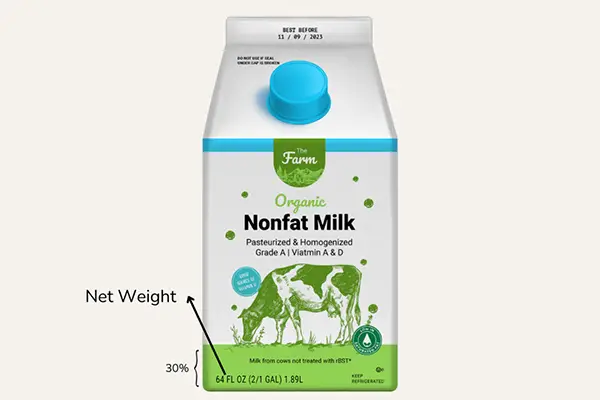
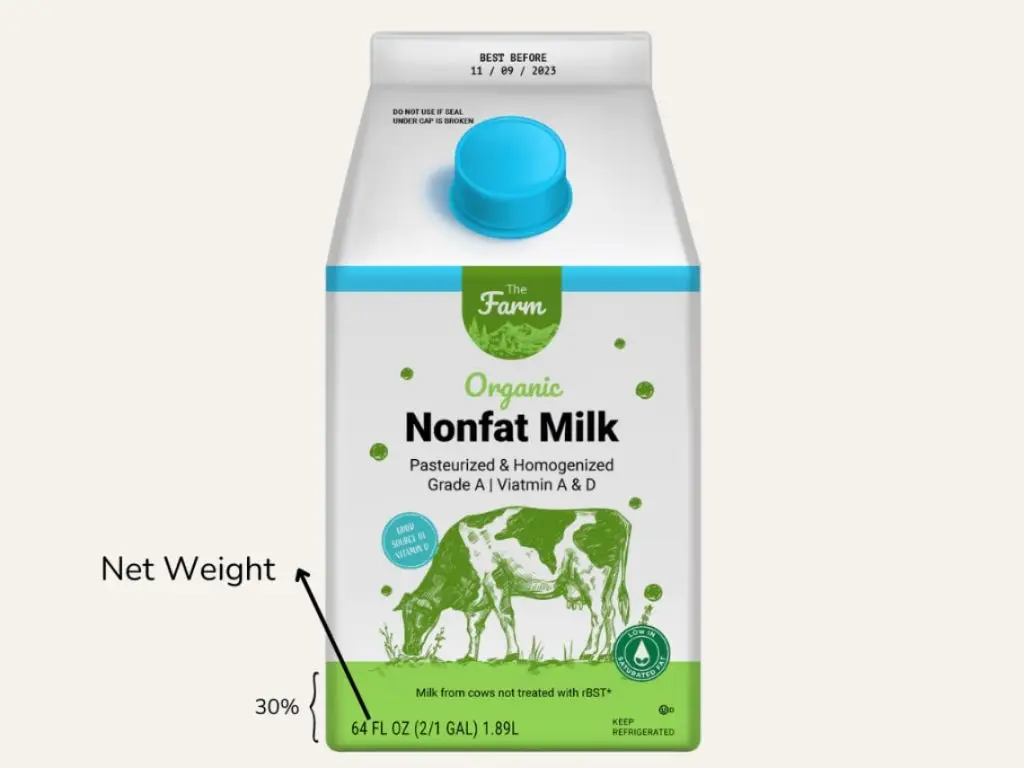
The net weight must be displayed on the principal display panel (PDP) of the product packaging. The principal display panel is the part of the label that is most likely to be seen by the consumer at the time of purchase. The net weight should be placed in the bottom 30% of the PDP, and the font size must be large and legible enough to be easily readable, with specific size requirements depending on the area of the PDP.
Labeling Exemptions Based on Package Size
Certain small packages may be exempt from some of the standard FDA net weight labeling requirements. For example, packages with a principal display panel of less than five square inches may have less stringent requirements for font size. However, even these small packages must provide net weight information clearly and conspicuously.
Bulk containers or wholesale products intended for further processing do not necessitate a net weight statement. However, if one is present, it must be accurately placed on the principal display panel, representing the net quantity of contents.
Requirements for Random Weight Items
Items that are not sold in a predetermined weight must still comply with FDA net weight labeling requirements. These random-weight items, often found in the deli or meat sections of grocery stores, must have their net weight determined at the point of sale and clearly displayed on the packaging.
Guidelines for Dual Declaration
The FDA requires that net weight be declared in both U.S. customary (pounds and ounces) and metric (grams or kilograms) units. This dual declaration ensures that all consumers, regardless of their familiarity with a particular measurement system, can understand the quantity of the product they are purchasing.
By adhering to these latest FDA regulations on net weight labeling, food and beverage manufacturers can ensure that their products comply, maintain consumer trust, and avoid potential legal issues. Whether you are a seasoned player in the industry or just starting out, understanding and implementing these guidelines is key to your product’s success on the shelves.
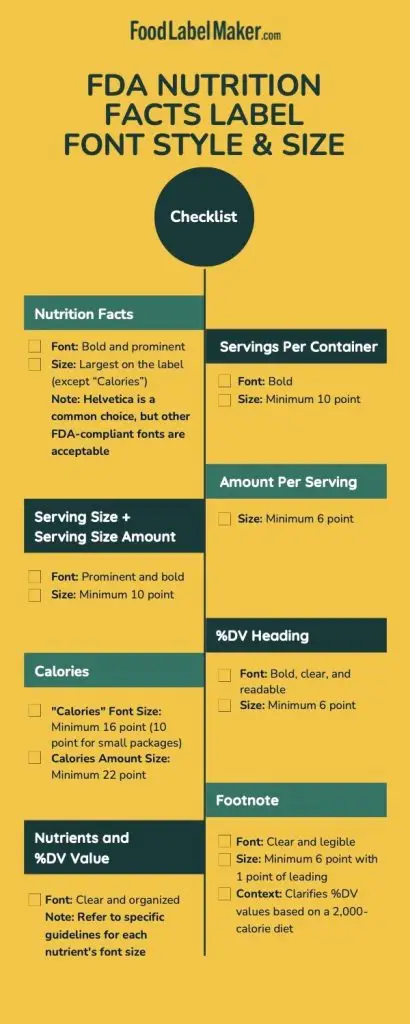
Download this checklist to determine whether you have followed the correct FDA standards for your nutrition facts label, or view Food Label Maker’s pricing plans to start creating your next food label.
Why Net Weight Labeling Matters: Food Safety & Consumer Transparency
Accurate net weight measurements are fundamental to food safety protocols. When manufactured foods undergo quality control, weigh scale integration (the connection of digital scales to inventory management software) with ERP systems helps track the actual quantity throughout production.
Tare weight calculations (subtracting the weight of containers and packaging materials from the total weight) account for glass or plastic surfaces and additional materials to ensure the declaration of net quantity reflects exactly how much product consumers receive. This precision in weight measurements protects against regulatory penalties and supports customer satisfaction by guaranteeing the packaged form contains the stated amount.
Whether a product is sold by count, volume, or weight, clear labeling helps consumers distinguish between weight ounces and fluid ounces – a vital distinction for liquid products and packaged goods.
Importance of Accuracy in Net Weight Labeling
Ensuring the accuracy of net weight labeling is paramount for maintaining consumer trust and upholding the integrity of your brand. When customers pick up a product, they rely on the information provided on the label to be truthful and precise. Accurate net weight labeling guarantees that consumers are getting exactly what they pay for, so they will trust your brand more and find it more reliable.
However, the stakes are high, as inaccuracies in net weight labeling can lead to severe legal implications. The FDA is vigilant in enforcing its labeling regulations, and any deviation can result in hefty fines, product recalls, and damage to your brand’s reputation. It is crucial to stay updated on the FDA’s net weight labeling requirements and ensure that your products comply to avoid these potential pitfalls and maintain a trustworthy relationship with your consumers.
The Intersection of USDA and FDA in Weight Regulations
While the FDA plays a significant role in regulating net weight labeling for food products, it’s important to understand that the United States Department of Agriculture (USDA) also has a stake in this area, particularly for products under its jurisdiction.
The USDA enforces its own set of regulations to ensure accurate weight labeling and prevent economic fraud. These regulations are in place to protect consumers and ensure fair competition among producers. In some cases, the regulations set by the USDA and FDA can overlap, creating a complex regulatory landscape for businesses to navigate.
USDA Regulations for Net Weight and Net Weight Labeling:
Here are some of the USDA’s regulations regarding net weight and net weight labeling:
- Net Weight Statement: The USDA requires that the net weight of a product be accurately stated and prominently displayed on the label. The net weight excludes the weight of any packaging material.
- Placement: The net weight statement should be placed on the principal display panel of the package.
- Font and Size: The USDA has specific requirements for the font and size of the net weight statement, ensuring it is easily readable.
- Bulk Containers: For bulk containers or wholesale products, such as combo bins for further processing, a net weight statement is not required. However, if a net weight statement is present, it must be accurate and placed on the principal display panel.
- Random Weight Items: Individual catch weight or random weight items are not required to have a net weight statement. However, the shipping container for these products must bear a net weight statement.
- Dual Declaration: The USDA requires a dual declaration of net weight in both U.S. customary and metric units.
FDA Guidelines for Net Weight and Net Weight Labeling:
The FDA oversees all other food products not regulated by the USDA. Here are some of their guidelines, some of which we have mentioned already:
NetContents:
The FDA requires that the net quantity of contents be stated in terms of weight, measure, or numerical count.
Placement:
The net quantity of contents must be placed on the principal display panel, in the bottom 30% of the package.
Font and Size:
The FDA has specific requirements for the font size, depending on the area of the principal display panel.
Dual Declaration:
The FDA also requires dual declaration of net quantity in both U.S. customary and metric units.
Scope:
The USDA regulates meat, poultry, and egg products, while the FDA regulates all other food products.
Specific Regulations:
The USDA has specific regulations for bulk containers and random-weight items, which are not explicitly mentioned in FDA guidelines.
Labeling of Meat and Poultry:
The USDA has more stringent labeling requirements for meat and poultry products compared to other food products regulated by the FDA.
How Food Label Maker Aids Accurate Weight Labeling
Food Label Maker is an indispensable tool for ensuring precise weight labeling on your food and beverage products. It simplifies the complex process of adhering to FDA and USDA guidelines by providing a user-friendly platform tailored for accuracy and compliance.
Its comprehensive database and intuitive design assist in generating labels that accurately reflect the net weight of your products so that all necessary information is clear, visible, and meets regulatory standards.
Our tool ensures that your labels are in strict adherence to legal requirements, safeguarding your brand’s reputation and fostering consumer trust. To see our tool in action, create a nutrition label for free or view our pricing plans for a complete solution.
Frequently asked questions about FDA Net Weight Labeling
What are the FDA requirements for net weight labeling?
The FDA requires the net weight to be displayed on the principal display panel in the bottom 30% of the package. It must be declared in both U.S. customary units (pounds and ounces) and metric units (grams or kilograms). Font size requirements vary based on the area of the principal display panel to ensure readability.
The net weight must represent only the product itself, excluding all packaging materials. Small packages with a principal display panel less than five square inches may have modified font size requirements, but must still display net weight clearly.
Food Label Maker automatically formats your net weight declarations to meet all FDA requirements, ensuring perfect compliance every time. Sign up for free to try our tool out or view our pricing plans to get started right away.
How to put net weight on a label?
To properly place net weight on a label, position it in the bottom 30% of the principal display panel; the part of the packaging most visible to consumers at purchase. Use a font size that meets FDA requirements based on your panel’s area.
Include both U.S. customary and metric measurements, such as “Net Wt. 16 oz (454g).” Ensure the declaration is clear, prominent, and easily readable against the background. The weight should exclude all packaging materials and represent only the actual product quantity.
Food Label Maker simplifies this process by automatically positioning and formatting net weight declarations according to FDA specifications, saving you time and ensuring accuracy. Generate a nutrition facts label to test this feature or sign up today.
Does net weight have to be exact?
While net weight should be as accurate as possible, the FDA recognizes that minor variations can occur due to factors like moisture loss, settling, or manufacturing tolerances.
However, labels must reflect the actual net weight at the time of packaging, and systematic underweight violations can result in regulatory action, fines, or product recalls. Manufacturers must implement quality control measures to ensure compliance with net weight declarations. Random sampling and testing help verify accuracy throughout production runs. Intentional or consistent underweight packaging violates FDA regulations and damages consumer trust.
Food Label Maker helps you maintain accurate weight labeling by providing tools that ensure your declarations match your actual product quantities. Try our nutrition label software or view our pricing plans to get started.
What is net weight and does it include packaging?
Net weight represents the weight of the product alone, completely excluding all packaging materials such as containers, boxes, wrappers, bottles, or cans. This distinction is crucial for consumer transparency, as shoppers rely on the net weight declaration to determine the actual quantity of usable product they are purchasing.
In contrast, gross weight includes both the product and its packaging combined, while drained weight may be required for products packed in liquid (like canned vegetables) to show the weight after the liquid is removed.
On product packaging, the net weight must appear on the principal display panel in both U.S. customary units (ounces, pounds) and metric units (grams, kilograms), or fluid measures for liquids.
Because these declarations are strictly regulated by the FDA to ensure accuracy across brands, proper labeling is essential to building consumer trust and avoiding regulatory issues.
Food Label Maker ensures your labels clearly display accurate net weight that complies with all FDA requirements. Sign up today for an account and ensure your packaging remains transparent and compliant.
Net weight vs. gross weight: what’s the difference?
Net weight is the weight of the product alone, excluding all packaging materials, and is the measurement consumers use to determine actual product quantity. Gross weight includes everything, both the product and all packaging materials combined, making it primarily useful for shipping, logistics, and inventory management rather than consumer information.
For example, a jar of jam might have a net weight of 12 oz (the jam itself) but a gross weight of 18 oz (jam plus glass jar and lid). FDA regulations require only net weight to be displayed on consumer packaging because it provides the most accurate and useful information for purchasing decisions.
Food Label Maker helps you calculate and display the correct net weight on your labels, ensuring FDA compliance and consumer clarity. Try our nutrition label software today or view our pricing to see which plan fits your business.

Related Posts