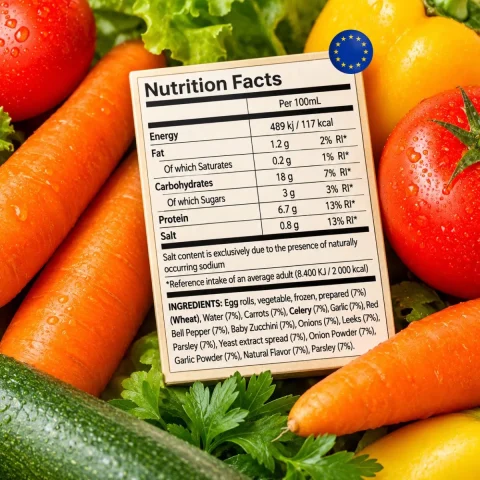
An EU nutrition label, officially called the nutrition declaration, is a table that lists energy in kJ and kcal, fat, saturates, carbohydrate, sugars, protein and salt per 100 g or 100 ml, in that exact order. Almost every prepacked food sold in the EU needs one. The format is set by EU law, so the same template works in every member state, translated into the local language.
This guide walks through the EU template line by line, what you can add to it, how front-of-pack labels like Nutri-Score work, and how to create your own EU label from your recipe.
Selling your food in the EU?
What Goes on an EU Nutrition Label?
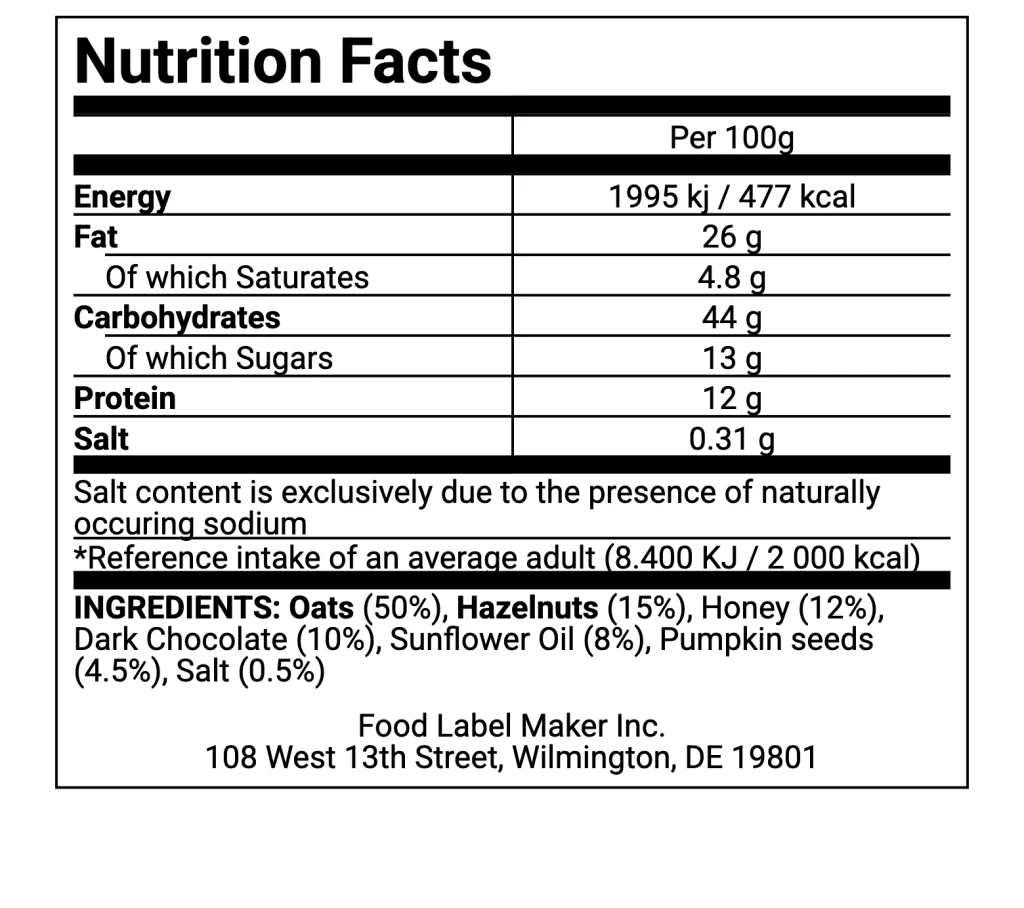
An EU nutrition label shows seven mandatory items in a fixed order: energy, fat, saturates, carbohydrate, sugars, protein and salt, all per 100 g or 100 ml. The EU’s food information regulation sets the order, the names and the units, so every EU nutrition label follows the same template.
The nutrition declaration is one of several items every EU food label needs. Our guide to mandatory food information in the EU covers the rest, including the ingredient list, allergens and date marking.
What Are the Mandatory Nutrients on an EU Nutrition Label?
Every EU nutrition label lists these seven items, in this order and with these units.
| Order | Nutrient | Unit | What it includes |
| 1 | Energy | kJ and kcal | Both units are required, with kJ shown first |
| 2 | Fat | g | Total lipids, including phospholipids |
| 3 | of which saturates | g | Fatty acids with no double bond |
| 4 | Carbohydrate | g | Carbohydrates the body digests, including polyols. Fibre goes on its own optional line |
| 5 | of which sugars | g | All monosaccharides and disaccharides, excluding polyols |
| 6 | Protein | g | Calculated as total nitrogen × 6.25 |
| 7 | Salt | g | Calculated as sodium × 2.5, including sodium that occurs naturally in the food |
Source: Regulation (EU) No 1169/2011, Annex I and Annex XV
How Should an EU Nutrition Label Be Laid Out?
The EU nutrition label is a table with the numbers lined up in one column, and a few layout rules apply to every product.
- Per 100 g or 100 ml: declare every value per 100 g for solid foods or per 100 ml for liquids. Values per portion are optional extras.
- Table format: use a table with the numbers aligned whenever the pack has room. Very small packs can use a linear format, covered further down.
- Fixed order and names: keep the seven items in the order above, with saturates and sugars as “of which” sub-rows.
- Local language: write the label in a language consumers in each member state where it’s sold can easily understand, as set out on Your Europe’s nutrition declaration page.
- No added sugars line: the EU label shows total sugars only.
What Can You Add to an EU Nutrition Label?
You can add values per portion, % reference intakes and a set list of extra nutrients to the EU nutrition label, as long as the mandatory values per 100 g or 100 ml stay on it. The European Commission’s nutrition labelling page notes that this extra information can’t take up the space needed for the mandatory items.
How to Show Nutrition Values per Portion
You can add a per portion column next to the per 100 g or 100 ml column whenever the portion is stated on the label.
- Keep the per 100 g column: per portion values go alongside it, with per 100 g staying on the label.
- Name the portion: state the portion size in grams or millilitres, such as “per 50 g portion.”
- Give the count: state how many portions are in the pack.
These conditions come from the EU’s rules on per portion values.
How to Show % Reference Intake (%RI) on an EU Label
%RI shows how much of an average adult’s daily intake one 100 g or one portion provides, and it’s optional for energy and the six mandatory nutrients. When you use it, the label also needs the statement “Reference intake of an average adult (8 400 kJ/2 000 kcal)” close to the values.
| Nutrient | Reference intake (average adult) |
| Energy | 8 400 kJ / 2 000 kcal |
| Fat | 70 g |
| Saturates | 20 g |
| Carbohydrate | 260 g |
| Sugars | 90 g |
| Protein | 50 g |
| Salt | 6 g |
Source: Regulation (EU) No 1169/2011, Annex XIII Part B
Vitamins and minerals use nutrient reference values (NRVs) in place of these numbers, and any vitamin or mineral you declare must show its % NRV. Our guide to EU nutrient reference values lists every NRV.
Which Nutrients Can You Add to an EU Nutrition Label?
The EU allows six extra items on the nutrition label, and each one has a fixed place in the table.
| Voluntary item | Where it goes in the table | When it becomes mandatory |
| of which mono-unsaturates | Under saturates | When you make a nutrition or health claim about it |
| of which polyunsaturates | Under mono-unsaturates | When you make a nutrition or health claim about it |
| of which polyols | Under sugars | When you make a nutrition or health claim about it |
| of which starch | Under polyols | When you make a nutrition or health claim about it |
| Fibre | After carbohydrate and its sub-rows, before protein | When you make a nutrition or health claim about it, such as “high fibre” |
| Vitamins and minerals | After salt, with % NRV | When you make a claim about them or add them to fortify the food |
Source: Regulation (EU) No 1169/2011, Article 30 and Annex XV
A vitamin or mineral can only be declared when the food contains a significant amount of it. That means at least 15% of its NRV per 100 g or 100 ml (7.5% per 100 ml for drinks), or 15% per portion when the pack holds a single portion. Our guide to voluntary nutrition information in the EU covers how to present these extras.
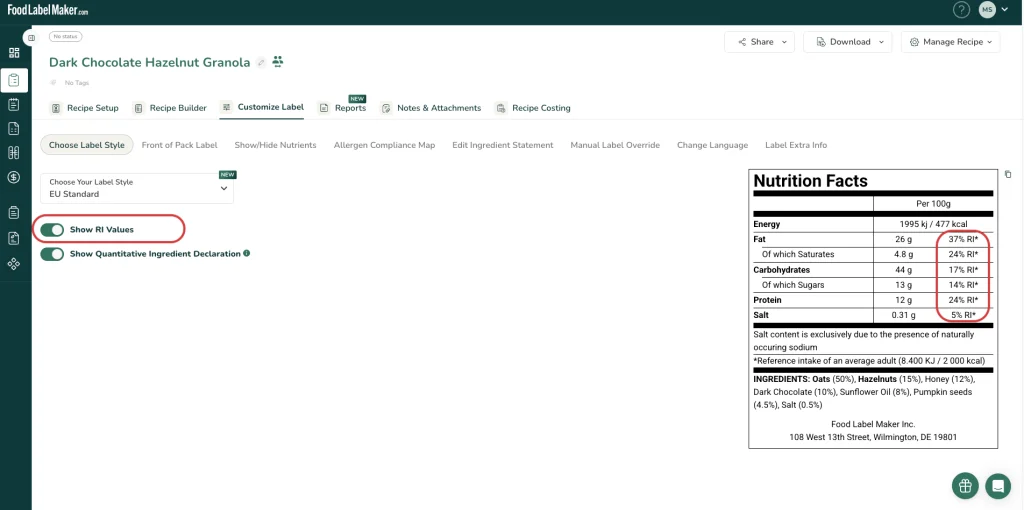
In Food Label Maker, turn on Show RI Values under Customize Label > Choose Label Style. This adds the %RI column and the reference intake statement to your EU label.
What Is Nutri-Score?
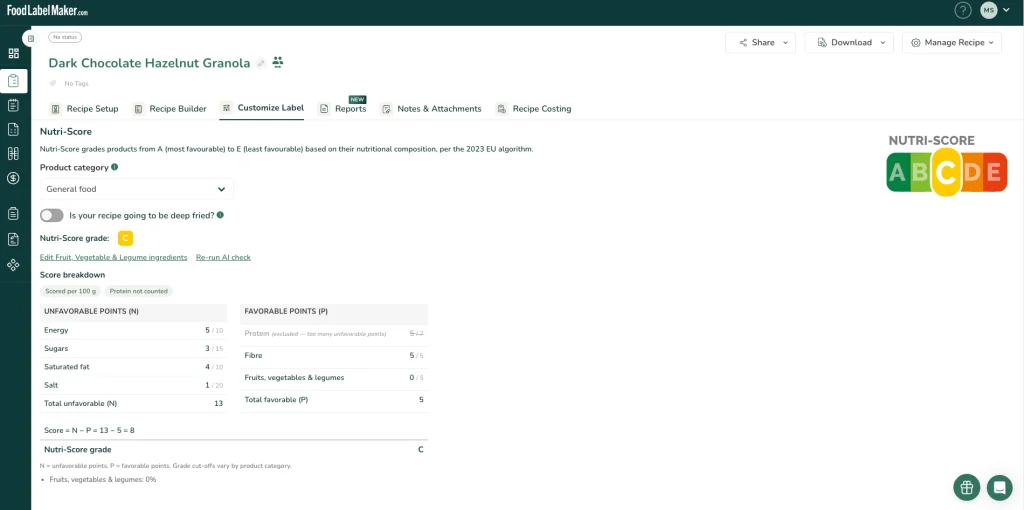
Nutri-Score is a voluntary front-of-pack label that grades a food from A (most favourable) to E (least favourable) based on its nutritional composition per 100 g or 100 ml. It’s used in France, Belgium, Spain, Germany, the Netherlands and Luxembourg, and in Switzerland outside the EU. EU law leaves front-of-pack designs to each country, and the European Parliament’s tracker shows that no proposal for one mandatory EU-wide front-of-pack label has been tabled.
How Is Nutri-Score Calculated?
Nutri-Score subtracts favourable points from unfavourable points per 100 g or 100 ml, and the final score sets the letter grade.
| Points | Nutrient | Maximum points |
| Unfavourable (N) | Energy | 10 |
| Unfavourable (N) | Sugars | 15 |
| Unfavourable (N) | Saturated fat | 10 |
| Unfavourable (N) | Salt | 20 |
| Favourable (P) | Fibre | 5 |
| Favourable (P) | Protein | 7 |
| Favourable (P) | Fruits, vegetables and legumes | 5 |
Source: Santé publique France, Nutri-Score questions and answers
- Protein cap: for general foods, protein isn’t counted when unfavourable points reach 11 or more.
- Adapted rules: drinks, cheese, red meat, and fats, oils, nuts and seeds have their own versions of the calculation.
- Example: the granola above scores 13 unfavourable points and 5 favourable points, for a final score of 8 and a grade C.
How to Use Nutri-Score on Your Labels
Brands that want to use Nutri-Score register first and then apply it across their range.
- Register: brands sold only in France register on the French registration site. Brands sold in several countries, or in Germany, Belgium or Luxembourg, use the international registration procedure.
- Use it on the whole brand: once a brand uses Nutri-Score, it applies to all of that brand’s food categories within 24 months (36 months for retailers’ own brands).
- Use the updated algorithm: the updated calculation took effect on January 1, 2024 in Germany, Belgium, the Netherlands and Switzerland, on March 5, 2024 in Luxembourg, and on March 16, 2025 in France, with a 24-month transition for some products.
Source for these rules: Santé publique France’s Nutri-Score questions and answers (version of March 17, 2025).
In Food Label Maker, open Customize Label > Front of Pack Label, choose your product category, and the app calculates your Nutri-Score from your recipe, with a full breakdown of the points behind the grade.
Want to know your product’s Nutri-Score?
Other EU Front-of-Pack and Small Package Formats
Besides Nutri-Score, EU rules allow three other options: repeating key nutrition values on the front of the pack, other national front-of-pack schemes, and a linear format for packs too small for a table.
How to Repeat Nutrition Information on the Front of Pack
You can repeat either energy alone, or energy plus fat, saturates, sugars and salt, on the front of the pack.
- Two options only: the EU’s food information regulation allows energy alone, or energy with fat, saturates, sugars and salt. Other nutrients, such as carbohydrate or protein, can’t be repeated on the front.
- Energy per 100 g: energy must appear per 100 g or 100 ml at a minimum, as FSAI’s nutrition labelling guide explains. The other values can also be given per portion.
- Full table stays: the front-of-pack values are a repeat. The full nutrition label still goes on the pack.
- %RI on the front: if you show %RI, the reference intake statement goes with it.
Our guide to EU front-of-pack nutrition labels covers where the EU stands on a single front-of-pack scheme.
Which Other Front-of-Pack Labels Are Used in Europe?
Several European countries have their own voluntary front-of-pack schemes, and each one is used alongside the mandatory nutrition label.
| Scheme | Where it’s used | How it works |
| NutrInform Battery | Italy | Shows energy, fat, saturates, sugars and salt per portion as a share of daily intake, in one colour |
| Multiple Traffic Lights | UK and Ireland | Red, amber and green for high, medium and low levels of fat, saturates, sugars and salt |
| Keyhole | Denmark, Sweden, Norway, Iceland, Lithuania | A logo marking a product as a healthier choice in its category |
| Heart Symbol | Finland | A logo for healthier choices, mainly based on salt and fat |
| Healthy Living logo | Croatia | A logo based on EU reference intakes |
| Protective Food logo | Slovenia | A logo for healthier choices within a category |
Source: FoodNavigator, Europe’s front-of-pack labelling schemes explained (August 2026)
For the UK traffic light format, see our guide to UK back-of-pack and front-of-pack labels.
When Can You Use a Linear EU Nutrition Label?
You can show the nutrition label as a single line of text when the pack is too small for a table.
- Space is the only reason: FSAI notes that the linear format can’t be used to free up room for marketing text.
- Same content: the linear format keeps the same nutrients, order and units as the table.
- Very small packs: foods in packaging whose largest surface is smaller than 25 cm² are exempt from the nutrition label altogether, under Annex V of the EU’s food information regulation.
EU Nutrition Label Rules to Check Before You Print
Before an EU nutrition label goes to print, check four things: how energy was calculated, how each value is rounded, how salt was worked out, and the size of the text.
How to Calculate Energy for an EU Nutrition Label
EU labels calculate energy from each nutrient using fixed conversion factors, and fibre counts towards the total.
| Component | kJ per gram | kcal per gram |
| Fat | 37 | 9 |
| Carbohydrate (except polyols) | 17 | 4 |
| Protein | 17 | 4 |
| Fibre | 8 | 2 |
| Polyols | 10 | 2.4 |
| Alcohol (ethanol) | 29 | 7 |
| Organic acid | 13 | 3 |
| Salatrims | 25 | 6 |
| Erythritol | 0 | 0 |
Source: Regulation (EU) No 1169/2011, Annex XIV
How to Round Values on an EU Nutrition Label
The European Commission’s guidance sets how far to round each value, based on how much of the nutrient is in 100 g or 100 ml.
| Item | Amount per 100 g or 100 ml | Round to |
| Energy | Any | Nearest 1 kJ and 1 kcal |
| Fat, carbohydrate, sugars, protein, fibre, polyols, starch | 10 g or more | Nearest 1 g |
| Fat, carbohydrate, sugars, protein, fibre, polyols, starch | More than 0.5 g and less than 10 g | Nearest 0.1 g |
| Fat, carbohydrate, sugars, protein, fibre, polyols, starch | 0.5 g or less | “0 g” or “<0.5 g” |
| Saturates, mono-unsaturates, polyunsaturates | 10 g or more | Nearest 1 g |
| Saturates, mono-unsaturates, polyunsaturates | More than 0.1 g and less than 10 g | Nearest 0.1 g |
| Saturates, mono-unsaturates, polyunsaturates | 0.1 g or less | “0 g” or “<0.1 g” |
| Salt | 1 g or more | Nearest 0.1 g |
| Salt | More than 0.0125 g and less than 1 g | Nearest 0.01 g |
| Salt | 0.0125 g or less | “0 g” or “<0.01 g” |
Source: European Commission guidance on tolerances and rounding for nutrition labelling
The same guidance sets how far a declared value can differ from a lab result. Our guide to EU nutrition labelling tolerances explains those limits.
How to Calculate Salt From Sodium
Salt on an EU label is the total sodium in the food multiplied by 2.5, which includes sodium that occurs naturally in the ingredients.
- Formula: salt (g) = sodium (g) × 2.5, as defined in Annex I of the EU’s food information regulation.
- Products with no added salt: these can carry a statement next to the table saying the salt content comes only from naturally occurring sodium.
- Products with added salt: these use the standard “Salt” line with no extra statement.
What Is the Minimum Text Size on an EU Nutrition Label?
Text on the nutrition label needs an x-height of at least 1.2 mm, or 0.9 mm on packs whose largest surface is smaller than 80 cm². X-height is the height of a lowercase “x” in the font, as set out in the EU’s food information regulation.
How Is an EU Nutrition Label Different From a US Label?
EU labels give values per 100 g or 100 ml and list salt, while US labels give values per serving and list sodium. Brands that sell in both markets need a separate label for each.
| EU nutrition label | US Nutrition Facts label | |
| Values based on | Per 100 g or 100 ml (per portion optional) | Per serving, with servings per container |
| Energy | kJ and kcal | Calories (kcal) only |
| Fat | Fat, of which saturates | Total Fat, Saturated Fat, Trans Fat |
| Cholesterol | Not required | Required |
| Carbohydrate | Excludes fibre | Total Carbohydrate includes dietary fiber |
| Fibre | Optional | Required |
| Sugars | Total sugars only | Total Sugars and Added Sugars |
| Salt or sodium | Salt in g (sodium × 2.5) | Sodium in mg |
| Vitamins and minerals | Optional unless claimed or added | Vitamin D, calcium, iron and potassium required |
| Daily intake reference | %RI optional | %DV required |
| Layout | Table, or linear on small packs | Fixed FDA design with set type sizes and bars |
Source: Regulation (EU) No 1169/2011 and FDA’s Nutrition Facts label rules
For the US side, see our FDA Nutrition Facts label templates, which cover every US format.
How to Create an EU Nutrition Label in Food Label Maker
Food Label Maker builds your EU nutrition label from your recipe. The values per 100 g, the salt calculation and the Nutri-Score all come from the ingredients you enter.
- Create a free account. Sign up at Food Label Maker and start a new recipe.
- Set up your recipe. Enter the recipe name, the number of packages the batch makes and the servings per package.
- Add your ingredients. Add each ingredient with the amount you use. Food Label Maker then calculates the nutrition values per 100 g.
- Choose the EU label style. Go to Customize Label > Choose Label Style and select EU Standard. Turn on Show RI Values to add %RI, and Show Quantitative Ingredient Declaration to add ingredient percentages, as explained in our guide to EU QUID rules.
- Add Nutri-Score. Open Customize Label > Front of Pack Label and choose your product category to calculate your grade.
- Download your label. Click Download, choose the EU Standard Label Format, tick the parts you need (such as the ingredient list, allergen statement and Front of Pack Label), and pick a file type such as PNG, PDF or SVG.
Ready to label your product for the EU?
Frequently Asked Questions About EU Nutrition Labels
1. Does every food sold in the EU need a nutrition label?
Most prepacked foods need one, and Annex V of the EU’s food information regulation lists the exemptions. These include unprocessed single-ingredient foods, water, herbs and spices, salt, tea and coffee, vinegar, food additives, and foods in packaging whose largest surface is smaller than 25 cm². Small quantities of food supplied directly by the maker to consumers or to local shops are also exempt.
2. Does Europe require all ingredients to be listed?
Yes. Prepacked foods sold in the EU list every ingredient in descending order of weight, and the 14 major allergens are emphasised in the list, for example in bold. A few foods are exempt, such as fresh fruit and vegetables and single-ingredient foods whose name identifies the ingredient. Our guide to mandatory food information in the EU covers the full list of label items.
3. What do EU labels use instead of a serving size?
EU nutrition labels give every value per 100 g or 100 ml, which makes products easy to compare. You can add values per portion as well, as long as you state the portion size and the number of portions in the pack.
4. What do EU labels use instead of % Daily Value?
EU labels can show % reference intake (%RI), based on an average adult’s intake of 8 400 kJ/2 000 kcal. %RI is optional for energy and the main nutrients. Any vitamin or mineral you declare shows its % of the nutrient reference value.
5. Is Nutri-Score mandatory in the EU?
Nutri-Score is voluntary. It’s used in France, Belgium, Spain, Germany, the Netherlands and Luxembourg, and in Switzerland. According to Santé publique France, a brand that registers to use it applies it to all of its food categories.
6. Does an EU nutrition label need to be translated?
Yes. The EU’s food information regulation requires mandatory food information in a language easily understood by consumers in each member state where the food is sold, and each country can require its own official languages.
7. Do food supplements need an EU nutrition label?
Food supplements follow their own rules under the EU food supplements directive, which sets how vitamins, minerals and other substances are declared. They’re exempt from the standard nutrition label described in this guide.
Need an expert to check your EU label?

Related Posts