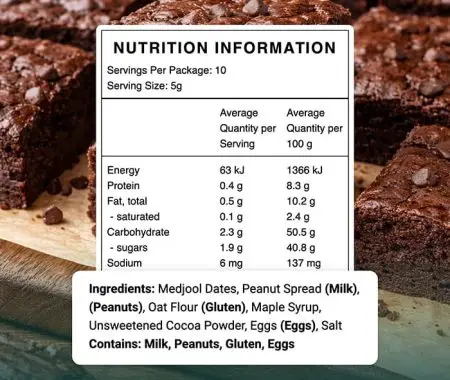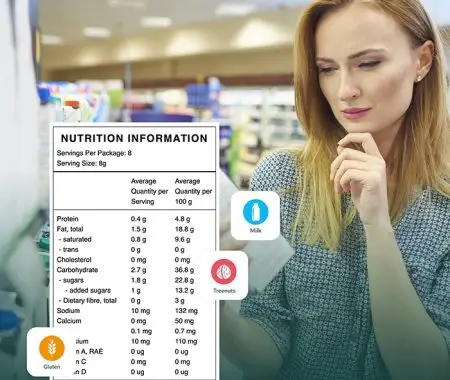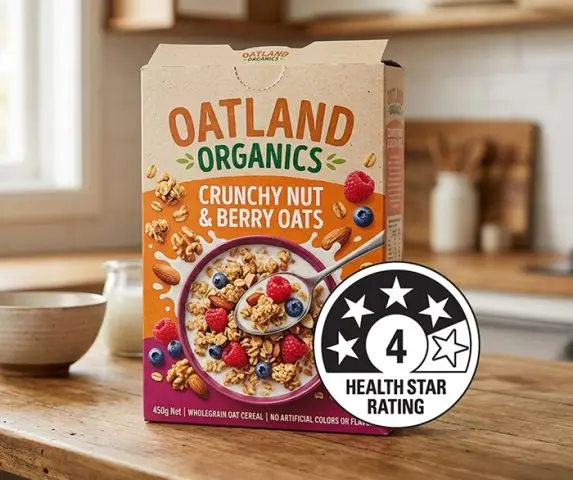
The Health Star Rating (HSR) is a voluntary front-of-pack labelling system used in Australia and New Zealand. It rates packaged food from half a star to 5 stars, so shoppers can compare the nutritional profile of similar products at a glance.
As of September 2026, the system is still voluntary. Governments wanted 70% of packaged products to carry a star rating by late 2025, but only 39% in Australia and 36% in New Zealand did. So Food Ministers asked Food Standards Australia New Zealand (FSANZ) to prepare a proposal to make it mandatory, and that proposal is now under assessment.
For food manufacturers, this comes down to one practical point: your star rating is calculated directly from your own Nutrition Information Panel data. This guide covers how the rating works, how to work out your product’s rating, and what changes if the mandate goes ahead.
What is the Health Star Rating System?
The Health Star Rating system gives packaged food a score from half a star to 5 stars, shown as shaded stars on the front of the pack. It was introduced across Australia and New Zealand in June 2014, and the idea is simple: the more stars, the better the product’s nutritional profile compared with similar foods. It’s designed to let shoppers spot the healthier option in a few seconds, without reading the full Nutrition Information Panel.
Why can you only compare similar products?
A Health Star Rating only means something next to another product of the same type e.g two boxes of cereal, or two yoghurts. Comparing a cereal to a yoghurt tells you nothing useful.
That’s because the rating isn’t worked out the same way for every food. Products are sorted into six categories covering beverages, dairy, fats and oils, and general foods, and each category is scored against its own thresholds. A 4-star yoghurt and a 4-star muesli bar have each been measured against their own category, not against each other.
Who runs the Health Star Rating system?
The system is a joint initiative funded by the Australian and New Zealand governments. The rating calculator was developed with Food Standards Australia New Zealand (FSANZ) and other nutrition and technical experts, and Food Ministers from both countries oversee the system and decide its future.
One point that catches food businesses out: governments don’t calculate or issue your rating. Food manufacturers and retailers work out their own Health Star Rating using the official calculator, and are responsible for getting it right, including making sure it’s consistent with the Nutrition Information Panel on the same pack.
How is the Health Star Rating calculated?
The Health Star Rating is calculated on a fixed amount of product: 100g for solids or 100mL for liquids. Package size and serving size are deliberately not considered because it means a 250g box and a 500g box of the same cereal get measured the same way, and shoppers can compare two products without doing the maths themselves.
There’s one exception. Products that have to be rehydrated, diluted, mixed with water or drained before eating, like cordial, soup powder and tinned vegetables, are rated as prepared rather than as they come. That list is kept tight because preparing a food spreads its sugar and salt across more volume, which lifts the rating.
What makes a Health Star Rating go up or down?
There are two official groups: baseline points, which come from the risk nutrients, and modifying points, which come from the positive nutrients. Modifying points are subtracted from baseline points to give a final HSR score, and the higher that score, the lower the rating on the 5-point scale.
Here’s a breakdown from start to finish on how a Health Star Rating is calculated.
| Baseline Points (Pushes the rating down) | Modifying Points (Pushes the rating up) |
| Energy (kilojoules) | Fruit, vegetable, nut and legume content |
| Saturated fat | Protein |
| Total sugars | Dietary fibre |
| Sodium |
You’ll also see FVNL used throughout the official documents. It’s just shorthand for fruit, vegetable, nut and legume content, and concentrated forms like purees and pastes count for more than fresh weight.
What are Product Categories in HSR?
Before any points get counted, your product has to be assigned to one of six categories:
- Category 1: non-dairy beverages, jellies and water-based ice confections
- Category 1D: milk and dairy beverages, including plant-based alternatives that meet the specified criteria
- Category 2: foods in general
- Category 2D: dairy foods
- Category 3: oils and spreads, like butter and margarine
- Category 3D: dairy fats, like cheese and cream
Each category is scored against its own thresholds, and some rules change completely between them. Category 1 products can’t earn protein points at all, and Category 1 can collect up to 10 baseline points where every other category caps at 8.
This is why a 4-star yoghurt and a 4-star muesli bar haven’t been measured against each other. Each was measured against its own category.
It’s also the most common error food businesses make, because a wrong category doesn’t give you a slightly wrong rating, it gives you an unusable one.
How does the score become a star rating?
Ratings are calculated in a straightforward way: add up the baseline points, subtract the modifying points, and what’s left is your final score.
The part that catches people out is the direction. A high final score means fewer stars, because the baseline points driving it up are the nutrients you want less of. Once you’ve got the final score, you look it up against the table for your category, which turns it into a star rating in half-star steps from 0.5 to 5.
See How FoodLabelMaker Can Help You
Is the Health Star Rating mandatory in 2026?
As of September 2026 the Health Star Rating is still voluntary, but that’s likely to change because Food Standards Australia New Zealand (FSANZ) is currently working through a formal proposal to make it compulsory, with a final decision expected in 2027.
Turning a voluntary system into a mandatory one came down to how it behaved in practice, because manufacturers with a highly rated product had every reason to display their stars while those with a poorly rated one simply left them off. That meant the products shoppers would most benefit from being warned about were exactly the ones least likely to carry a rating.
Governments set a target of 70% of products carrying a rating by 14 November 2025, but only 39% in Australia and 36% in New Zealand did. Ministers had already agreed to consider mandating the system if that target was missed, so in February 2026 they asked FSANZ for a formal proposal, which became Proposal P1067.
P1067 would amend the Australia New Zealand Food Standards Code to:
- require a Health Star Rating on most packaged foods that already need a Nutrition Information Panel
- standardise where the symbol sits on the pack
- write the calculation method into the Code itself
FSANZ has said mandating it “appears warranted” on current evidence, and the first round of submissions closed in July 2026, with a second still to come before Ministers make the final call.
What do I do if my Health Star Rating is very low?
If your rating is low, check the product’s categorisation before you start reformulating. Since each category is scored against its own thresholds, a product assessed in the wrong one can come out looking far worse than it is.
If the category is correct and the score is still low, then it’s the recipe that needs work.
How to improve your product’s Health Star Rating
Sodium is usually the easiest place to start, because the thresholds are tight enough that even a modest reduction can shift a rating, and it often affects taste less than people expect. Total sugars and saturated fat work the same way, and since both also feed into the energy count, reducing them tends to help twice over.
On the other side you can earn points back by increasing the fruit, vegetable, nut and legume content, which counts for more in concentrated forms like purees and pastes, or by raising dietary fibre and protein. Worth remembering that non-dairy beverages can’t earn protein points at all, so if you’re making a drink in that category the protein route is closed to you.
The one thing that won’t work is changing your pack or serving size, because the whole calculation runs on a fixed 100g or 100mL and takes no notice of how much you actually sell.
How to work out the Health Star Rating for your product
Everything the calculation needs comes from your Nutrition Information Panel, so the rating is only ever as accurate as the panel behind it. If your figures are estimated or out of date then the star rating inherits those errors, and if the mandate goes ahead that stops being a marketing problem and becomes a compliance one.
The official HSR Calculator is free from the Health Star Rating website, either as an online tool or an Excel workbook, and it does the job. The limitation is that it sits on its own and you have to do a lot of manual work: you type your per 100g figures in by hand, you work out the fruit, vegetable, nut and legume percentage yourself, and you do all of it again every time a recipe changes.
How to calculate your Health Star Rating in Food Label Maker
Food Label Maker cuts down on the majority of manual work when it comes to the Health Star Rating calculation. You build your recipe once from a database of verified ingredients, and everything else comes from it: your Nutrition Information Panel, your allergen declarations and your Health Star Rating. Nothing needs re-entering and nothing gets copied between tools.
- Build your recipe in the Recipe Builder so your Nutrition Information Panel is complete, since the rating is calculated from those figures.
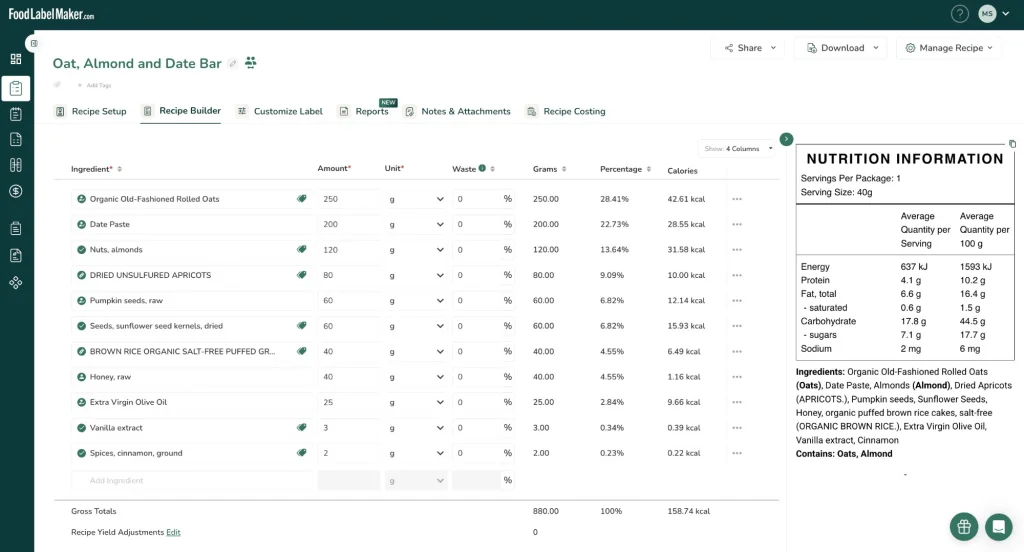
- Open the Customize Label tab and select Front of Pack Label.
- Choose your product category from the dropdown. This is where most errors happen, so it’s worth checking against the category definitions rather than going with whatever seems obvious.
- Review the fruit, vegetable, nut and legume ingredients. Food Label Maker runs an AI check across your ingredient list and flags which ingredients count toward FVNL, which type each one is, and whether it counts as concentrated. For this bar it picked up the almonds, pumpkin seeds and sunflower seeds, marked the date paste and dried apricots as concentrated fruit, and left out the oats, honey, olive oil, puffed rice, cinnamon and vanilla.
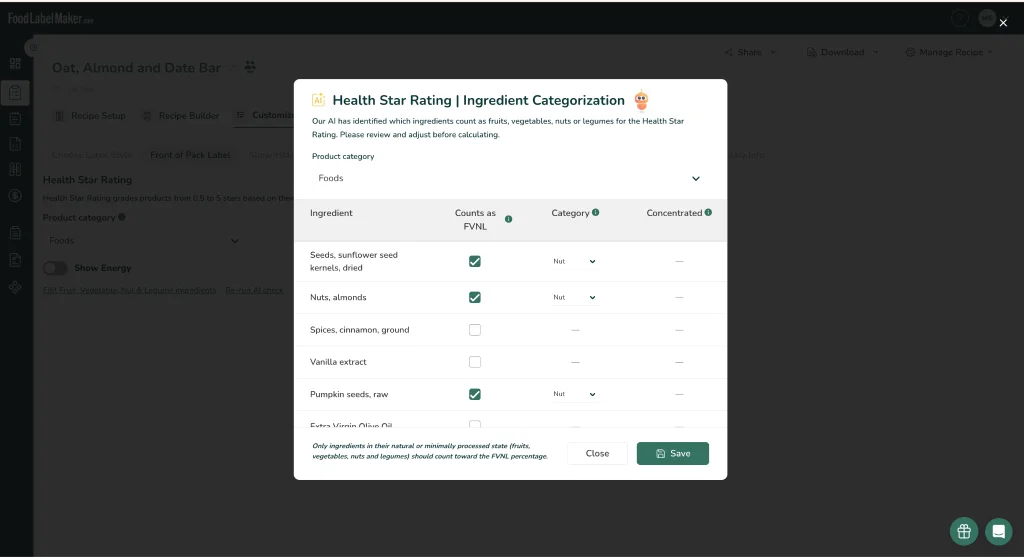
- Adjust anything that isn’t right and save. The rating appears straight away, along with a full score breakdown.
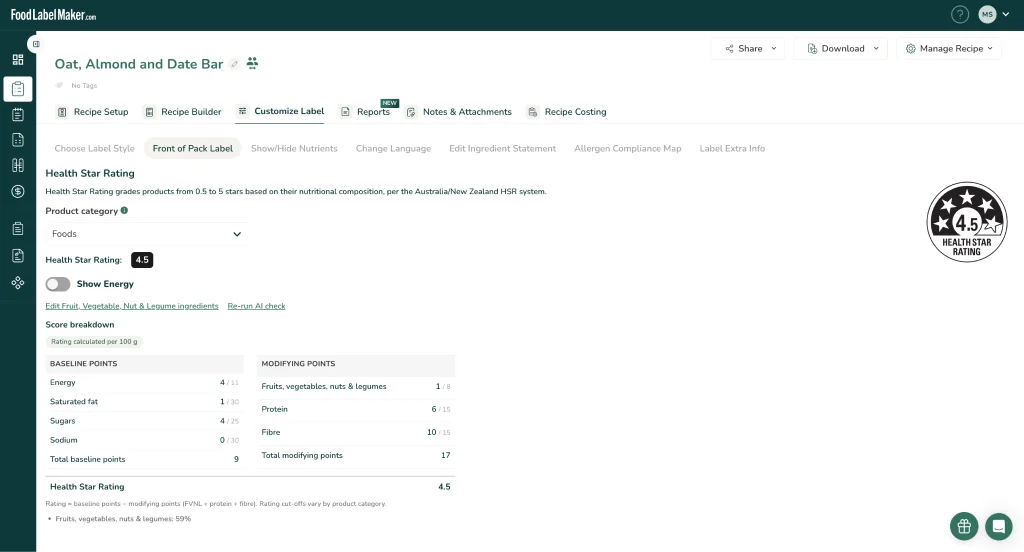
Our Oat, Almond and Date Bar came out at 4.5 stars, and the breakdown shows exactly why. It picked up 9 baseline points, with 4 from energy, 4 from sugars, 1 from saturated fat and none at all from sodium. Against that it earned 17 modifying points, made up of 10 from fibre, 6 from protein and 1 from a fruit, vegetable, nut and legume content of 59%. Subtract one from the other and the final score is minus 8, which in the Foods category lands at 4.5 stars.
That breakdown is also the quickest way to see where a rating is losing ground. Sugars is the only meaningful lever left on this bar, which is why any reformulation would start with the dates or the honey.
How do I add the Health Star Rating to my packaging?
Getting a Health Star Rating onto your packaging is simpler than most people expect, since there’s no approval process, nothing to register and nothing to pay. You work out your rating, put the graphic on the pack, and the responsibility for it being right sits with you rather than with any regulator.
There are four approved formats, and you can use whichever suits your packaging:
- The stars on their own, as a round badge
- The stars with the energy icon
- The stars with the energy icon and three nutrient icons, laid out horizontally
- The same information stacked vertically
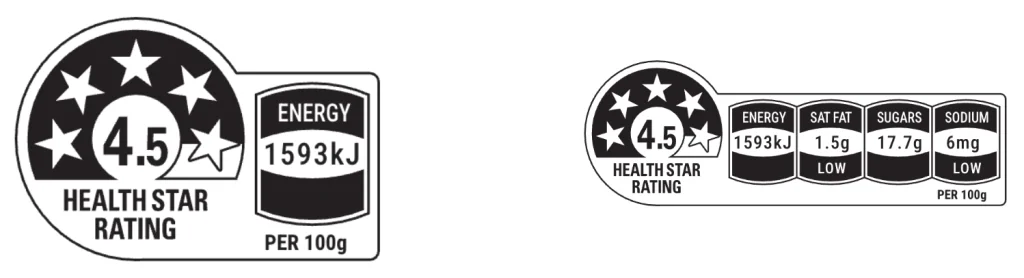
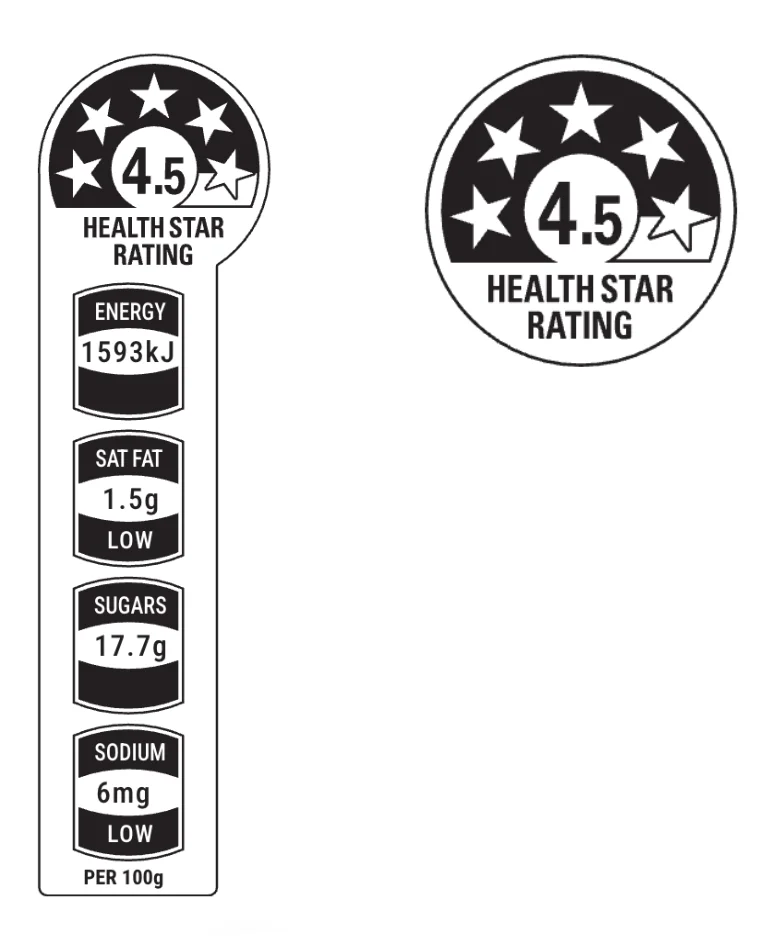
The nutrient icons carry saturated fat, sugars and sodium per 100g, with a LOW descriptor where the amount qualifies for it. On our bar the saturated fat and sodium both show LOW while the sugars don’t, which is a fair summary of where that 4.5 came from and a reminder that the fuller formats tell a shopper more than the stars alone.
The official artwork is free from the Health Star Rating website as EPS files, which a designer opens in Adobe Illustrator and sets to your rating. The rules for applying the graphic to packaging sit in the Health Star Rating System Implementation Guide, which is the document to check before artwork goes to print. Food Label Maker generates all four formats with your product’s figures already in place, so what goes to your designer is finished artwork rather than a rating and a list of numbers to type in by hand.
Placement and size of Health Star Rating
Right now there’s no mandated minimum size and no fixed position for the front-of-pack graphic. The graphic can be scaled to fit whatever space you have, as long as every element stays clearly readable and the rest of your label still meets the Food Standards Code. Most products carry it in the lower right of the front panel, but that’s convention rather than a rule. It also has to sit alongside everything else your label needs, so it’s worth checking the graphic doesn’t crowd your ingredients list or your allergen declarations.
It’s also one of the things Proposal P1067 would change, because alongside making the rating compulsory it proposes standardising both the design of the symbol and where it sits. That means packs already carrying a rating today could still need artwork updates to meet a prescribed format, and it may well mean the choice between those four formats narrows.
Which products are exempt from Health Star Ratings?
Not every packaged food is meant to carry a rating, and some are barred from it altogether. A product is only intended for the system if it already requires a Nutrition Information Panel under the Food Standards Code and there’s enough nutritional variation between similar products for a rating to mean anything, which is why flours and cooking oils are in scope while single ingredient products like eggs, sugar and baking powder aren’t. Those last ones are still permitted to display a rating if you want to, they’re just not expected to.
A separate group is excluded outright and must not display the graphic at all. That covers infant formula and food for infants under Standards 2.9.1 and 2.9.2, formulated supplementary foods for young children including toddler milks, formulated supplementary sports foods, and foods for special medical purposes. Anything alcoholic above 0.5% by volume is out, along with the non-alcoholic versions of alcoholic drinks, alcohol kits and kava. Products sold for further processing or for institutional meal service are excluded too, since they never reach a shopper making a comparison.
Final Thoughts on the Health Star Rating System
For more than a decade the Health Star Rating has been something food businesses could take or leave, and plenty have left it. That’s the part most likely to change, because FSANZ has already said mandating the system appears warranted and a decision is expected in 2027.
If your products don’t carry a rating yet, the useful thing to do now isn’t to redesign your packaging, it’s simply to find out what you’d score. Knowing whether a product lands at 2 stars or 4 tells you whether you’re looking at an artwork update or a reformulation, and reformulation takes a lot longer than anyone plans for. Working that out while it’s still your choice is considerably more comfortable than working it out once it isn’t.
You can calculate your product’s Health Star Rating in Food Label Maker alongside the Nutrition Information Panel it’s based on, and see exactly which nutrients are holding the score back.
Health Star Rating FAQs
1. How does the Health Star Rating work?
Every product is measured on a fixed 100g or 100mL, so pack size and serving size don’t affect the result. The calculation adds up baseline points for energy, saturated fat, total sugars and sodium, then subtracts modifying points for fruit, vegetable, nut and legume content, protein and dietary fibre, and the lower the final score the more stars you get. All of it comes from the figures in your Nutrition Information Panel, and the government sets out the full method in its guidance on how ratings are calculated.
2. What is the Health Star Rating system?
It’s a voluntary front-of-pack labelling scheme run jointly by the Australian and New Zealand governments and introduced in June 2014. Food Ministers from both countries oversee it and FSANZ helped develop the calculator behind it, but manufacturers work out and display their own ratings, and no government body approves or issues them.
3. What is the Health Star Rating?
It’s the number of stars printed on the front of a packaged food, running from half a star up to 5 in half-star steps. The more stars, the better that product’s nutritional profile compared with similar foods in the same category.
4. Is the Health Star Rating mandatory in Australia?
Not yet. It’s still voluntary as of September 2026, but FSANZ is assessing Proposal P1067, which would require most packaged foods that already need a Nutrition Information Panel to display a rating. FSANZ has said that mandating it appears warranted on current evidence, and a decision is expected in 2027.
5. What is a good Health Star Rating?
There’s no official threshold, and a rating only means something against similar products. Four stars is strong for a breakfast cereal and fairly ordinary for a plain yoghurt, so the useful comparison is against what else sits on your shelf rather than against a universal pass mark.
6. Is 0.5 a bad rating? Is 3.5 good?
Half a star is the lowest the scale goes, so it points to a product high in energy, saturated fat, sugars or sodium with little to offset it. A 3.5 sits in the upper middle and is a solid result in most categories, though again it depends entirely on what you’re comparing it against.
7. Why do some foods not have a Health Star Rating?
Usually because the system is voluntary and the manufacturer has chosen not to display one. Some products are excluded outright though, including infant formula, foods for special medical purposes, alcoholic drinks above 0.5% by volume and kava, and fresh unpackaged foods aren’t part of the system at all.
8. How reliable is the Health Star Rating?
It does what it was designed to do, which is compare similar packaged products across a handful of nutrients, but it isn’t a complete verdict on how healthy a food is. It doesn’t account for processing, additives, or vitamins and minerals, and it’s been criticised for rewarding reformulation that lifts a score without meaningfully improving the food. The as prepared rule drew particular criticism, which is why it’s now limited to products that genuinely need rehydrating, diluting or draining. FSANZ also chose not to undertake a full algorithm review as part of P1067, and that decision has its critics on both sides.
9. How do I work out the rating for my own product?
You can use the free official calculator from the Health Star Rating website, either online or as an Excel workbook, entering your per 100g figures and working out your fruit, vegetable, nut and legume percentage yourself. Or you can calculate it in Food Label Maker, where the rating comes from the same recipe that produces your Nutrition Information Panel and updates whenever an ingredient changes.
3: 10. Does the Health Star Rating apply in New Zealand too?
Yes. It’s a joint Australian and New Zealand initiative using the same calculator and the same rules on both sides of the Tasman. Uptake has been slightly lower in New Zealand, at 36% of products compared with 39% in Australia.
11. Do I have to add a Health Star Rating if it’s low?
At the moment, the system is voluntary, so there’s nothing stopping you leaving the stars off a product that scores poorly, and plenty of manufacturers do exactly that.
That’s getting less comfortable for two reasons. If Proposal P1067 goes ahead then displaying a rating stops being optional, and the products currently keeping quiet are the ones that’ll have the most work to do. Even before any mandate, as coverage rises a missing rating starts to say something on its own, because a shopper who sees stars on three products and nothing on the fourth can reasonably guess why.
Either way it’s worth knowing your score even if you don’t intend to print it, because you can’t plan a reformulation or a packaging update around a number you’ve never worked out.