The Industrial Revolution replaced muscle with machines and permanently changed how the world worked. The AI Revolution is replacing cognitive labor with algorithms and moving ten times faster.
While Large Language Models (LLMs) like ChatGPT, Gemini, Claude are helpful for content and brainstorming ideas – they function on word probability rather than mathematical or regulatory logic. In an industry where a “good guess” is a liability, roughly 15-19% of AI responses, on law and healthcare, contain fabricated information or “hallucinations”. In the food industry, an “almost accurate” nutrition label is the riskiest choice a food business can make that leads to recalls and FDA (and other regulatory bodies) warning letters.
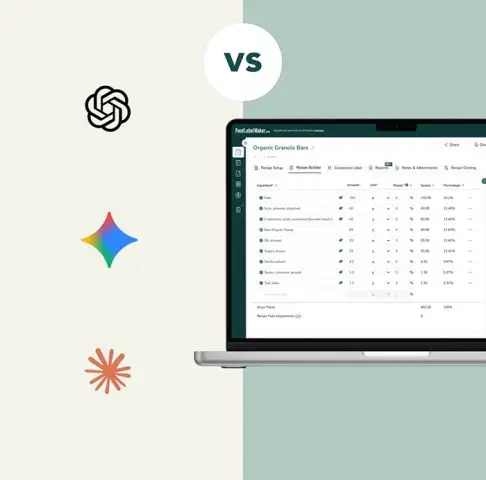
This article provides a unique deep dive into how AI models stack up against a dedicated nutrition facts label generator like Food Label Maker. We will explore the 6 critical risks food enterprises may face when relying on AI as a nutrition label generator, and why specialized regulatory software is the only way to ensure 100% compliance across all markets.
Want to get started? Create a free label with our nutrition facts label generator.
TL;DR — Key Takeaways
- How LLMs Work: ChatGPT, Claude, and Gemini are built on a sequence prediction architecture meaning every output is a statistical estimate based on training data, not the result of applying a fixed rule.
- Up-to-date Knowledge: Most LLMs have knowledge cutoffs, making them unaware of current mandates such as Canada’s 2025/2026 Front-of-Package requirements and updated FDA rounding rules.
- Label Formatting: Because AI estimates rather than enforces, it cannot reliably produce the pixel-perfect font sizes, border weights, and bilingual layouts that FDA and CFIA regulations require.
- Recipe Management: AI operates in isolated chat sessions with no persistent memory, making centralized ingredient management and cross-recipe updates structurally impossible.
- Food Traceability: AI generates static text with no supplier linkage, no version history, and no audit trail, none of which meets the documentation standards expected in regulatory reviews.
- Data Security: Content entered into standard consumer AI accounts may be used to train future models. Food Label Maker operates on SOC 2 Type II audited infrastructure where recipe data remains private.
| Feature | ChatGPT / Gemini / Claude | Food Label Maker |
| Regulatory currency | Knowledge cutoff Unaware of 2025/2026 mandates | Live-synced with FDA, CFIA, EU and other global food labeling regulations |
| Yield & moisture math | ProbabilisticMight be ignored moisture loss unless explicitly prompted by the user | Deterministic |
| Recipe management | Fragmented chat threads No persistence | Centralized dashboard Global ingredient syncing |
| Label formatting | Inconsistent Varies per prompt | Native FDA and global food labeling templates Pixel-accurate output |
| Food traceability | Static textNo audit trail | Linked spec sheets Full change history |
| Data security | Public model Data may train future models | SOC 2 Type II CompliancePrivate infrastructure |
How AI Models Like ChatGPT, Claude and Gemini Actually Work
Before getting into the details of what AI can and can’t do with nutrition labels, it helps to understand what the LLM Models (like ChatGPT, Claude, Gemini etc) actually do when they’re prompted with a task.
Every modern generative AI tool available today is built on a foundational architecture called the Transformer.
Definition of an AI Transformer Model:
A deep learning architecture that functions primarily as a sequential prediction engine. Text-generative Transformer models operate on the principle of next-token prediction: given a text prompt from the user, what is the most probable next token (a word or part of a word) that will follow this input?
In relation to prompts, this means: AI doesn’t read instructions and execute them the way software does. It reads instructions and produces the most statistically likely response based on everything it was trained on and all the past information it has received. There are no coded rules underneath, only patterns and probabilities. For most tasks this works well enough to seem like rule-following. But ask it to produce something that must be precisely, legally, and repeatedly correct (such as a nutrition facts label) – the gap between predicting what looks right and enforcing a rule without exception becomes a serious problem.
Using AI for Real-Time Regulatory Compliance
Most large language models have a knowledge cutoff that makes them unaware of the latest FDA rounding rules, Canada’s 2025/2026 Front-of-Package (FOP) labeling mandate and other significant regulatory changes. A nutrition facts label generator with live regulatory synchronization eliminates this risk entirely.
Does AI Know the Updated Nutrition Regulatory Rules?
Most LLMs have knowledge cutoffs; they are not inherently aware of the most recent regulatory changes in nutrition labeling. For example:
- OpenAI (GPT-4o): Knowledge cutoff is October, 2023
- Anthropic (Claude): Knowledge cutoff is August, 2025
- Gemini (Google): There is no clear knowledge cutoff for current models making the use of Gemini models for up-to-date knowledge more unreliable
Even though LLMs run through the web to find the latest information, all they do is summarize and retrieve the text. An LLM might find a news article about the change and the updated logic but there’s a high chance that the old logic is applied when generating a label. The model’s “reasoning” about how to calculate and format nutrition data is based on how it was trained and not updated in real-time. Final takeaway is that AI cannot reliably apply new regulatory logic to your label calculations even when it knows the rule exists.
Automated Compliance Updates in Food Label Maker
When it comes to up-to-date regulatory compliance, the fundamental difference between AI and a nutrition facts label generator like Food Label Maker, is that the software is constantly being updated with recent regulations and has human intervention to ensure every rule is implemented correctly.
Behind every nutrition labeling update is a team that actively monitors regulatory announcements from the FDA, CFIA, FSA, and other governing bodies. When a regulation changes, our developers don’t just read about it – they translate the legal language into exact calculation logic, test it against real product data, and push the update to every user’s account. There’s no ambiguity, no interpretation by a language model that might get it half right. A human regulatory expert verifies the change, a developer encodes it, and QA confirms the output matches what the regulation requires.
This is something AI fundamentally cannot replicate. An LLM has no team behind it watching for regulatory updates to nutrition labeling specifically. It has no quality assurance process for food compliance. With Food Label Maker, there is a dedicated regulatory team ensuring the update is live before any enforcement date.
See How FoodLabelMaker Can Help You
Why AI Struggles at Moisture Loss and Yield Calculations
LLMs account for moisture loss and yield if the user explicitly prompts them to. If a user doesn’t know they need to ask, it’s most likely that AI won’t know it needs to calculate it, therefore creating a nutrition label based on raw ingredient weights instead of what the consumer actually eats.
How Does AI Hallucinate Nutrition Yield Calculations?
When a product is baked, water evaporates and the final product weighs less than the sum of its raw ingredients. That weight change directly affects nutrient density such as calories, sodium, and fat per serving, as they all increase relative to the smaller finished weight. LLMs are likely to have no awareness of this unless explicitly prompted.
This limitation is supported by research. A study evaluating three large language models for nutritional content estimation from food images found that LLMs struggle to accurately estimate food weight, energy content, and macronutrient composition – even from standardized photographs. Moisture loss is fundamentally a weight estimation task; if AI cannot reliably estimate ingredient weight to begin with, it’s highly unlikely to be able to reliably calculate the resulting yield after cooking
This places the burden entirely on the user. Getting an accurate label from AI requires knowing to specify yield percentage, understanding how moisture loss affects nutrient density, prompting the AI to recalculate, and then verifying the output manually. Missing any one of those steps produces a non-compliant label.
How a Nutrition Facts Label Generator Accurately Handles Yield Calculations
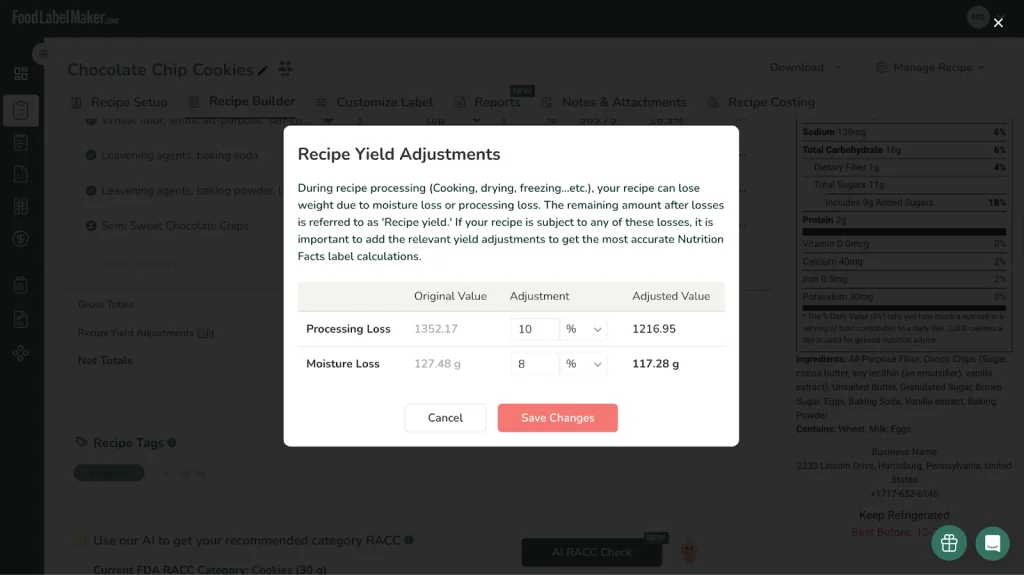
Food Label Maker takes on the burden of complex moisture loss calculations. The software prompts for yield as a standard step in the recipe workflow, not as an afterthought that depends on the user’s food science knowledge.
Once entered, nutrient density is calculated based on the finished product weight using deterministic formulas, not probabilistic text prediction. This means a first-time user with no labeling experience gets the same mathematically accurate result as an experienced food scientist. The software doesn’t skip steps, doesn’t need to be reminded, and doesn’t silently default to raw ingredient weights when yield data is missing. A purpose-built nutrition facts label generator treats yield as non-negotiable.
AI vs. A Centralized Recipe Management Hub
AI chat threads are fragmented by design. Every ingredient change requires re-prompting from scratch. A centralized nutrition facts label generator maintains a single source of truth for all recipes, ingredients, and supplier data.
The Risk of Managing Recipes in Disconnected AI Chat Threads
LLMs operate in isolated chat threads with no persistent memory between sessions. When a food business manages dozens or hundreds of recipes and ingredients, this becomes a serious operational problem. If a supplier changes the nutritional profile of an ingredient, for example a flour supplier switches to a different mill, every recipe using that ingredient needs to be recalculated. With AI, this means manually re-prompting each recipe individually, hoping the model applies the updated values consistently, and verifying the output every single time.
There is no central database connecting multiple conversations meaning each chat thread exists independently, with little connection of what was calculated in another session. An ingredient update that should take seconds instead becomes a tedious, error-prone process of copying data between threads and trusting that the AI interprets each prompt the same way twice – a high-risk process.
For businesses operating at a larger scale, this fragmentation introduces real compliance risk. A missed re-calculation on even one food item means a label with outdated nutritional data is potentially going to market, a recipe for recalls.
Using a Centralized Database for Global Ingredient Syncing
In contrast, a nutrition facts label generator is a centralized database where recipes are part of an interconnected system rather than isolated text files. This “single source of truth” allows users to store ingredients in a master library. If a supplier updates a spec sheet, the data is changed once in the dashboard, and the update automatically cascades through every linked recipe. This eliminates the manual re-prompting and “copy-paste” errors inherent in AI workflows. Furthermore, the software provides instant cross-recipe intelligence, allowing a business to search its entire product line for specific allergens or ingredients in seconds. This is a near impossible task for an LLM which cannot perform a global search across independent, disconnected chat sessions.
The Struggle of AI with Compliant Label Formats
AI-generated nutrition labels are highly likely to produce inconsistent formatting that varies with every prompt. The FDA and other regulatory bodies have strict visual requirements that a probabilistic text generator cannot reliably reproduce. A dedicated nutrition facts label generator uses pre-built, regulation-locked templates to create compliant nutrition labels.
Why AI Cannot Generate Print-Ready Nutrition Labels
FDA, and other governing bodies, have strict nutrition label requirements, not suggestions. Visual elements such as: minimum font sizes, border weights, line spacing, and bilingual column layouts must be exact. This is where the probabilistic nature of AI becomes a direct compliance liability.
With the LLMs sequence prediction engines, they estimate the most statistically likely output based on training data rather than applying rules.
Studies show that generative AI models struggle with precise, non-negotiable rules, which is the exact type of precision that FDA, CFIA, FSA and other, formatting rules demand. More extensive research also shows that AI models perform significantly worse on fine-grained visual details, specifically small-scale elements and precise spatial relationships. On a food label this means wrong stroke weights, fonts that fall below the required point size at print resolution, or bilingual columns that fail exact spacing tolerances. Another really important study dove deep into how regenerating or adjusting one element could cause others to be quietly shifted. This is identified as instruction inconsistency where the AI model could quietly override explicit instructions as it hallucinates.
Imagine asking for a 6pt font twice and getting two different results – this is where the details of generating compliant nutrition labels really matters.
How Food Label Maker Produces Audit-Ready Nutrition Labels
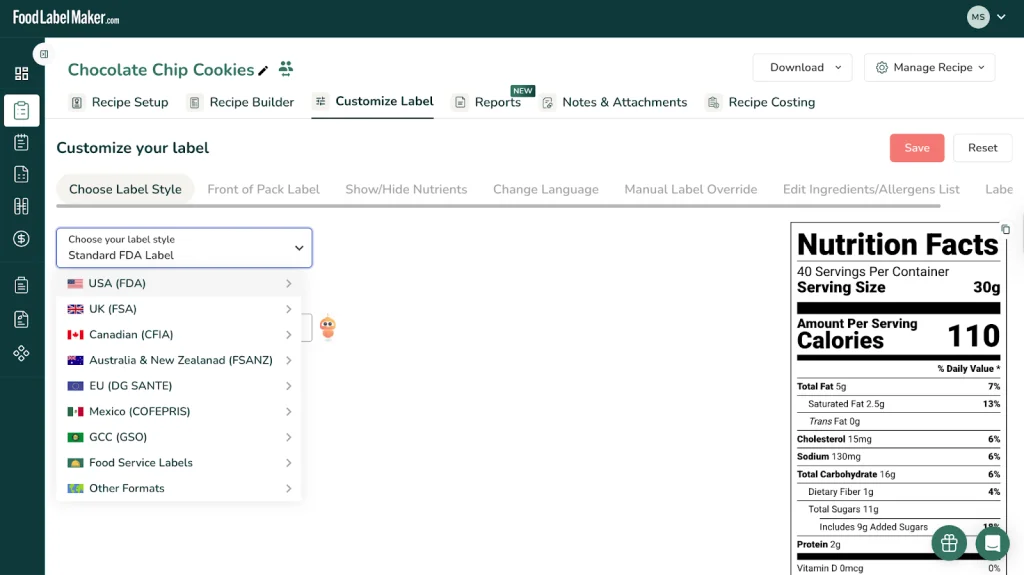
The Food Label Maker software is built around pre-coded, regulation-locked templates rather than AI estimations from training data. This means every visual element of a nutrition label is governed by exact rules, not statistical prediction. Every format requirement such as: font sizes, border weights, line spacing, and column layouts are applied to the exact specification required by the relevant regulatory body. Users can switch between FDA vertical, tabular, simplified, and dual-column formats in one click, with correct rounding rules applied instantly each time.
For businesses selling across multiple markets, Food Label Maker handles multi-region compliance without any manual reconfiguration. Switch between FDA, CFIA, EU, and other regional formats and the software automatically applies the correct daily values, bilingual requirements, and visual formatting standards for that market. This is not a task that needs a re-prompt, it’s a rule the software enforces every single time.
Labels are also exported as high-resolution print-ready files (PDF, SVG, BMP, or PNG) at the resolution required for packaging production
This is the fundamental difference: AI produces a label that looks compliant. Food Label Maker produces a label that is compliant and can prove it.
Why AI is Unreliable for Food Traceability
Food traceability requires verified, linked data — not static text generated from a prompt. AI cannot connect supplier spec sheets to specific recipes or maintain an audit trail of ingredient changes. A nutrition facts label generator like Food Label Maker links traceability reports directly to your recipes and supplier data.
Why AI Cannot Produce a Verified Food Traceability Record
Food traceability requires a verifiable, connected record of every ingredient, its source, and every change made to it over time. AI is unable to produce this level of detail and accountability. What it produces is static text, a response generated from a prompt, with no connection to suppliers, no memory of previous sessions, and no log of what changed or when.
When ingredient changes are managed through AI chat threads, no record of those changes is retained between sessions. There is no version history, no link to the previous values, and no way to verify which iteration of a recipe produced a given nutrition label. This gap becomes significant during a supplier audit or regulatory review.
Integrated Spec Sheets and Audit History in Food Label Maker
Food Label Maker approaches traceability as a connected system. When a custom ingredient is added to the platform, a supplier’s spec sheet can be uploaded directly into the ingredient record. The Food Label Maker AI spec sheet parsing tool reads the document and automatically populates the full nutritional breakdown (calories, macronutrients, micronutrients, vitamins, minerals, and amino acids) alongside the supplier’s name and supplier code, so the origin of every ingredient is attached to its record from the point of entry.
That ingredient is then linked to every recipe that uses it. When a value is updated, the change is reflected across all associated recipes automatically with no manual re-entry required.
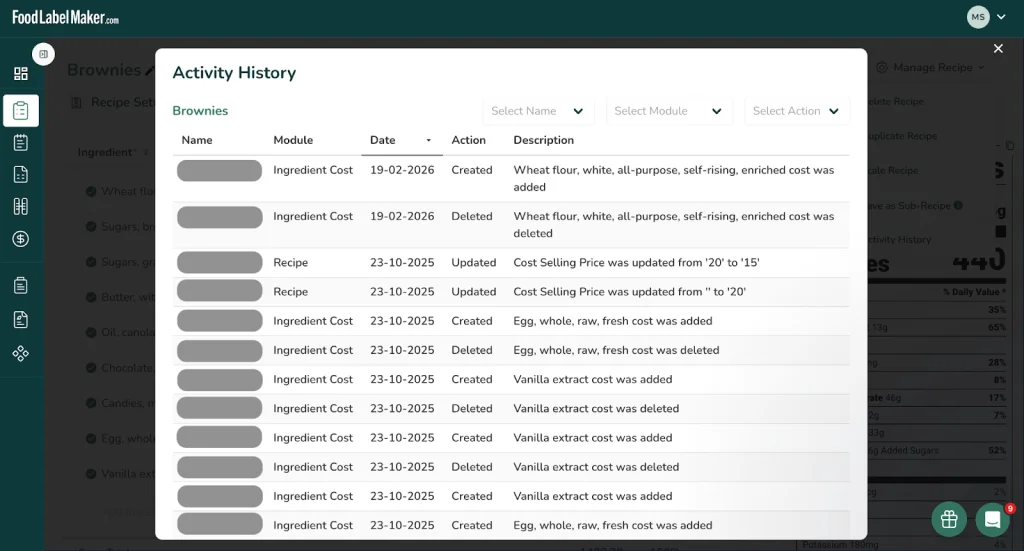
Every action taken in the platform is captured in the Activity History log, recording the user’s name, the date, the module affected, and a precise description of what changed – whether an ingredient was added, a value was updated, or a cost was modified. The result is a timestamped, user-attributed record of every change made to every recipe and ingredient in the system, which is the kind of documentation that supplier audits and regulatory reviews typically require.
High Security – Why SOC 2 is Better than Public AI
When you paste proprietary recipes into ChatGPT, Gemini, or Claude, that data may be used to train future models unless you have an enterprise agreement. A SOC 2 Type II audited nutrition facts label generator keeps your formulations private and never exposes them to third-party training pipelines.
What Happens to Recipe Data When Using a Public AI Tool
When proprietary recipes are entered into a public AI tool like ChatGPT, Gemini, or Claude, that content is collected and stored by the platform. According to the published privacy policies of OpenAI, Google, and Anthropic, content submitted through standard consumer accounts may be used to improve and train their models – unless the user actively opts out or holds an enterprise-level agreement.
For food businesses, this creates a straightforward intellectual property risk. A proprietary formulation, a custom ingredient ratio, or a unique manufacturing process entered into a chat prompt is no longer exclusively private. Even with opt-out settings enabled, the data has passed through a third-party infrastructure with no food-industry-specific security standards, no contractual confidentiality protections, and no SOC 2 audit to verify how that data is handled.
How Food Label Maker Keeps Recipes Private and Secure
Food Label Maker operates on private, SOC 2 Type II audited infrastructure — meaning the platform’s security controls are independently verified against a recognized standard. Recipe data, ingredient formulations, and supplier information entered into the platform are not used for model training, are not shared with third parties, and remain the exclusive property of the food enterprise that entered them.
For food manufacturers, contract manufacturers, and multi-site enterprises, this distinction matters. SOC 2 Type II attainment is not a self-assessed claim — it requires an independent audit of how data is accessed, stored, and protected over time. It is the same standard applied in banking and healthcare software, and it provides the contractual and operational assurance that a public AI tool cannot offer.
Conclusion: Trust the Nutrition Facts Label Generator Built for Compliance
AI has earned its place in the modern food business for drafting copy, brainstorming product ideas, summarizing research, and speeding up routine tasks. But nutrition labeling is not a routine task. It is a legal obligation with measurable, enforceable specifications, and the consequences of getting it wrong range from costly reformulations to warning letters and product recalls.
Every major AI model is a sequence prediction engine built to estimate the most statistically likely output, not to apply rules without exception. That distinction becomes a direct compliance liability when the task requires exact font sizes, precise border weights, correct daily values for multiple markets, a verified audit trail, and the assurance that proprietary formulations never leave a secure environment.
Purpose-built software exists because some problems require deterministic answers, not informed guesses. Food Label Maker is built around that principle with regulation-locked templates, deterministic calculations, centralized recipe management, and independently audited data security. Not because AI is a poor technology, but because compliance is a domain where “close enough” has never been good enough.
Frequently Asked Questions
1. Can ChatGPT Create Compliant Nutrition Labels?
While AI tools like ChatGPT can generate text that resembles a nutrition label, they are not designed to meet the precise legal requirements that food labeling regulations demand. LLMs generate outputs based on statistical patterns rather than regulatory logic, meaning font sizes, border weights, rounding rules, and bilingual layouts may vary between outputs and fall outside what bodies like the FDA, CFIA, FSA, and EU require.
For food businesses operating in regulated markets, the recommendation is to use purpose-built nutrition label software that is built and updated specifically around compliance requirements. A dedicated nutrition facts label generator applies the correct rules exactly, every time which is something a general-purpose AI tool is not architected to do.
If you’d like to get started, create a free label now or reach out to our hire an expert team for further information.
2. Is AI Accurate Enough For Food Labeling?
For most everyday tasks, AI is accurate enough. But food labeling sits in the same high-stakes category as legal and medical information. These domains have research showing hallucination rates reach as high as 6.4% even among the best performing models. That means the most capable AI tools available today still generate fabricated or incorrect information roughly 1 in every 16 responses when the task involves precise, rule-bound information.
For food labeling, where a single inaccuracy can trigger a warning letter from regulatory bodies, a product recall, or a failed retailer audit, that error rate is not an acceptable risk. Compliance requires a tool that applies the correct rules every single time and not one that gets it right most of the time.
To create compliant nutrition labels, get started here.
3. What Is A Nutrition Facts Label Generator?
A nutrition facts label generator is purpose-built software that calculates nutritional values from ingredient data using fixed, coded formulas, then outputs labels in formats that comply with the specific regulations of a given market whether that’s FDA in the United States, CFIA in Canada, COFEPRIS in Mexico, FSA in the UK, or EU standards across Europe.
Unlike a general-purpose AI tool, a nutrition facts label generator doesn’t predict what a label should look like based on patterns. Instead, it applies exact rules from the correct font sizes, border weights, rounding logic, and daily values to the bilingual requirements for each market. A regulatory nutrition labeling platform, like Food Label Maker, generates the same way every time, regardless of who is using it or how the recipe is worded.
Explore the Food Label Maker free nutrition label generator software here.
4. How Does Food Label Maker Differ From Using AI For Nutrition Labels?
The fundamental difference is that Food Label Maker is purpose-built for regulatory compliance in nutrition labeling, while AI is a general-purpose tool that was never designed for it.
Food Label Maker applies regulation-locked label templates for FDA, CFIA, FSA, EU, and other markets meaning every font size, border weight, rounding rule, and bilingual requirement is hard-coded to the current regulatory standard, not estimated from training data. Yield and moisture loss calculations are built into the standard recipe workflow, so nutrient density is always based on the finished product weight rather than raw ingredient totals. All recipes and ingredients are stored in a centralized database, so a single ingredient update cascades through every recipe that uses it automatically. Labels are exported as high-resolution print-ready files at packaging-production resolution. And every change made in the platform is logged with a timestamp and user attribution, creating a verifiable audit trail.
AI chat tools operate without any of these structural features. There is no persistent memory between sessions, no regulation-locked formatting, no automatic yield prompting, and no audit history. For routine tasks, that is fine. For producing a label that must meet a legal standard, it is not recommended.
Learn more about how to create compliant nutrition labels for all 8 major, global markets.
5. Does AI Account For Moisture Loss When Calculating Nutrition Facts?
Not automatically. Because AI has no built-in recipe workflow, it only calculates what the user explicitly asks for. A food business owner who doesn’t already know they should prompt for yield will receive a label calculated on raw ingredient weights rather than the finished product weight. It’s also unlikely they will receive a warning from the tool that anything is missing.
This matters because cooking, baking, and dehydration reduce the finished product weight relative to raw ingredients, which directly affects nutrient density per serving. Research evaluating LLMs for nutritional content estimation found that AI struggles to accurately estimate food weight and nutrient composition, making reliable yield calculation unlikely without explicit user intervention.
Food Label Maker prompts for yield as a standard step in the recipe workflow and calculates nutrient density based on the finished product weight using fixed, coded formulas. Create a free label today.
6. Is It Safe to Paste Recipes into ChatGPT?
For businesses using standard consumer accounts, there is a data privacy risk worth understanding. According to the published privacy policies of OpenAI, Google, and Anthropic, content submitted through standard accounts may be used to improve and train their models unless the user actively opts out or holds an enterprise-level agreement.
For food businesses, this means a proprietary formulation, a custom ingredient ratio, or a unique manufacturing process entered into a chat prompt is no longer exclusively private. Even with opt-out settings enabled, the data has passed through a third-party infrastructure with no food-industry-specific confidentiality protections.
Food Label Maker operates on SOC 2 Type II audited infrastructure, meaning recipe data, ingredient formulations, and supplier information entered into the platform remain the exclusive property of the business that entered them and are never used for model training.
Create your first free label, securely.
7. What Regulations Does Food Label Maker Support?
Food Label Maker supports nutrition labeling regulations across eight major global markets:
- United States — FDA, including all standard label formats, RACC checks, and allergen declarations
- Canada — CFIA, including bilingual English/French requirements and Front-of-Package (FOP) labels
- United Kingdom — FSA, including mandatory back-of-pack and traffic light front-of-pack formats
- European Union — DG SANTE, covering all 27 member states
- Australia & New Zealand — FSANZ, covering compliance for both countries under the Food Standards Code, including nutrition information panel requirements, allergen declarations, and country of origin labeling.
- Mexico — COFEPRIS, including mandatory frontal warning labels and dual-language formats
- Gulf Cooperation Council — GSO, including Arabic and bilingual label formats
Each market’s label format, daily values, rounding rules, bilingual requirements, and visual specifications are pre-coded into the platform and updated as regulations change.
Create a free nutrition label for any major region here.
8. What Does Hallucinations In Large Language Models (LLMs) Mean?
In the context of AI, a hallucination refers to when a model generates information that is plausible-sounding but factually incorrect or entirely fabricated, and presents it with the same confidence as accurate information.
This happens because of how LLMs are fundamentally built. As established earlier in this article, models like ChatGPT, Gemini, and Claude are sequence prediction engines that generate outputs by calculating the most statistically likely response based on patterns in their training data. When a model encounters a gap in its knowledge, rather than flagging uncertainty, it fills that gap with what statistically fits, which may have no basis in fact.
In the context of nutrition labeling, hallucinations can manifest as incorrect nutrient values, fabricated regulatory thresholds, rounding rules that don’t exist, or formatting that looks compliant but isn’t. The particular risk is that these errors are not flagged. The output looks and reads like a correct label, which makes them easy to miss without manual verification against the actual regulatory standard.
Ready to create a fully compliant nutrition label? Get started here.

Related Posts