The Texas cottage food law lets you make most foods in your home kitchen and sell them directly to consumers without a state or local permit, as long as your gross annual sales stay at or under $150,000. Meat, seafood, ice cream and a few other foods are excluded, and every product must carry a label with your name, your address or DSHS registration number, the product name, any major food allergens and a required statement in capital letters.
This guide covers what you can sell, where you can sell it, when you need to register, and exactly what your label must say under the rules in force since September 1, 2025.
| Texas cottage food law at a glance | |
| Sales cap | $150,000 in gross annual sales, adjusted yearly for inflation |
| Permit or license | None from your city or county; DSHS registration only in some cases |
| Foods allowed | Most foods, except meat, poultry, seafood, ice and ice cream products, low-acid canned goods, CBD or THC products and raw milk products |
| Where you can sell | Directly to consumers anywhere in Texas, online with personal delivery, and through registered cottage food vendors |
| Training | Accredited food handler course |
| Label | Required on every product |
Source: Texas DSHS cottage food production guidance and Senate Bill 541.
Selling homemade food in Texas? Get your label right from day one.
What is the Texas cottage food law?
The Texas cottage food law, often called the Texas cottage law, is the part of the Texas Health and Safety Code, chapter 437, that lets a “cottage food production operation” make and sell food from home without a food manufacturer license or health inspections.
A cottage food production operation is an individual working from their own home, or a nonprofit working from the home of one of its directors or officers, that:
- earns $150,000 or less a year in gross income from food sales, and
- sells directly to consumers or to a registered cottage food vendor.
The Texas Department of State Health Services (DSHS) oversees the program. Local health departments cannot inspect your home kitchen, but they do keep records of complaints, and DSHS or the local health authority can step in if a product poses an immediate and serious threat to health.
What changed with SB 541 in 2025
Senate Bill 541 rewrote most of the law, effective September 1, 2025. The main changes are:
- Sales cap tripled from $50,000 to $150,000, with DSHS adjusting it each year for inflation.
- Almost any food is allowed. The old law listed what you could sell; the new law lists only what you can’t.
- Refrigerated foods are allowed if you register with DSHS and follow extra rules.
- Wholesale to cottage food vendors is now possible for shelf-stable foods.
- A new label statement replaced the old “made in a home kitchen” wording.
- Mail-order sales were removed. Online sales now need personal delivery.
If you printed labels before September 2025, check the statement on them. The old wording no longer meets the law.
What foods can you sell under the Texas cottage food law?
You can sell any food made in your home kitchen except the six categories the law excludes. That covers cookies, cakes, breads, pies, candy, jams, granola, dry mixes, pickles and many refrigerated items such as cheesecakes or cream pies.
| Allowed (examples) | Not allowed |
| Baked goods: cookies, cakes, breads, pies, tortillas | Meat, meat products, poultry and poultry products |
| Candy, fudge, chocolate | Seafood, fish and shellfish products |
| Jams, jellies, fruit butters | Ice and ice products: shaved ice, ice cream, frozen custard, popsicles, gelato |
| Pickles, fermented and acidified vegetables (batch rules apply) | Low-acid canned goods |
| Granola, trail mix, dry mixes, spices | Products containing CBD or THC |
| Refrigerated foods, with DSHS registration | Raw milk and raw milk products |
Source: Senate Bill 541, section 437.001 and Texas DSHS.
Eggs used as an ingredient are fine, since they are not on the excluded list.
Refrigerated (TCS) foods
TCS stands for “time and temperature control for safety”: foods that need refrigeration to stop bacteria from growing, such as cream-filled pastries, cheesecake or cut fruit. You can sell them under the cottage food law if you:
- register with DSHS before selling,
- store and deliver them cold enough to keep the food at 41°F or below,
- put the date the food was made on the label, and
- add the safe handling statement described in the labeling section.
TCS foods can only go directly to consumers. You cannot sell them wholesale to a cottage food vendor or donate them.
Where and how you can sell cottage food in Texas
You can sell directly to consumers anywhere in Texas: from home, at farmers markets, at events, at pop-ups, or by delivery.
- Online: allowed within Texas if you, an employee or someone in your household personally delivers the food. Before the customer pays, your website must show all the label information except your address. Shipping by mail is no longer allowed.
- Through a cottage food vendor: you can sell shelf-stable (non-TCS) foods wholesale to a registered cottage food vendor, who then sells them at farmers markets, farm stands, restaurants or retail stores. The vendor must display the “private residence” statement on a sign, and the label must show the date the food was made.
- Samples: you can hand out samples anywhere in Texas without a permit or fee, following the same sanitation rules as farmers market sampling.
- Donations: you can donate shelf-stable foods for events such as charity bake sales.
Keep an eye on your total sales. Once your gross annual food income goes over the cap, you are no longer a cottage food production operation.
Do you need a permit or license for cottage food in Texas?
No. Your city, county or local health department cannot require a license, permit or fee to produce cottage food or sell it to consumers or vendors. You still have two state-level steps.
When you must register with DSHS
Registration on the DSHS Online Licensing Registry is required if you:
- sell refrigerated (TCS) foods, or
- want to print a DSHS unique identification number on your labels instead of your home address.
Cottage food vendors who buy from you wholesale also register. If you only sell shelf-stable foods and are happy to print your address, you don’t need to register.
Food handler training
Before you sell, you must complete an accredited food handler course. DSHS also accepts an accredited Food Manager certification. Anyone who helps you prepare food must be trained too, unless they are a member of your household or work under direct supervision of someone trained, according to the DSHS cottage food rule.
Texas cottage food labeling requirements
Every cottage food product sold in Texas must be packaged to prevent contamination and carry a legible label. Items too large or bulky to package, such as a wedding cake, can carry the same information on an invoice or receipt instead.
What every Texas cottage food label must include
| Label element | What to write |
| Business name | The name of your cottage food production operation |
| Address or ID | Your home address, or your DSHS unique identification number if registered |
| Product name | The common or usual name, such as “Chocolate Chip Cookies” |
| Major food allergens | Every major allergen in the product, such as milk, eggs, wheat, soy, peanuts, tree nuts or sesame |
| Required statement | THIS PRODUCT WAS PRODUCED IN A PRIVATE RESIDENCE THAT IS NOT SUBJECT TO GOVERNMENTAL LICENSING OR INSPECTION. |
| Batch number | Only for pickled, fermented or acidified canned plant foods: a unique number for each batch |
| Date made | Only for refrigerated (TCS) foods and foods sold through a cottage food vendor |
| Safe handling statement | Only for refrigerated (TCS) foods, in at least 12-point font, on the label, invoice or receipt |
Source: Senate Bill 541, section 437.0193 and Texas DSHS.
The safe handling statement for refrigerated foods reads: “SAFE HANDLING INSTRUCTIONS: To prevent illness from bacteria, keep this food refrigerated or frozen until the food is prepared for consumption.”
Update labels that use the old statement
Labels printed before September 1, 2025 often say “This food is made in a home kitchen and is not inspected by the Department of State Health Services or a local health department.” That wording came from the old law and still appears in the state’s written rule, which DSHS had not updated for SB 541 at the time of writing. The statute now requires the new statement, in capital letters, exactly as written in the table above. Replace old labels as you reprint.
How to declare allergens on a cottage food label
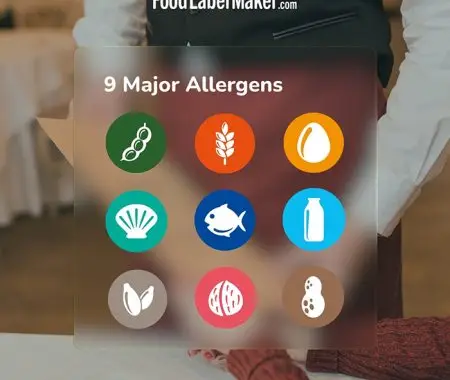
Texas requires you to list the major food allergens your product contains, and the clearest way to do it is the way FDA asks packaged food companies to do it. Name each allergen by its common name: write “milk”, not “dairy”, and “wheat”, not “gluten”. Declare any of the nine major food allergens FDA recognizes: milk, eggs, fish, crustacean shellfish, tree nuts (name the nut, such as almonds or pecans), peanuts, wheat, soybeans and sesame.
Most labeling mistakes we see from small bakers come from hidden sources: butter and whey are milk, many chocolate chips contain milk and soy, and some breads and buns contain sesame. A blanket “may contain nuts” line does not replace listing the allergens actually in the product.
“The allergen people forget is almost never the one they added on purpose. Home bakers list the butter, eggs and flour from their recipe card, then miss the soy lecithin in their chocolate chips or the milk in a store-bought caramel. Before you print a label, read the label of every ingredient you buy and carry each allergen through to your own.”
Rachelle, Regulatory Lead at Food Label Maker
Our FDA allergen statement guide shows the “Contains:” format in detail.
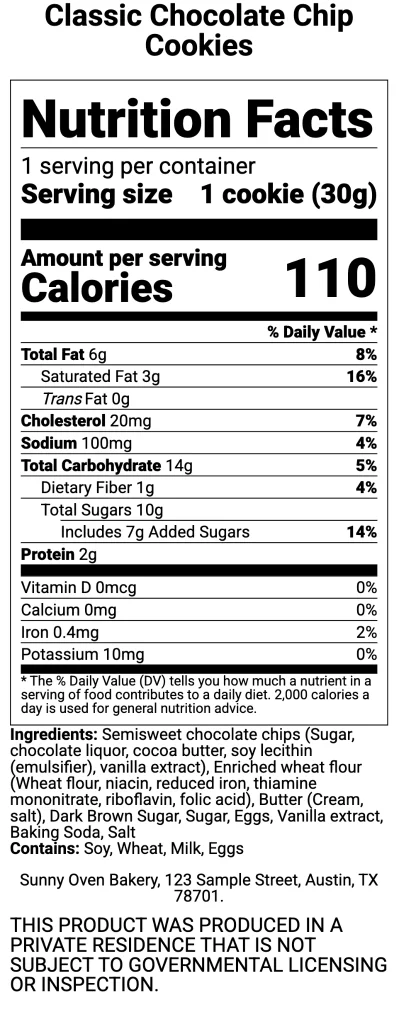
Example Texas cottage food label
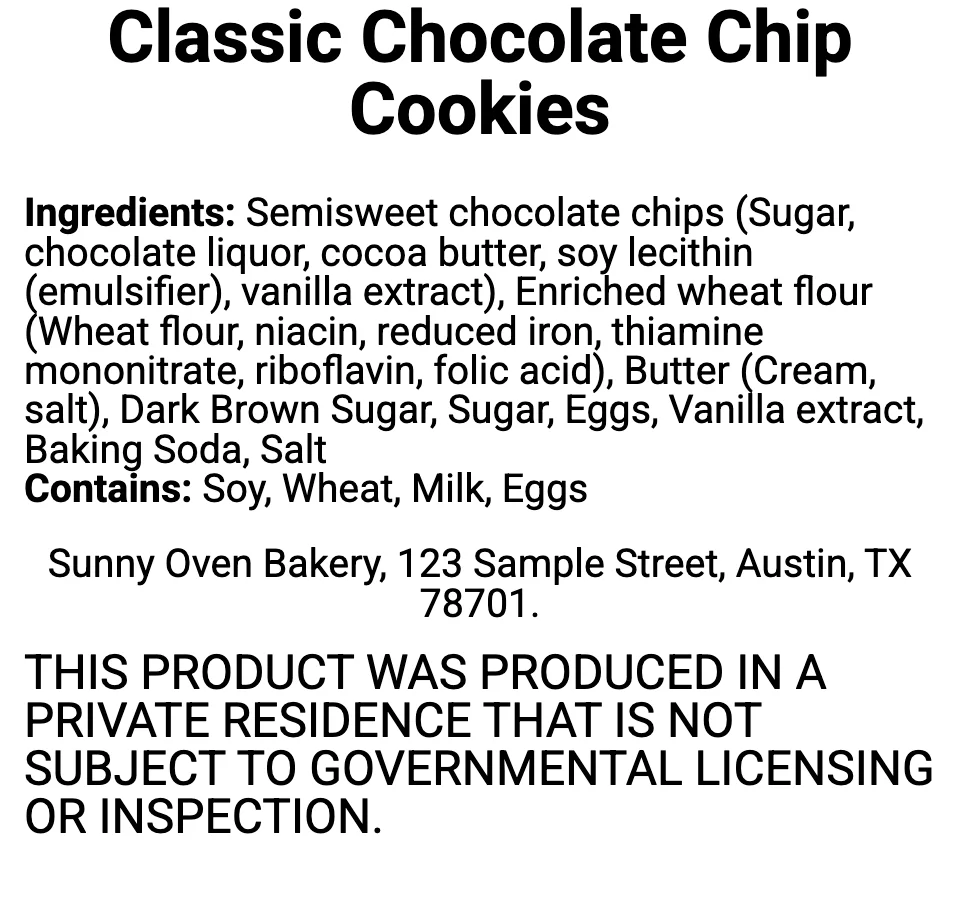
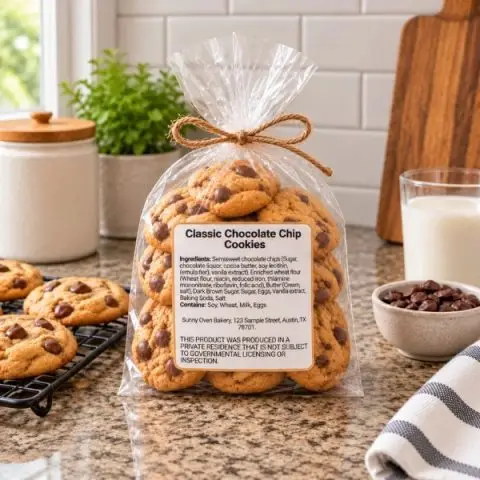
Example label text:
Classic Chocolate Chip Cookies
Ingredients: Semisweet chocolate chips (sugar, chocolate liquor, cocoa butter, soy lecithin (emulsifier), vanilla extract), enriched wheat flour (wheat flour, niacin, reduced iron, thiamine mononitrate, riboflavin, folic acid), butter (cream, salt), dark brown sugar, sugar, eggs, vanilla extract, baking soda, salt.
Contains: Soy, Wheat, Milk, Eggs.
Sunny Oven Bakery, 123 Sample Street, Austin, TX 78701
THIS PRODUCT WAS PRODUCED IN A PRIVATE RESIDENCE THAT IS NOT SUBJECT TO GOVERNMENTAL LICENSING OR INSPECTION.
How to create a compliant cottage food label with Food Label Maker
You can use Food Label Maker to create a Texas cottage food label that includes everything the law requires. It writes the ingredient statement and allergen declaration from your recipe, holds your business details and the required Texas statement, and lets you choose exactly what appears on the label you print. The example label above was made this way.
- Sign up and enter your recipe: each ingredient and its quantity. Food Label Maker matches each ingredient to our verified database of 500,000+ ingredients, and you can add sub-ingredients from your supplier’s label, such as the soy lecithin in chocolate chips.
- Review your ingredient statement and allergens. Ingredients are listed in descending order by weight, and the Big 9 allergens appear in a “Contains” line, so you can check both before you print.
- Add your business name and your home address, or your DSHS identification number if you have registered.
- Add the required Texas statement to your label notes, in capitals and word for word. If your product needs a batch number or the date made, add it to the label notes too.
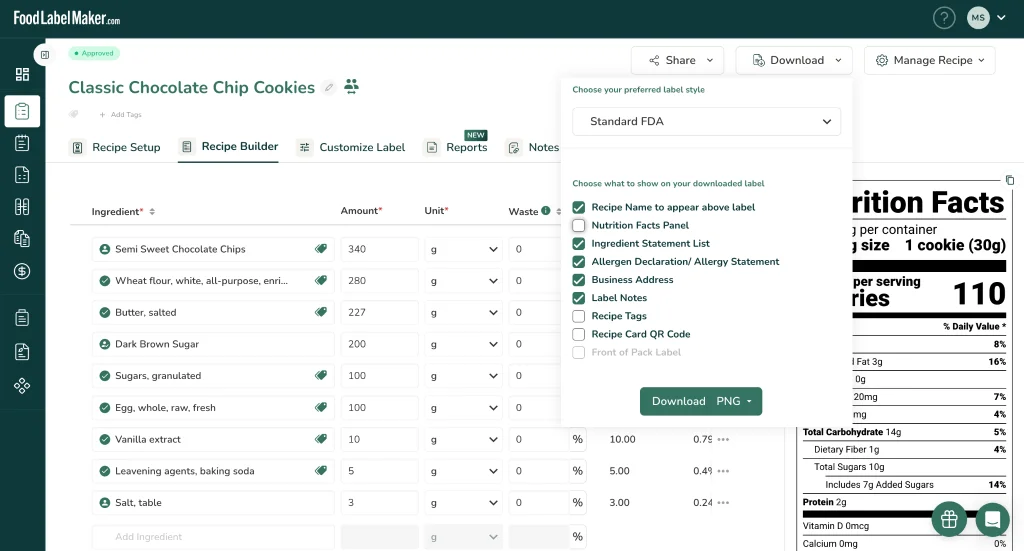
- Choose what appears on your label by ticking the parts you want on the printed label. For a Texas cottage food label, tick Recipe Name, Ingredient Statement List, Allergen Declaration, Business Address and Label Notes. Leave Recipe Tags unticked, since they are for your own records, and leave Nutrition Facts Panel unticked unless you want to add one by choice.
You can create your first label free when you sign up.
Know every allergen in your recipe before your customers ask.
Do cottage foods need a Nutrition Facts label in Texas?
No. The Texas cottage food law does not require a Nutrition Facts panel or an ingredient list. A Nutrition Facts panel becomes required as soon as you make a nutrition claim.
Nutrition and health claims
The DSHS cottage food rule says any health or other claims must follow FDA’s labeling rules. Under FDA rules, a claim such as “sugar free”, “low fat”, “high protein” or “keto friendly” on your label, website or social posts removes the small business nutrition labeling exemption, so that product needs a full Nutrition Facts panel. The claim itself must also meet FDA’s definitions; our guide to FDA nutrient content claims explains them.
Why many cottage sellers add an ingredient list anyway
An ingredient list is optional in Texas, but we recommend it. It shows customers where each allergen comes from, it answers the questions you get at every market table, and it is required in full once you sell as a licensed food business. Our FDA ingredient list guide explains the order and naming rules.
Some sellers also add Nutrition Facts by choice, often because customers with diabetes or food allergies ask for it. If you do, the panel must be accurate and follow FDA format.
When you outgrow the Texas cottage food law
You move outside the cottage food law when your gross annual sales go over the cap, when you want to sell shelf-stable products to stores yourself rather than through a cottage food vendor, when you want to ship orders or sell outside Texas, or when you start producing in a commercial kitchen. At that point you generally need a DSHS Food Manufacturer license, and your labels must follow FDA’s full packaged food rules:
- net quantity of contents,
- a full ingredient list in descending order by weight,
- an allergen statement,
- the name and place of business of the manufacturer, packer or distributor, and
- a Nutrition Facts panel, unless the product qualifies for FDA’s small business nutrition labeling exemption.
Food Label Maker is built for this step. You enter each recipe once and get an FDA-compliant Nutrition Facts label, ingredient statement and allergen statement, in the label format your packaging needs. Our US nutrition label templates show the formats available.
Growing past cottage food? Your recipes come with you.
Texas cottage food law FAQs
1. Do I need a cottage food license in Texas?
No. Texas has no cottage food license, and local governments cannot require a permit or fee. You only need DSHS registration if you sell refrigerated (TCS) foods or want a unique ID number on your label instead of your address.
2. Can I sell cottage food online in Texas?
Yes, within Texas, if you or someone in your household or business personally delivers the order. Your website must show the required label information before the customer pays, and mail-order shipping is not allowed.
3. Do you have to pay sales tax on cottage food in Texas?
It depends on the product. Baked goods sold to go, without plates or eating utensils and without heating, are generally not taxed, while candy, gum and soft drinks are taxable. If you sell taxable items, you need a Texas sales tax permit, so check your product mix with the Comptroller.
4. Can I sell to a coffee shop or grocery store?
Not directly. Shelf-stable cottage foods can reach stores and restaurants only through a registered cottage food vendor, and the label must show the date made. Refrigerated foods cannot be sold this way.
5. What happens if I go over $150,000 in sales?
You are no longer covered by the cottage food law and generally need a food manufacturer license and a commercial facility. DSHS adjusts the cap for inflation each year, so check the DSHS cottage food page for the current figure.
Want a labeling consultant to check your cottage food labels?