Google will tell you beef jerky needs to hit a strict 0.75:1 moisture-to-protein ratio to legally use the word “jerky.” That rule doesn’t exist anymore – the USDA quietly killed it in 2025, and most of the internet hasn’t caught up.
What actually decides whether your beef jerky nutrition facts label is legal comes down to three things: which USDA approval track your claims fall into, how dehydration messes with your nutrition math, and whether your bag size forces a dual-column label. Get any of these wrong and your product can’t legally ship until it’s fixed.
Here’s how to build a beef jerky nutrition label that’s fully U.S market-compliant, in Food Label Maker, step by step.
Need help creating a beef jerky nutrition label? Hire a regulatory expert who can get it done for you in 3-5 business days.
Key takeaways
- Beef jerky falls under USDA regulation (9 CFR Part 317), not FDA. Nutrition claims like “no nitrates added” or “grass-fed” require FSIS sketch approval before the label can be used; a plain jerky label can self-certify under generic approval instead.
- The old 0.75:1 moisture-to-protein ratio rule no longer exists. FSIS removed it from its Policy Book in 2025, and the real food-safety benchmark is water activity at 0.85 or below.
- The RACC for beef jerky is 30g, and every number on the panel has to come from the finished, dried weight, not the raw marinade, since dehydration concentrates protein, sodium, and fat as water leaves the product.
- Most beef jerky easily clears the 20% DV threshold for a “high protein” claim, but a “low sodium” claim is nearly impossible without reformulating the recipe.
- Dual-column labeling isn’t tied to a fixed package size. It depends on how the bag is declared and whether it passes the “reasonably consumed in one sitting” test.
- Getting the recipe and moisture-loss yield adjustment right comes first. RACC, claims, and allergen declarations all follow directly from those two numbers.
Is Beef Jerky Regulated by USDA or FDA?
The USDA regulates beef jerky, not FDA, under Title 9 CFR Part 317, which sets the label format, placement, and container marking rules for meat and poultry products. The bigger question for most brands is whether their nutrition label needs approval before it can be used at all.
Most plain jerky labels can self-certify under USDA’s generic approval system, no waiting or submission required. But beef jerky labels claiming grass-fed, no nitrates added, non-GMO, or organic need FSIS sketch approval first, submitted and approved before the food label goes on the product.
The safest advice for beef jerky nutrition labels is for food businesses to check nutrition claims before printing.
What Goes on a Beef Jerky Nutrition Label?
A beef jerky label carries the same Nutrition Facts panel as any packaged snack: serving size, calories, protein, sodium, fat. Those values have to be calculated from the finished dried product, not the raw marinade recipe.
What’s the Serving Size (RACC) for Beef Jerky?
Beef jerky’s reference amount (RACC) is 30 grams, listed as “dried, e.g., jerky” in the FDA reference amount table, the same table USDA uses to set jerky’s serving size on the label.
Common Labeling Mistakes for Beef Jerky Food Labels
The most common labeling mistake for beef jerky nutrition labels is calculating nutrition values from the raw marinade – values for the nutrition facts panel but come from the finished, dried beef jerky.
Remember, dehydration removes water, not nutrients meaning, a 100g batch of raw marinated beef that dries down to 40g of finished jerky concentrates every nutrient as it loses water weight. Therefore, protein, sodium, and fat per gram all rise, so the nutrition label has to reflect that smaller, denser finished weight. If the raw ingredient list is used to calculate nutrient content, the panel will severely understate calories, protein, sodium, and fat across the board.
Can Beef Jerky Be Labeled “High Protein” or “Low Sodium”?
Beef jerky nutrition labels can usually qualify for protein claims but are highly unlikely to qualify for sodium claims.
“High,” “rich in,” or “excellent source of” protein requires 20% or more of the Daily Value per serving under 9 CFR 317.354(b)(1), which works out to 10g of protein per 30g RACC. Most beef jerky clears that easily once the numbers are recalculated for the dehydrated weight, often landing at 9 to 13g of protein per serving.
“Good source of protein” requires only 10-19% of daily value per serving, also making it an achievable, and common, nutrient claim for beef jerky,
Sodium claims are harder to attain, on beef jerky labels, because a typical 30g serving has about 400-600mg of sodium making it a food product high in sodium. A claim of “Low Sodium” requires 140mg or less per RACC, which almost no regular beef jerky would qualify for without needing a massive recipe reformulation.
See How FoodLabelMaker Can Help You
What Label Format Does Beef Jerky Need?
For beef jerky, the nutrition label format comes down to two things: whether your bag size pushes you into dual-column territory, and whether vertical or tabular actually fits the package.
Does Beef Jerky Need a Dual-Column Label?
Dual-column labeling shows nutrition values two ways: per serving and per package, side by side, so a shopper can see both without doing the math themselves.
For beef jerky, whether you need it comes down to how your bag gets declared. Under 9 CFR 317.309(b)(8), a bag with less than 200% of the 30g RACC is declared a single serving. A bag at 200% or more can still be declared a single serving, but only if it passes the “reasonably consumed at a single-eating occasion” test, a judgment call based on how the product is actually packaged and eaten, not a strict formula.
| Jerky Package Type | Typical Package Size (oz) | Can the Whole Package Be Eaten in One Sitting? | Serving Size Declared on Label |
| Snack-size jerky bag | 2 to 3 oz | Yes | Single serving |
| Resealable multi-serve bag | 8 to 10 oz | No, built for repeat snacking | Multiple servings |
If the bag doesn’t clear that test, it’s declared as multiple servings, and dual-column becomes an available format. This is not something the USDA automatically requires at a set servings count the way the FDA does for its own regulated foods.
Many brands still choose it once a bag lands around 2 to 3 servings, since it’s clearer for shoppers than a single column under a high total count. If you’d like to confirm your serving size with a regulatory expert, click here for more information.
Vertical or Tabular: Which Label Format Is Correct for Beef Jerky?
Vertical format is the standard Nutrition Facts layout most shoppers recognize, one column of information stacked top to bottom. Tabular format lays that same required information out horizontally instead, built for packages that don’t have enough vertical room for the standard layout.
Tabular display is allowed when a label doesn’t have roughly 3 inches of continuous vertical space to fit all the required nutrients. A narrow jerky bag, especially a tall, slim pouch, often runs into exactly this space constraint, since the printable area for the nutrition panel competes with front-of-pack branding, the ingredient statement, and required USDA elements like the establishment number.
If your bag has the vertical room, stick with the familiar vertical format shoppers expect. If it doesn’t, tabular keeps you compliant without shrinking the type size below the required minimums.
Beef Jerky Nutrition Facts Label Benchmarks From Top U.S. Brands
Checking nutrition facts against established food businesses is common practice among regulatory experts, and it’s a smart first step before finalizing your own label. If your sodium, protein, or calorie numbers land far outside what top U.S. brands already declare for a similar product, that’s usually a sign worth double-checking your recipe or your serving size math before you print.
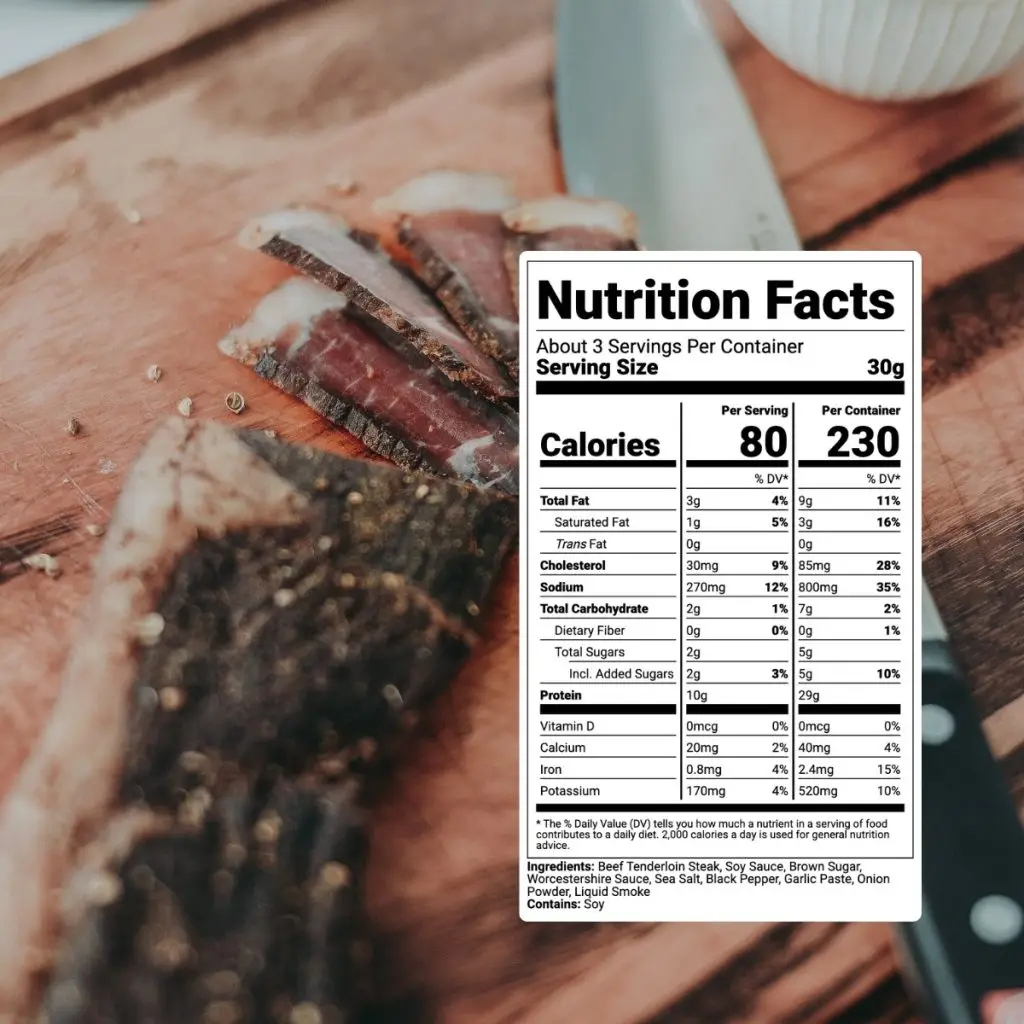
Here’s a quick comparison table showing the nutrition facts of Jack Link’s Original, Country Archer Original and KRAVE Sea Salt Original Beef Jerky.
| Brand | Serving Size | Servings/Container | Calories (per serving) | Sodium (per serving) | Protein (per serving) | Format |
| Jack Link’s Original | 1oz (28g) | About 3 | 80 (230 per container) | 520mg (1,490mg per container) | 10g (30g per container) | Dual-column |
| Country Archer Original | 1oz (28g) | About 2.5 | 70 | 420mg | 9g | Single-column |
| KRAVE Sea Salt Original | 1oz (28g) | About 2.6 | 80 | 300mg | 8g | Single-column |
All three, top U.S beef jerky products, land in the same 2.5 to 3 servings-per-container range, the zone where a small bag could reasonably be finished in one sitting, yet only Jack Link’s uses dual-column format; Country Archer and KRAVE stick with single-column. That’s further proof that dual-column is a formatting choice for each brand rather than a mandatory regulation.
Sodium and protein numbers show a similar pattern. Even KRAVE’s lowest sodium figure, 300mg, is still more than double the 140mg “low sodium” threshold, so none of these three could carry that claim without reformulating. On protein, Jack Link’s 10g clears the “high protein” cutoff exactly, while Country Archer’s 9g and KRAVE’s 8g both land in “good source of protein” territory instead, the one-gram gap that often decides which nutrition claim makes it onto the front label.
How to Build a Compliant Beef Jerky Label in Food Label Maker
Here’s the full process, start to finish, using an Original-style beef jerky recipe as the working example.
Step 1: Set Up Your Recipe
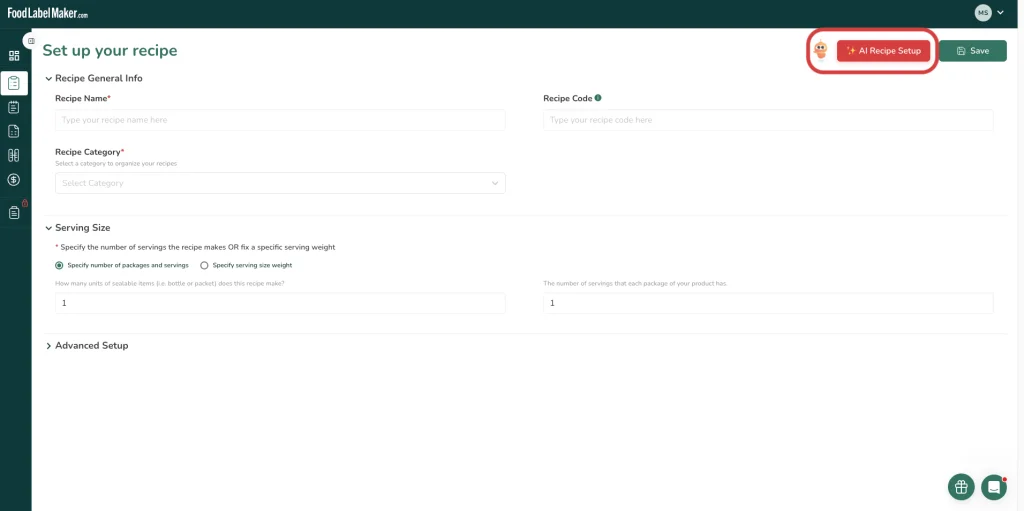
Before entering ingredients, set up the basics in Recipe Setup: recipe name, category, and how you want to define serving size, either by number of packages and servings or by a fixed serving weight.
For a quicker, and more efficient workflow, you can opt for the AI Recipe Setup. This option draws from our Regulatory Intelligence Assistant (RIA) to transform any recipe into a compliant nutrition label by simply pasting either a list of ingredients or a file/image of a recipe.
Step 2: Enter Your Recipe by Weight
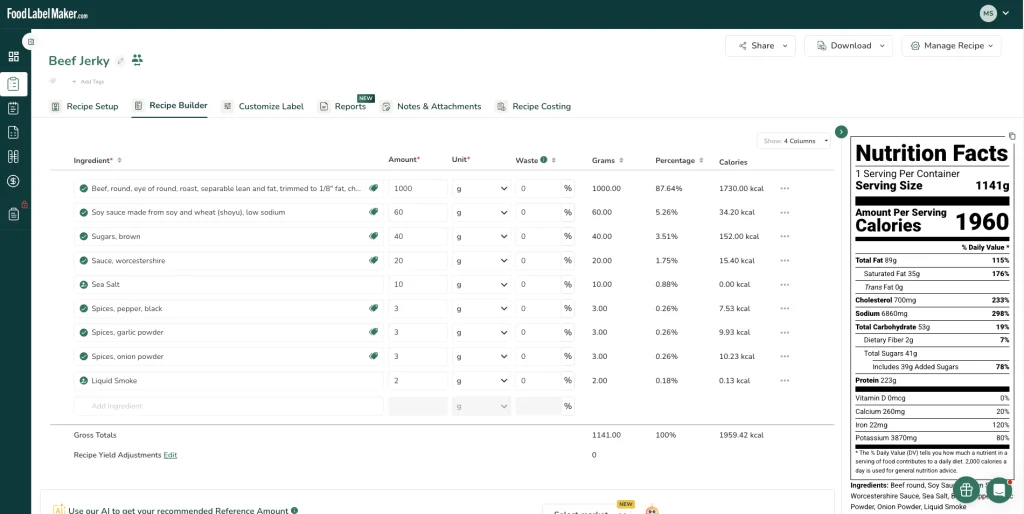
Build the recipe in Recipe Builder using the raw, marinated ingredients before dehydration, entering each one by weight. For this example: 1,000g beef, 60g soy sauce, 40g brown sugar, 20g Worcestershire sauce, 10g sea salt, 3g black pepper, 3g garlic paste, 3g onion powder, and 2g liquid smoke, for a gross total of 1,141g.
Step 3: Adjust For Moisture Loss After Dehydration
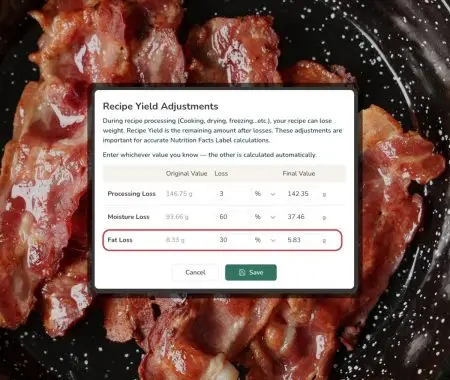
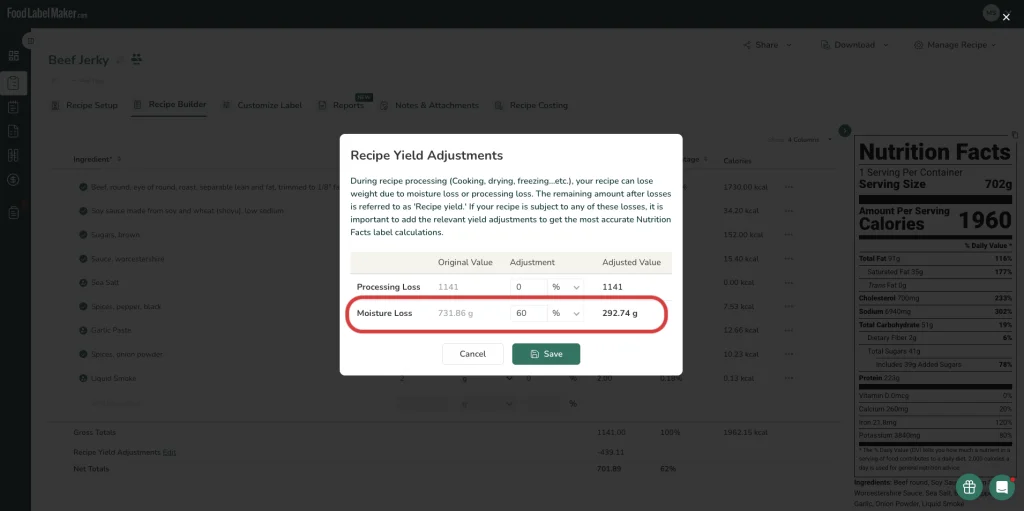
Dehydration removes water weight, not nutrients, so the panel has to reflect the finished, dried product instead of the raw batch. To get this number for your own recipe, weigh the raw marinated batch before drying and the finished jerky after drying, then calculate the percentage lost between the two. For this recipe, that worked out to 60% Moisture Loss entered into Recipe Yield Adjustments, applied against the recipe’s moisture-bearing ingredients rather than the full batch weight. That brought the net total down to 701.89g, about 62% of the original 1,141g batch.
For a deeper dive into recipe yield adjustments, read our blog: Moisture Loss in Food Labeling: Formula, Chart & How to Calculate Yield for Accurate Nutrition Labels
Step 4: Confirm Your Serving Size With the AI RACC Check
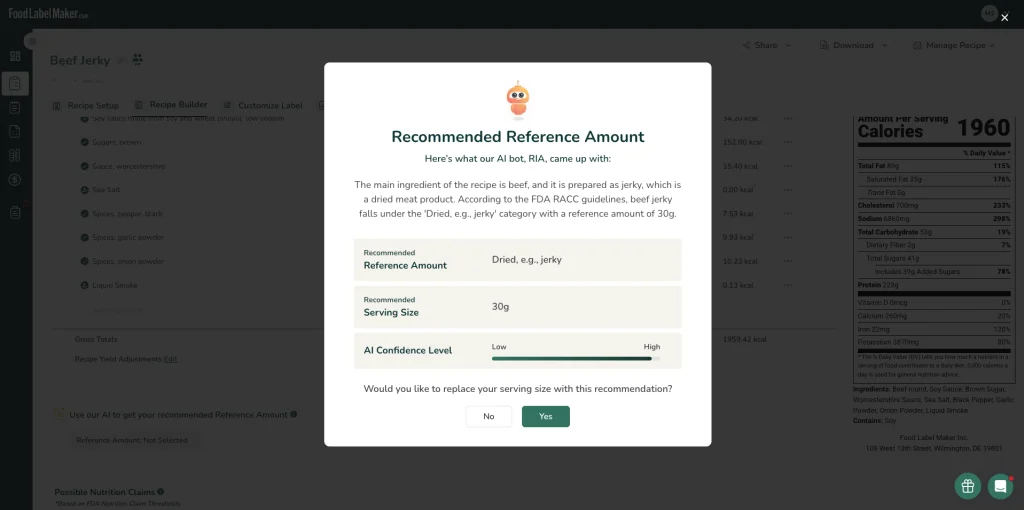
Run the AI RACC check to confirm the serving size against the correct food category, “Dried, e.g., jerky,” which returns the 30g reference amount. Accepting it adjusts and corrects the whole panel: 23 servings per container, 80 calories, 300mg sodium, and 10g protein per serving.
Step 5: Check Your Allergen Declarations
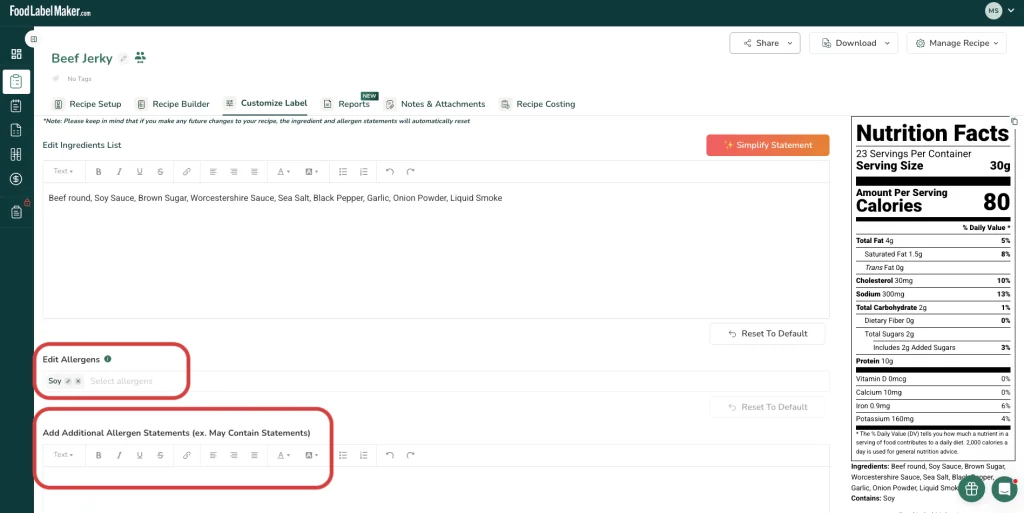
The Food Label Maker automated allergen management software feature suggests allergens based on the ingredients added.
Under Customize Label, Edit Ingredients/Allergens List auto-generates the ingredient statement and flags allergens straight from the recipe, for this marinade, that’s soy, pulled from the soy sauce.
Review the generated list and use the “Add Additional Allergen Statements” field for any “may contain” cross-contact language your facility needs. Do this after the recipe itself is finalized, since any later ingredient changes reset these statements automatically.
Step 6: Choose Your Label Format
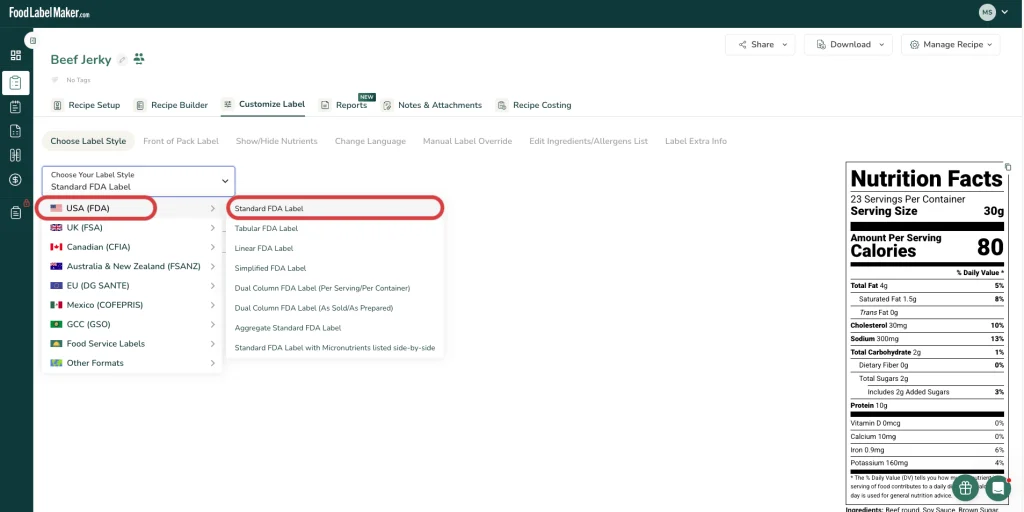
In Customize Label, pick the format that actually matches your package size. For a large batch like this one, 23 servings per container, Standard FDA Label is the right call, since it’s not something reasonably finished in one sitting. A smaller snack-size bag landing in the 2 to 3 serving range would instead use the Dual Column FDA Label (Per Serving/Per Container) option covered earlier.
Step 7: Check Your Nutrition Claims
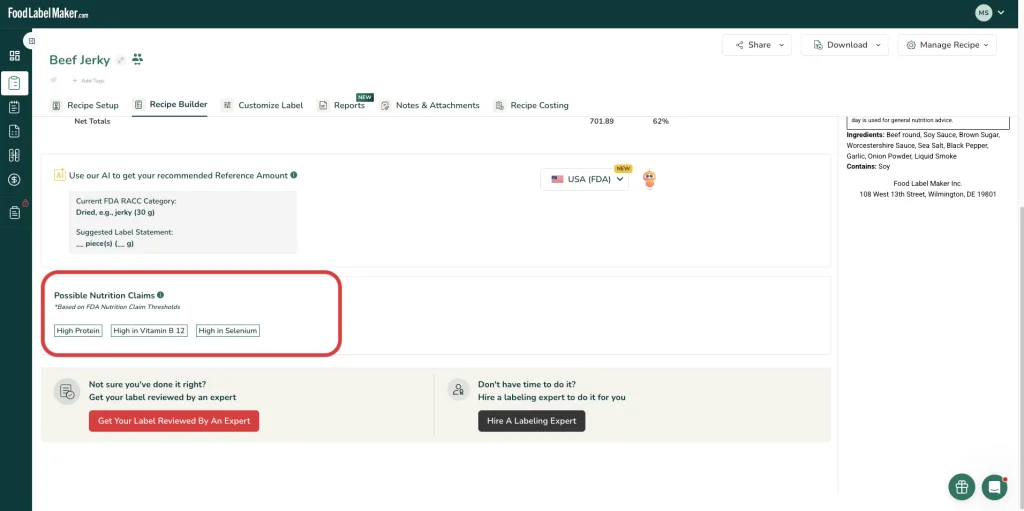
Before printing, confirm your numbers actually support any nutrient content claim you want on the package. This recipe’s 10g of protein per serving clears the 20% DV threshold for a “high protein” claim exactly. Sodium runs the other way: at 300mg per serving, it’s more than double the 140mg limit for a “low sodium” claim, so that one’s not possible without reformulating the recipe.
Build a Compliant Beef Jerky Nutrition Label With Confidence
Beef jerky’s label depends on two things getting handled correctly: the USDA facility inspection and label pre-approval process, and an accurate yield adjustment for moisture loss, since dehydration concentrates protein and sodium into a much smaller finished weight than the raw batch started with. Once those numbers are right, the rest of the label, from RACC to claims to allergens, follows directly from the recipe.
Build your beef jerky label in Food Label Maker and have a regulatory expert review it before it goes to print.
Frequently Asked Questions About Beef Jerky Nutrition Labels
1. What allergens need to be declared on a beef jerky label?
Beef itself isn’t a major allergen, but the marinade usually is. Soy sauce and Worcestershire sauce both introduce soy, and often wheat depending on the brand, so a jerky recipe built around a soy-based marinade typically carries a “Contains: Soy” or “Contains: Soy, Wheat” statement. Spice blends can also introduce sesame or tree nuts, so check every marinade ingredient individually rather than assuming beef jerky is allergen-free.
2. Does beef jerky have to meet a moisture-to-protein ratio to be labeled as jerky?
No. FSIS removed the moisture-to-protein ratio reference from its Food Standards and Labeling Policy Book in September 2025, and no regulation ever established that ratio as a legal standard of identity. The actual food-safety benchmark that governs shelf stability is water activity at 0.85 or below
3. Do small-batch or home-based beef jerky producers need USDA inspection?
Yes, if the product will be sold. Any jerky sold to the public, whether it’s a single farmers-market stand or a full production run, has to come from a USDA-inspected facility and carry a USDA-approved label, since jerky is a processed meat product under Title 9. There’s no small-batch or home-kitchen exemption the way there sometimes is for FDA-regulated foods.
4. Can beef jerky legally be labeled “no nitrates or nitrites added”?
Under 9 CFR 317.17, a cured-style product made without any added nitrate or nitrite has to carry a “No Nitrate or Nitrite Added” statement next to the product name, in lettering at least half the size of the name.
This disclosure exists because nitrite normally does more than season a cured product, it’s what stops Clostridium botulinum from growing in a shelf-stable item, so a version made without it needs to be clearly flagged as lacking that built-in protection. That’s also why the rule pairs the claim with a “Not Preserved, Keep Refrigerated” statement, unless the product is dried to a water activity of 0.92 or below, which properly made jerky already meets.
Natural curing sources like celery powder still introduce nitrate into the product, and FSIS has proposed tightening this rule since 2020 to require extra disclosure in that case, but that change was never finalized, so it isn’t currently a legal requirement
5. What should the product name on a beef jerky label actually say?
The name needs to accurately describe what’s in the package, so a marinade-heavy recipe should be named to match, like “Teriyaki Beef Jerky” or “Spicy Beef Jerky,” not just “Beef Jerky” if the flavor is a defining characteristic. There’s no fixed standard of identity locking in an exact name the way there is for some FDA-regulated foods, but USDA still requires the common or usual name to be truthful and not misleading about what the product is.