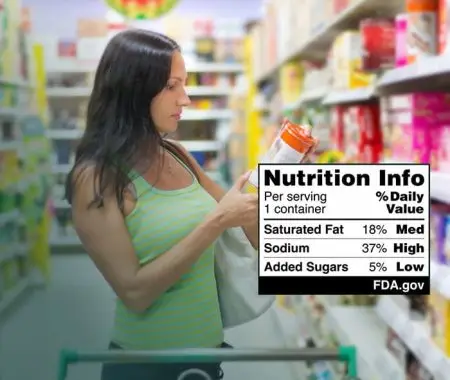
When you’re browsing the aisles of your favorite grocery store, you’re not just shopping for food – you’re also making decisions that impact your health and wellness. That’s where Percent Daily Value (%DV) becomes your nutritional compass.
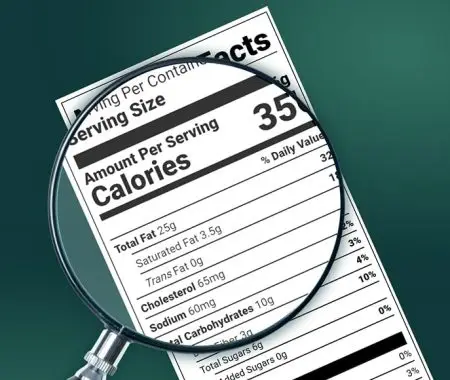
This little percentage, found on the Nutrition Facts label of packaged foods, guides you through the landscape of dietary choices, helping you to discern which foods align with your nutritional needs. The FDA underscores the importance of %DV in empowering consumers to make informed food choices that contribute to a healthful diet. For businesses, ensuring that these labels provide clear, FDA-compliant nutritional information is paramount.
This guide will delve into the essentials of calculating %DV, simplifying the complexities of other nutrient values, and ensuring you’re informed about the Daily Values recommended by the FDA. To assist in this process, Food Label Maker offers a streamlined tool that accurately and automatically calculates %DV and formats your Nutrition Facts panel to FDA standards. Try our nutrition label software today, or browse our pricing plans to find the right fit for your business.
See How FoodLabelMaker Can Help You
Key Takeaways
- Percent Daily Value (%DV) shows how much a nutrient in one serving contributes to the recommended daily intake, based on a 2,000-calorie total daily diet.
- FDA Daily Values provide general nutrition advice for most people and help compare different nutrients across foods.
- To calculate percent daily value, divide the nutrient amount per serving by the FDA Daily Value and multiply by 100. As a general rule, a %DV of 5% or less is low, while 20% or more is high. Serving size directly affects %DV.
What Is Percent Daily Value (%DV)?
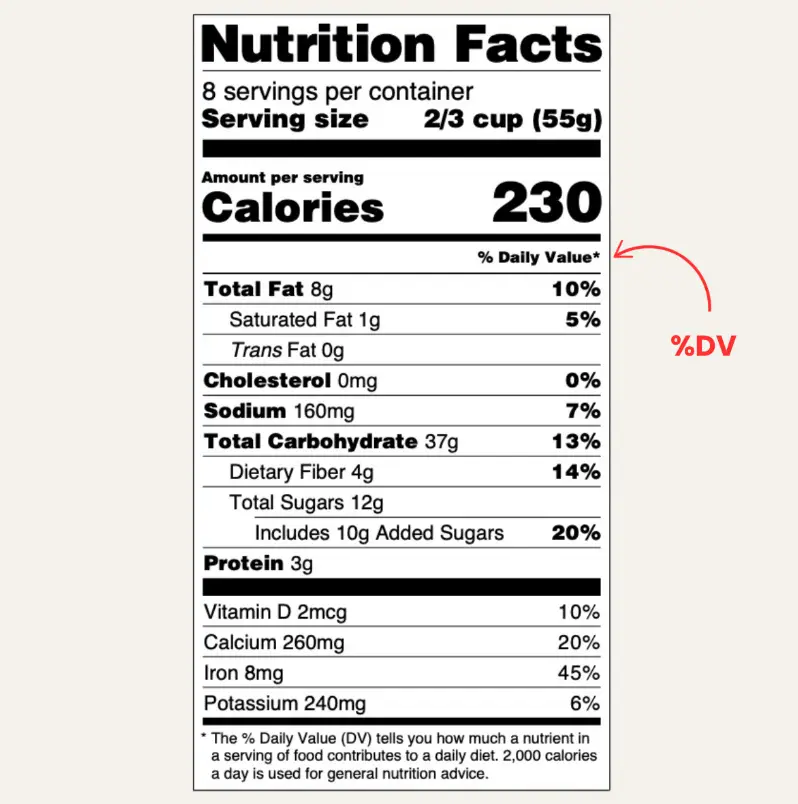
Percent Daily Value (%DV) is the percentage of a nutrient in a single serving of food compared to the total amount you should consume in a day as part of your total daily diet, providing general nutrition advice rather than personalised dietary guidance. It provides a quick, standardised benchmark to determine whether a food contains a little or a lot of a particular nutrient—such as fat, fibre, sodium, or vitamins—based on a 2,000-calorie reference diet used by the FDA.
FDA Daily Values Used to Calculate %DV
Knowing the %DV requires understanding the FDA’s Daily Values (DVs) for each nutrient. These values are established based on current scientific data and updated periodically. Using the correct DV is essential for accurate calculations and compliant labels.
Standard Daily Values for Macronutrients and Micronutrients
Below is an updated reference list of commonly required FDA Daily Values:
| Nutrient | FDA Daily Value (DV) |
| Total Fat | 78 g |
| Saturated Fat | 20 g |
| Carbohydrates | 275 g |
| Added Sugars | 50 g |
| Protein | 50 g |
| Dietary Fibre | 28 g |
| Sodium | 2,300 mg |
| Potassium | 4,700 mg |
| Calcium | 1,300 mg |
| Iron | 18 mg |
| Vitamin D | 20 mcg |
How to Calculate Daily Value: The %DV Formula
The Percent Daily Value (%DV) is calculated using a simple formula:
- %DV = (Amount of nutrient per serving ÷ FDA Daily Value) × 100
Calculating Percent Daily Values (%DV) is a key aspect of understanding food labels. While tools provided by companies like Food Label Maker automatically calculate the %DV for you when creating nutrition facts labels, this knowledge is vital for both consumers and food manufacturers. Consumers benefit by gaining a deeper insight into their dietary intake to make more informed food choices. For food manufacturers, these values are essential for securing nutrient content claims, such as ‘High in Protein’ or ‘Excellent Source of Fiber’, which serve as powerful marketing tools to differentiate their products. Let’s explore the practical steps and tips for accurately calculating %DV.
Step-by-Step %DV Formula Explained
Understanding how to calculate %DV becomes much easier when you break the process into simple, repeatable steps. Whether you’re working with fats, carbohydrates, vitamins, or minerals, the calculation follows the same logic every time:
- Find the nutrient amount per serving (from lab analysis or nutrition software)
- Look up the FDA Daily Value (DV) (see table above or official FDA daily value amounts)
- Divide the nutrient amount by the DV
- Multiply by 100 to convert the value to a percentage
- Round appropriately according to FDA rounding rules
- This method applies to all nutrients, regardless of whether they’re measured in grams, milligrams, or micrograms.
How to Calculate %DV Using the DV Reference Table
Using the DV table makes calculations quick and accurate.
Example with dietary fibre:
- DV = 28 g
- Serving contains 7 g
- 7 ÷ 28 × 100 = 25% DV
This approach works for all nutrients—including sodium, sugars, fat, and vitamins.
FDA Rounding Rules for %DV
When declaring nutrients other than vitamins and minerals that have Recommended Daily Intakes (RDIs) as a %DV, it’s important to follow the FDA’s rounding rules:
- Round to the nearest 1% DV increment.
- For amounts less than 1% DV, it can be expressed as “<1% DV.”
These rounding rules help in maintaining consistency and clarity on nutrition facts labels, making it easier for consumers to understand and compare products.
For a detailed walkthrough on the regulations, read our blog on FDA Rounding Rules.
Calculating %DV: Real-World Examples
Example 1: How to Calculate the %DV for Fat
Suppose a serving of a snack contains 8 grams of total fat.
The fat DV set by the FDA is 78 grams.
Using the formula:
- (8 g ÷ 78 g) × 100 = 10% DV
This means one serving provides 10% of the recommended daily amount of total fat for someone following a 2,000-calorie diet.
Example 2: How to Calculate the %DV for Sodium
Imagine a packaged soup that contains 460 milligrams of sodium per serving.
The FDA Daily Value for sodium is 2,300 milligrams.
Using the formula:
- (460 mg ÷ 2,300 mg) × 100 = 20% DV
This means one serving of the soup provides 20% of the recommended daily sodium limit, which is considered a high amount. Because this product hits the 20% threshold, it is legally classified as “High Sodium.” Food manufacturers should be aware that this may require a disclosure statement if other healthy claims are made, or they may choose to reformulate to avoid this “high” designation.
Example 3: How to Calculate the %DV for Carbohydrates
Let’s say a granola bar contains 33 grams of carbohydrates per serving.
The Daily Value for carbohydrates is 275 grams.
Using the formula:
- (33 g ÷ 275 g) × 100 = 12% DV
This means the granola bar provides 12% of the recommended daily carbohydrate intake.
Example 4: How to Calculate the %DV for Added Sugars
If a beverage contains 10 grams of added sugars per serving, and the FDA Daily Value for added sugars is 50 grams:
Using the formula:
- (10 g ÷ 50 g) × 100 = 20% DV
This means the beverage contributes 20% of the maximum recommended daily added sugar intake, which is considered high.
Example 5: How to Calculate the %DV of Protein
Protein %DV is only required if the product makes a protein claim like “High in protein”. Unlike other nutrients, this calculation requires the PDCAAS (Protein Digestibility Corrected Amino Acid Score) to account for protein quality.
If a serving contains 10 grams of protein with a PDCAAS score of 1.0 (perfect digestibility), and the Daily Value is 50 grams:
Using the formula: (10 g × 1.0) ÷ 50 g × 100 = 20% DV
Reaching the 20% DV threshold allows food manufacturers to legally use the nutrient content claim “Excellent Source of Protein.” However, if the protein source has a low PDCAAS score, this claim may be considered invalid even with high gram counts. Manufacturers must choose high-quality protein sources to maintain premium marketing labels.
Note: If the protein quality is lower (e.g., Wheat Gluten with a PDCAAS of 0.25), the %DV would drop significantly even if the gram weight stays the same.
Example 6: How to Calculate %DV for Dietary Fiber
Suppose a serving of cereal contains 4 grams of dietary fiber.
The FDA Daily Value for dietary fiber is 28 grams.
Using the formula:
- (4 g ÷ 28 g) × 100 = 14% DV
This means one serving of the cereal provides approximately 14% of the recommended daily fiber intake for a person following a 2,000-calorie diet.
At 14% DV, this product qualifies as a “Good Source of Fiber” (which requires 10–19% DV). To reach an “Excellent Source” claim, the manufacturer would need to increase the fiber content to at least 5.6g per serving to hit the 20% mark.
Deeper Dive Into Nutrition Facts and %DV
What Does “DV” Mean in Nutrition?
DV, or Daily Value, is the FDA-established reference amount for how much of a nutrient most people should consume—or avoid exceeding—each day, based on FDA-defined recommended amounts. DVs are expressed in grams, milligrams, or micrograms and apply to nutrients such as fats, carbohydrates, protein, vitamins, and minerals.
For example, the DV for sodium is 2,300 mg, and the DV for dietary fibre is 28 g per day.
The Percent Daily Value (%DV) builds on this concept by indicating how much of that Daily Value a serving contributes. For example, if a product lists 5% DV of fat, it means that one serving contributes 5% of the total fat recommended per day on a 2,000-calorie diet.
%DV is calculated using a 2,000-calorie daily diet, which the FDA uses as a general guideline for nutrition labelling. Individual needs may vary, but %DV offers a consistent way to judge whether a food is high or low in a nutrient.
The Relationship Between %DV, Serving Size, and Nutrient Intake
%DV becomes meaningful only when viewed in the context of serving size. Because all nutrient amounts on a Nutrition Facts label are tied to the serving size, the %DV shown reflects the contribution of that one serving to your daily intake. If you eat more than one serving, your nutrient intake—and the effective %DV consumed—multiplies accordingly.
The %DV scale provides a simple way to interpret nutrient content without doing manual calculations. However, it’s important to note that %DVs do not add up to 100%; Each one represents its own independent contribution to daily intake, as different nutrients serve different types of physiological roles and are evaluated separately. Additionally, not all nutrients, such as total sugars or trans fat, have an assigned DV, so if they’re present in a food product, they will not display %DV values.
While %DV helps consumers evaluate food choices, it serves a secondary purpose for manufacturers: acting as the legal benchmark for using marketing claims like ‘low sodium’ “good source of fiber” or “high in vitamin C”. For example:
- A 5% DV of fat means the serving contributes 5% of the total fat recommended per day.
- 5% DV of fat = low fat
- A serving with 460 mg of sodium, compared to the DV of 2,300 mg, provides 20% DV.
- 20% DV of sodium = high sodium
- If a product lists 10% DV of fibre, it provides 10% of your recommended daily fibre intake per serving.
- 10% DV of fibre = moderate fibre contribution
By presenting nutrition information in a consistent format, %DV allows shoppers to:
- Compare nutrients across similar products
- Identify foods rich in beneficial nutrients (like fibre and iron)
- Notice foods high in nutrients to limit (like sodium, saturated fat, and added sugars)
What Is Considered a High or Low %DV?
Consumers often rely on %DV to understand whether a nutrient is present in beneficial or concerning amounts. The FDA defines “high” and “low” %DV as:
- A %DV of 5% or less per serving indicates that the nutrient is low.
- A %DV of 20% or more per serving suggests that the nutrient is high.
In terms of dietary choices, it’s generally advisable to opt for foods that are:
- Higher in %DV for nutrients like Dietary Fiber, Vitamin D, Calcium, Iron, and Potassium.
- Lower in %DV for Saturated Fat, Sodium, and Added Sugars.
Imagine a cereal that lists a 25% DV for dietary fiber per serving. According to the general guide, this cereal is considered a high-fiber product since it surpasses the 20% DV threshold.
If your dietary goal is to increase fiber intake, this cereal is a good choice. However, if you consume two servings of this cereal, you would be getting 50% of the DV for dietary fiber. This is half of the fiber recommended for the entire day, based on a standard diet, and underscores the importance of portion control and understanding how multiple servings can significantly impact your intake of specific nutrients.
Monitoring %DV is especially important for people managing or reducing the risk of chronic diseases, such as heart disease or diabetes, where nutrients like sodium, added sugars, and saturated fat play a significant role.
Consumers should essentially aim to choose foods that are higher in nutrients they need more of and lower in those they need less of.
Serving Size: Its Significance and How It Affects %DV
The serving size on a food label is more than just a suggestion; it’s a crucial factor in understanding nutritional content. Serving size, determined by the FDA, reflects the amount typically consumed and is not necessarily a recommendation of how much to eat. The % Daily Value (%DV) on the nutrition label is calculated based on this serving size.
If a package contains only one serving, the Nutrition Facts label may reflect values for the whole container, meaning the %DV represents total intake for that product.
This means that all the nutrient amounts and %DVs you see are specific to the serving size listed. For instance, if a package lists a serving size of one cup with a %DV of 20% for fat, consuming two cups would mean you’re taking in 40% of your daily recommended fat intake. It’s essential to compare your actual portion size with the serving size on the label to accurately gauge nutrient intake.
Fats: Types of Fats and Their Individual %DVs
Fats are a complex group in nutrition, divided into several types, each with a different impact on health. Saturated and trans fats are often highlighted on food labels due to their association with heart disease. The FDA recommends keeping these fats to a minimum, with %DVs based on a daily limit rather than a recommended intake.
Unsaturated fats, such as polyunsaturated and monounsaturated fats, are considered healthier options but aren’t required to include a %DV. When assessing a product’s fat content, look for lower %DVs of saturated and trans fats. For example, a product with 5% DV of saturated fat per serving is a better choice than one with 20% DV.
Carbohydrates: Understanding Total Carbs vs. Dietary Fiber
Carbohydrates on food labels are presented as “Total Carbohydrates,” which include dietary fiber, sugars, and other starches. Dietary fiber, an essential part of a healthy diet, is listed both as part of the total carbs and separately. This is because while it is a carbohydrate, it has different effects on health compared to other carbs. High dietary fiber is beneficial and is often associated with bowel movement improvement and a lower risk of heart disease and certain types of cancer.
The %DV for total carbohydrates includes all these types, but the dietary fiber will have its own %DV, indicating its specific contribution to your daily fiber intake. For a balanced diet, look for foods high in dietary fiber %DV and moderate in total carbohydrate %DV.
Sugars: Natural vs. Added Sugars and Their Impact on %DV
The sugars listed on the Nutrition Facts label include both natural sugars, found in fruits and dairy products, and added sugars, which are added during processing. The FDA’s recent labeling changes now require added sugars to be listed separately, helping consumers differentiate and make healthier choices.
While there is no %DV for total sugars, there is a %DV for added sugars. This distinction is crucial as consuming too much added sugar can lead to health issues like obesity and heart disease. The %DV for added sugars helps you understand how much of your daily sugar allowance is used up by each serving of a product. For a healthier diet, aim for foods with a lower %DV of added sugars. The term “includes” before Added Sugars on a food label signifies that the grams of Added Sugars are part of the total grams of Sugars listed for the product.
For food manufacturers, this %DV calculation is a critical regulatory and formulation metric. Since the FDA establishes a specific Daily Value of 50g for added sugars, manufacturers must monitor this percentage to ensure their labels are compliant. For example, if the %DV of added sugars is too high, it may disqualify the product from making “Healthy” claims or necessitate a recipe reformulation to meet the 5% (low) or 20% (high) thresholds that drive consumer purchasing decisions.
Common Mistakes & Tips for Ensuring Accuracy
Using the Wrong Serving Size (RACC Requirements)
Incorrect serving sizes are one of the most frequent causes of inaccurate %DV values and one of the most common food labeling mistakes that food manufacturers make. Since all nutrient amounts and %DVs are calculated per serving, an incorrect serving size leads to errors across the entire food label.
- Serving sizes must follow the FDA’s Reference Amounts Customarily Consumed (RACC) tables.
- Always verify that the serving size used in calculations matches the one listed on the label.
- Remember that %DV is based on a 2,000-calorie diet. If your product is intended for a different population (e.g., children), the %DV may need adjustment.
Using Outdated FDA Daily Values
- Some older databases, calculators, or spreadsheets still rely on pre-2016 DVs.
- Since the FDA updated many Daily Values—including fibre, sodium, and several vitamins—using outdated numbers will result in inaccurate %DVs.
- Always reference the latest DV table to ensure your label meets current FDA requirements.
Rounding Errors in Nutrition Labelling
The FDA has specific rounding rules for both nutrient amounts and %DV values. Manual calculations often introduce inconsistencies, especially when dealing with nutrients measured in milligrams or micrograms.
- %DV must be rounded to the nearest whole percentage, unless it is less than 1%, in which case it may be shown as <1%.
- Nutrient amounts also have mandated rounding thresholds that must align with the format of the Nutrition Facts label.
Using a daily value calculator helps prevent rounding problems that can lead to non-compliant labels.
Final Thoughts on Calculating Percent Daily Value (%DV) for Food Labeling
Understanding how Percent Daily Value is determined—how Daily Values work, how %DV is calculated, how to interpret high and low values, and how serving sizes affect nutrient intake is essential for creating clear, accurate, and FDA-compliant Nutrition Facts labels.
By applying the correct DVs, following FDA rounding rules, and using consistent serving size information, manufacturers can ensure that their nutrition labels are fully compliant with the FDA regulations and help consumers make informed dietary decisions.
Of course, putting these principles into practice can be time-consuming, especially when managing multiple food products or frequent recipe updates. Food Label Maker’s software streamlines this entire workflow by automating nutrient calculations and generating compliant nutrition facts labels in minutes. This not only saves you valuable time but also gives you the confidence that your products are ready for the market.
Ready to simplify your labeling process? Create a free label to see how our tool works, or view our pricing plans to find the perfect solution for your business.
Frequently Asked Questions About How to Calculate Percent Daily Value
How do you calculate percent daily value?
The Percent Daily Value (%DV) tells consumers how much a nutrient in a serving of food contributes to a total daily diet.
It is calculated by dividing the amount of the nutrient in a serving by the FDA’s recommended Daily Value (DV) for that nutrient, then multiplying by 100. The standard baseline is a 2,000-calorie diet.
For example, if the Daily Value for Sodium is 2,300mg and your product contains 230mg per serving: (230 ÷ 2,300) x 100 = 10% DV.
Food Label Maker’s intuitive software simplifies these complicated calculations for daily percent values. Sign up for free to try our tool out or view our pricing plans to get started right away.
How do you calculate the percent daily value for total fat?
To calculate the %DV for Total Fat, you divide the amount of total fat in a serving by the FDA’s recommended Daily Value (DV), and then multiply it by 100. The standard baseline is a 2,000-calorie diet.
The standard FDA Daily Value of total fat is 78g (for adults and children over 4 years old). So you would simply take the grams of fat in your serving, divide it by 78, and multiply by 100.
As an example, if your snack bar contains 12g of Total Fat, your calculation would be:
(12g ÷ 78g) x 100 = 15% DV
You must then apply rounding rules (usually to the nearest percent) to ensure compliance.
Food Label Maker’s nutrition facts label software instantly computes fat percentages and applies the necessary rounding rules to your labels. Try our nutrition label software or view our pricing plans to get started.
How do you calculate the percent daily value of protein?
Calculating the %DV for protein is more complex than other nutrients, as the FDA requires the inclusion of the PDCAAS (Protein Digestibility Corrected Amino Acid Score) to ensure accuracy.
If you make any nutrition claims like “High Protein” or the food is for infants/children under 4, you must adjust for protein quality using the PDCAAS when listing the %DV for protein.
The FDA-Compliant Formula is
(%DV = (Protein in Grams × PDCAAS Score) ÷ 50) × 100
For example, 10g of protein from wheat (low score) yields a much lower %DV than 10g of protein from milk (perfect score).
- 10g of Wheat Gluten (PDCAAS 0.25): Calculation: (10 x 0.25) ÷ 50 x 100 = 5% DV
- 10g of Milk Protein (PDCAAS 1.0): Calculation: (10 x 1.0) ÷ 50 x 100 = 20% DV
Even though the gram amount is identical, the compliant value on the label changes drastically based on quality.
Because this requires specific digestibility data, manual calculation is often prone to errors. Tools offered by brands like Food Label Maker accurately calculate these values in an instant, providing food service businesses and manufacturers with peace of mind when it comes to creating compliant nutrition labels. Generate a nutrition facts label to test this feature or sign up today.

Related Posts