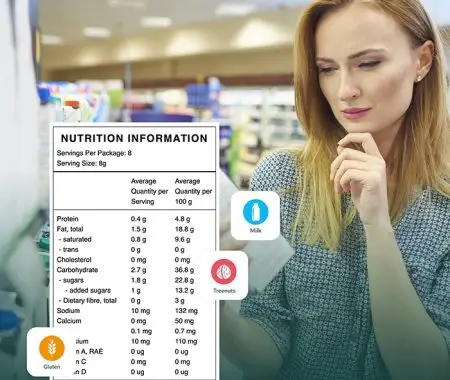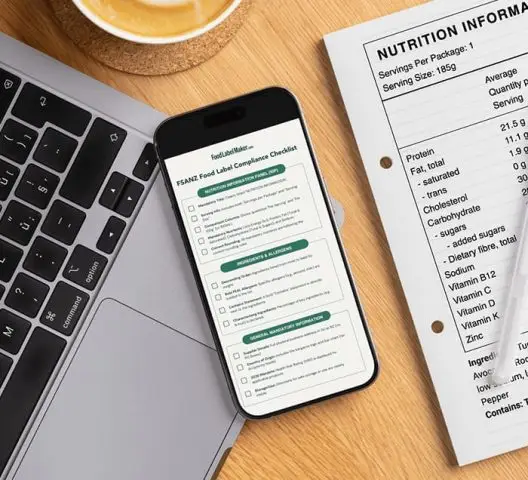
Understanding food compliance in Australia and New Zealand starts with the nutrition information panel (NIP). This guide provides a high-level overview of the mandatory requirements and explains the significance of each nutrient to help you build a nutrition label that is both compliant and informative.
At a Glance: FSANZ Nutrition Information Panels
- Mandatory Nutrients: All NIPs must list Energy (in kJ), Protein, Total Fat, Saturated Fat, Carbohydrates, Sugars, and Sodium.
- Dual Columns: You must show quantities “Per Serving” and “Per 100g” (or 100mL for liquids).
- Standard 1.2.8: This is the primary regulation in the Food Standards Code governing nutrition labeling in Australia and New Zealand.
- Exemptions: Some products, like plain water, spices, or very small packages, may be exempt from carrying an NIP.
Ready to get started? Use our FSANZ nutrition panel template to generate a compliant label in minutes.
Introduction: Why the NIP Matters
Under the FSANZ regulations (Food Standards Australia New Zealand 1.2.8) most packaged foods are legally required to display this standardized table to ensure transparency for consumers. However, compliance is about more than just avoiding penalties, it’s about meeting the evolving expectations of the modern shopper. With over 70% of people trusting mandatory back-of-pack food labelling (like the nutrition information panel and ingredients list) , maintaining a professional nutrition information panel New Zealand and Australian shoppers can easily read provides a distinct competitive advantage in a crowded market.
What Foods Are Required to Have a Nutrition Information Panel (NIP)?
Most packaged foods require an NIP, but there are specific exemptions under the rules for food labeling Australia compliance. The below do not require nutrition information panels:
- Food made and packaged on the premises from which it is sold (e.g. a bakery).
- Fresh fruit and vegetables
- Food sold at fundraising events
- Ready-to-eat foods
See How FoodLabelMaker Can Help You
What is on a Nutrition Information Panel?
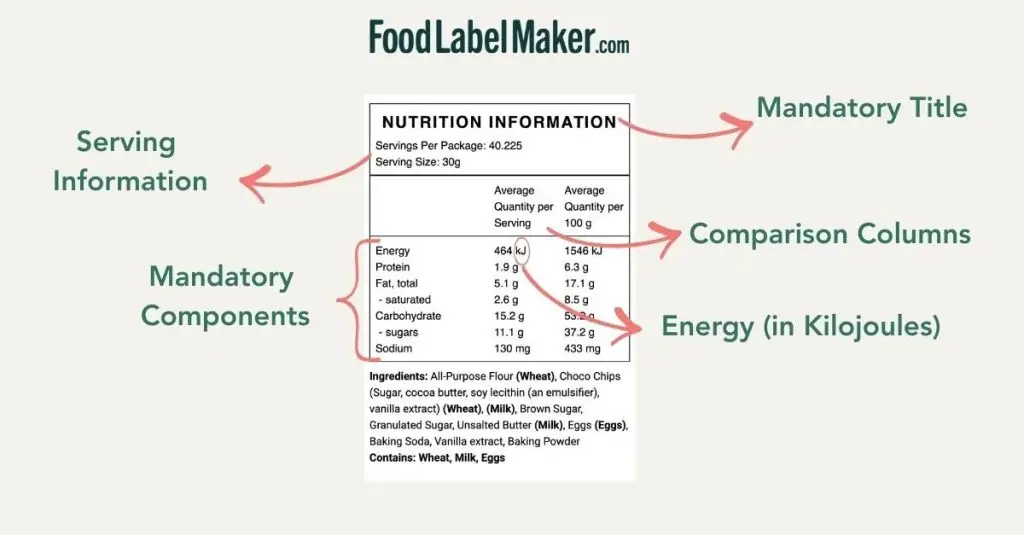
Components of the Nutrition Information Panel
- The Mandatory Title: The panel must be clearly titled as ‘NUTRITION INFORMATION’ so consumers can identify it immediately.
- Serving Information: This includes both the “Servings Per Package” and “Serving Size”. Manufacturers must define a realistic serving size and state how many of those servings are in the entire pack. Unlike the FDA, which regulates serving sizes to ensure consistency and clarity for consumers, the FSANZ does not have its own RACC (Reference Amounts Customarily Consumed) to determine serving sizes for foods.
- Comparison Columns: These dual columns ( “Quantity per Serving” and “Quantity per 100 g”) are required for comparing similar products across different brands, using the 100g standard, and so consumers can see exactly what they are consuming per portion.
- Energy (in Kilojoules): In Australia and New Zealand, energy on a nutrition panel must be presented in kilojoules (kJ).
- The Mandatory Macronutrients & Micronutrients
- Protein: Measured in grams.
- Fat (Total and Saturated): Total fat and saturated fat must be listed separately to help consumers monitor heart health.
- Carbohydrate (Total and Sugars): This shows the total carbs versus the amount that comes specifically from sugars (naturally occurring or added).
- Sodium: Always listed in milligrams (mg) because even small amounts significantly impact health.
Formatting & Style
To remain compliant, the NIP must be presented in the standard English format and must be prominently and legibly displayed, which often includes being set within a distinct border to separate it from other packaging design elements.
While there is some flexibility in layout for uniquely shaped packages, the primary goal is to ensure consumers can clearly read the information without it being obscured or crowded.
If you are struggling with complex calculations or layout rules, try our nutrition information calculator Australia-based food businesses trust, ensuring font sizes and borders meet the “legibility” test.
Additional Nutrition Labeling Requirements in Australia & NZ
While the NIP is the core of your label, it is only one part of a compliant product. Food manufacturers are legally required to integrate mandatory safety elements, such as allergen warnings. Voluntary marketing tools, like nutrition claims, can also be added but must meet specific regulatory standards to ensure they’re not misleading.
Nutrition Content Claims
One of the most common ways businesses enhance their labels is through voluntary nutrition content claims, such as “High in Fibre”, “Good source of Calcium” or “Low Fat”. Under Standard 1.2.7, once you choose to make a claim, it becomes mandatory to include that specific nutrient in your NIP and meet the prescribed criteria for that claim.
The Health Star Rating (HSR) System
For over a decade, the Health Star Rating system has operated as a voluntary front-of-pack labeling tool designed to help consumers compare the nutritional profiles of similar products. However, in February 2026, Food Ministers from Australia and New Zealand formally agreed to begin the process of mandating the system after voluntary industry uptake failed to reach the 70% target.
It is important to note that while the process to mandate has officially begun, the HSR system remains voluntary during the current transition period. Food Standards Australia New Zealand (FSANZ)is now beginning the 12-to-18-month legislative process to formally add the HSR to the Food Standards Code. For manufacturers, this is a critical time to ensure your NIP data is accurate, as these figures will directly determine your product’s star rating once the mandate takes effect.
Other Mandatory Label Elements
Beyond nutritional data, Standard 1.2.1 requires several other non-negotiable elements for a food product label. This includes :
- Product Identity: The label must include a name or description that clearly indicates the “true nature” of the food to prevent misleading consumers. It must also include Lot Identification (batch numbers) to assist in the event of a food recall.
- Safety Information & PEAL: Mandatory allergen declarations must now follow Plain English Allergen Labelling (PEAL) standards. Allergens must be bolded in the ingredients list and repeated in a separate bold “Contains” statement. Other safety elements include advisory statements (e.g., for caffeine) and date marking (Use By or Best Before).
- Transparency & Supplier Details: A complete statement of ingredients is required, listed in descending order by ingoing weight. Additionally, you must include the name and physical street address of the supplier in Australia or New Zealand; a PO Box is legally insufficient for this requirement.
- Country of Origin: Most food sold in retail in Australia must display a country of origin label. For “priority foods,” this includes the well-known kangaroo logo, a bar chart showing the percentage of local ingredients, and a supporting text statement.
- Special Instructions: To ensure the food remains safe until its expiration, you must include specific storage conditions (e.g., “Store below 4°C”) and directions for use if the food requires preparation before consumption.
How to Generate a Compliant Nutrition Information Panel
Choosing the right method for your NIP depends on your product’s complexity and budget. There are 3 primary approaches used by AU/NZ food manufacturers:
| Feature | Lab Analysis | Spreadsheet (Manual) | Food Labeling Software (Food Label Maker) |
| Cost | High ($500+ per test) | Free | Low / Subscription |
| Speed | 2–4 Weeks | Slow (Manual Entry) | Instant |
| Accuracy | High (Chemical) | Low (User Error Risk) | High (Verified Databases) |
| Compliance | Technical Report | Manual Formatting | FSANZ Template Built-in |
A food labeling software like Food Label Maker provides a fast, reliable and cost-effective alternative to lab testing for all food products whilst ensuring calculations automatically follow strict FSANZ rounding rules and formatting standards. Accuracy in your NIP is more critical than ever; as of February 2026, the Health Star Rating (HSR) system has officially moved from voluntary to mandatory on all packaged foods in Australia and New Zealand. Because your mandatory star rating is calculated directly from your NIP data, any error in your panel can lead to an incorrect rating and regulatory non-compliance.
By getting all the elements right on the nutrition label, and staying ahead of mandatory requirements, food businesses are able to position themselves for long-term success in a competitive market. Avoid costly manual errors and stay ahead of these new 2026 mandates by downloading and following this Checklist for FSANZ Label Compliance.
Frequently Asked Questions About Nutrition Information Panels
What Is A Nutrition Information Panel?
A Nutrition Information Panel (NIP) is a standardized table found on most packaged food labels in Australia and New Zealand. Its purpose is to provide consumers with the average quantity of energy and key nutrients contained within the food. Under Standard 1.2.8 of the Food Standards Code, almost all retail-packaged foods must display this information to help people make informed dietary choices. A standard NIP must declare seven mandatory components: energy (in kilojoules), protein, total fat, saturated fat, total carbohydrates, sugars, and sodium.
To create an FSANZ-Compliant Nutrition Label, start here and create a free NIP label. You can also view our pricing plans or reach out to one of our nutrition experts if you need help with your Australia and New Zealand nutrition labels.
How Do You Read A Nutrition Information Panel?
Reading an NIP involves looking at two distinct columns of information:
- Quantity per Serving: Use this column to see how much of a nutrient you are actually consuming in one portion, as defined by the manufacturer.
- Quantity per 100g (or 100mL): This column is the most effective way to compare different brands or similar products. Since serving sizes vary between manufacturers, the “per 100g” standard provides an equal playing field for comparison.
When reading, prioritize looking for products that are lower in saturated fat, sodium, and added sugars, while keeping an eye on the total energy (kJ) content.
If you’re looking to create Nutritional Information Panels compliant with FSANZ regulations, click here to generate your free label using our Australia and New Zealand NIP generator.
How Do You Create A Nutrition Information Panel For Australia and New Zealand Food Businesses?
Food businesses can generate a compliant NIP using two main methods:
- Laboratory Analysis: You can send a physical sample of your product to an accredited laboratory for chemical testing. This is usually expensive and requires a lot of back-and-forth to ensure your food label is fully compliant and accurate with FSANZ regulations.
- Software Calculation: Manufacturers can use verified database values to calculate the NIP based on their specific product recipe. Compliant and accurate platforms like Food Label Maker allow you to enter ingredients and quantities to automatically generate a panel that meets the formatting and rounding requirements of Standard 1.2.8.
To get started, generate your FSANZ NIP for free or view our pricing plans.